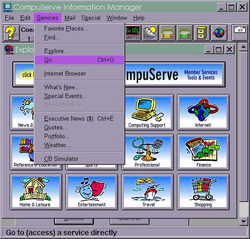
WinCIM
~ the obituary ~
CompuServe reached me as a file extension before it reached me as anything else. The company invented GIF in 1987, and a decade later every animated banner and every spinning mail icon I loaded on a 33.6k line in Ankara was carrying the company's name inside the file header. The service that paid for that invention was a different world entirely.
CompuServe was text. You dialed in and typed GO followed by a word, and it answered with menus and numbered messages. In 1989 the company moved to a private binary protocol called HMI, for Host-Micro Interface, which an ordinary terminal program could not read at all. That was deliberate. HMI let CompuServe ship its own software and turn the same forums into windows and buttons.
The software was called CompuServe Information Manager, and it came in a build for every platform that mattered, from DOS to the Macintosh. The Windows one, WinCIM, is the build people remember. The earliest copy anybody has archived is version 1.0.3, stamped March 1993. Version 2.0.1 arrived with a build of NCSA Mosaic packed inside it, dated 1994 by Wikipedia and March 1995 by the copy sitting on the Internet Archive. By late 1996 there was a version 3.0, arriving while the company briefly rebranded itself CSi and pointed the whole thing at AOL.
~ the case file ~
| Born | 1989, when CompuServe moved to the binary HMI protocol |
|---|---|
| Peak | the standard way into CompuServe through most of the 1990s |
| Killed | 30 June 2009 |
| Lifespan | twenty years |
| Made by | CompuServe Incorporated |
| Killed by | AOL switching off CompuServe Classic |
~ the funny part ~
PC Magazine looked at the CompuServe client stack in February 1993 and was harder on WinCIM than on the shareware competing with it. The complaint was specific. The official graphical client saved you no money, and it could take longer to get through your messages than doing the same work with no client at all. CompuServe billed by the hour. Software that made you slower was software that charged you more.
Meanwhile TapCIS, a DOS program written by a marketing executive in Delaware and sold as shareware for seventy nine dollars, did the whole job in two short connections and hung up. So the company's own client was the expensive way to use the company's own service, and CompuServe went on billing by the minute for another four years before finally moving to a flat rate in late 1997.
~ what came after ~
The Mosaic decision is the one worth sitting with. Putting a web browser inside the client was obviously correct and it also ended the argument. Once a browser was on the machine, there was no reason a private binary protocol should be the way you reach a message board, and the forums CompuServe had spent fifteen years building started converting to HTML in 1997.
AOL bought the company in 1998 and began putting CompuServe branding on AOL's own client. The old WinCIM path kept running under the name CompuServe Classic, which is what a company calls a product once it has decided the product has no future. On 15 April 2009 AOL announced that Classic would stop being an internet service provider, and on 30 June it did. Thirty years of service, and the last thing switched off was the protocol that had made the client necessary in the first place.
~ leave a rose ~
an anonymous tribute. one rose per visitor per day.
@}-->-- ... roses left here
~ leave a wreath ~
a rose fades by morning. a wreath stays on this grave for good, with your name on it.
from $1, paid once through stripe. it keeps the graveyard running: the hosting and the nightly digging. adopt it and the headstone reads "maintained in memory by" you. the groundskeeper plants new wreaths at the next tending, usually within a day.
» one email a week: new graves and the anniversaries of the dead. subscribe
other software: Adobe BrowserLab, Adobe Photoshop Mix, Windows Live OneCare, Windows Media Encoder
also died in the 2000s: Sony Connect Music Store, Diamond Rio PMP300, Deja News
~ leave a note ~
visitors before you have left these graveside notes. anonymous welcome.