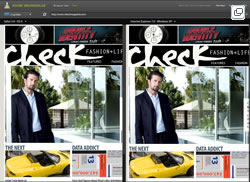
Adobe BrowserLab
» see browserlab.adobe.com as it lived, on the wayback machine
~ the goodbye ~
The hardest browser to test a page in was always the one nobody at the desk owned. Around 2005 you could install Internet Explorer and Firefox next to each other and be reasonably honest about both. The Mac was the problem. Finding out how a layout landed in Safari meant knowing somebody who had bought one, which in most rooms here was a favor rather than a task. BrowserLab was Adobe selling the favor.
It started as MeerMeer, worked out in Chicago from 2006 by a group of four who had the sensible idea that nobody should need to own the hardware to see the output. Adobe bought the application and its patent in December 2007, showed it at MAX the following November, and opened a free public preview on 4 June 2009 with five thousand seats. The browser list at that point tells you what the web still was. Firefox 2 and 3 were both on it, sitting next to Internet Explorer 6 and 7, and Safari was on version 3.
You gave it a url and a set of browser and operating system pairs. It rendered your page on machines in Adobe's building and sent back pictures, and the pictures were the entire product. Two of them could be laid over each other so the four pixel difference wrecking your header showed up as a ghost, or stood side by side for the failures you could see without help. Later it reached into work that had not been published yet, through Firebug or Dreamweaver CS5, so a page living only on your own machine could still be photographed somewhere else.
The problem it solved was mine. The tool was not. BrowserLab arrived free on Adobe Labs and then settled into Creative Suite, which is to say it became a line item inside a license priced for studios. Working the way most people here worked in 2010 meant solving the same problem with a folder of old browser installers and a friend who had a Mac. The service was for people whose employer had already signed for the suite.
~ the chronicle ~
| Born | june 4, 2009, free public preview on adobe labs |
|---|---|
| Peak | five thousand beta seats, then bundled into creative suite 5 |
| Killed | march 13, 2013, effective immediately |
| Lifespan | three years and nine months |
| Made by | adobe, out of a chicago project called meermeer |
| Killed by | phones, and adobe's attention leaving with them |
~ what a screenshot could not tell you ~
A photograph is strong evidence and narrow evidence. BrowserLab could prove that your two column layout collapsed in Internet Explorer 6, and it could not tell you that the dropdown above it never opened. It caught a page at rest. Everything after the first click sat outside what it was able to see, which is why the services Adobe eventually pointed people toward run actual browsers you can drive rather than cameras aimed at them.
That limit was reasonable in 2009 and looked worse every year afterward, because the thing being tested kept moving. A page in 2009 was mostly a document that had been styled. By 2013 it was an application that happened to be delivered as a document, and a still image of one is close to useless.
~ the shape of the web it was built for ~
There was a stretch of about eight years when the same markup produced two different documents depending on which browser opened it, and no authority existed to say which one was wrong. Internet Explorer 6 shipped in 2001 and was still on a third of desktops when BrowserLab launched, running a box model of its own invention. Everything written in that period carried a tax, paid in hacks and conditional comments, and every developer paid it privately with no way to know how bad the damage was on a machine they could not reach.
BrowserLab existed to make that damage visible. It is a product that could only have made sense inside a specific window, opening when the browser field fragmented past what one desk could hold and closing when the field consolidated again onto two rendering engines that mostly agreed.
~ what adobe said instead ~
The end came on 13 March 2013, effective the same day, announced on a blog that had given no warning of any kind. Adobe's statement blamed the market rather than the product: with the growth of phones and tablets the landscape had changed, usage had dropped over the past year, and the engineering team was focused on the new challenge. Users were pointed at BrowserStack and Sauce Labs, both of which are still going, and at Adobe Edge Inspect for the mobile side.
Edge Inspect has a grave here too. The pattern in the statement is the honest part of it, even if it was written to be soothing. A service like this needs somebody to keep buying machines, installing the browser of the month on them and throwing the old ones out, forever, for a userbase that shrinks as the browsers converge. Adobe had stopped wanting to be in that business roughly a year before it said so.
~ leave a rose ~
an anonymous tribute. one rose per visitor per day.
@}-->-- ... roses left here
~ leave a wreath ~
a rose fades by morning. a wreath stays on this grave for good, with your name on it.
paid once through stripe. payments are handled by OÜ Lakeview, the small company that keeps rip.so running. the money pays for the hosting and the nightly digging. adopt it and the headstone reads "maintained in memory by" you. the groundskeeper plants new wreaths at the next tending, usually within a day.
» one email a week: new graves and the anniversaries of the dead. subscribe
other software: Adobe Photoshop Mix, WinCIM, Windows Media Encoder, Windows Live OneCare
also died in 2010-2014: Crime Library, schülerVZ, Yahoo! China Mall
~ leave a note ~
visitors before you have left these graveside notes. anonymous welcome.