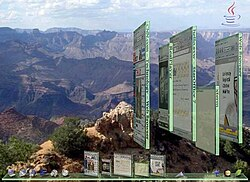
Project Looking Glass
» see lg3d.dev.java.net as it lived, on the wayback machine
~ the last words ~
The 3D desktop of the middle 2000s was something you passed around rather than something you used. The demo video was the artifact. I was a computer engineering student on a Turkish broadband line through most of that window, taught Java in class like everyone else in the program, and running hardware with firm opinions about what Java 3D was going to do on it.
Looking Glass started as a side project by Hideya Kawahara, a Sun programmer building it on a Linux laptop in his own time. Jonathan Schwartz demonstrated it at LinuxWorld Expo in San Francisco in August 2003, and for a few weeks afterward it was the most talked about thing Sun had shown in years. It was written in Java on top of the Java 3D API, which meant it ran wherever that runtime did, so Linux and Solaris in practice.
What it did on screen still reads well twenty years later. Windows tilted back into perspective instead of stacking flat on top of each other, so a dozen of them could be seen at an angle at once. A rotated window had a back side, and Sun used that surface for video, which meant a film could play on the reverse of a browser. Transparency and zoom came with it, both of which turned up later on every desktop anybody actually shipped.
Sun released the source under the GPL at JavaOne on 28 June 2004, as an open source project hosted on java.net. That is usually the point where a company either commits or lets go, and Sun let go. Development stopped in late 2006 with no announcement attached. Version 1.0.1 arrived on 29 January 2007 into a codebase nobody was moving anymore, and years afterward the project page said plainly that it had been practically dead since late 2006.
~ the record ~
| Born | August 2003, demonstrated at LinuxWorld Expo in San Francisco |
|---|---|
| Peak | the LinuxWorld demo, then the open source release on java.net in June 2004 |
| Killed | late 2006, when Sun stopped development |
| Lifespan | about three years |
| Made by | Sun Microsystems, led by Hideya Kawahara |
| Killed by | Sun deciding it was not a priority, with an Apple lawsuit threat in the background |
~ the phone call ~
The best documented moment in its whole life happened off screen. Schwartz told the story publicly in March 2010: after the LinuxWorld demo, Steve Jobs called his office to say the graphics were stepping all over Apple's intellectual property, and that if Sun tried to commercialize it he would sue. Schwartz's answer was that Apple's Keynote looked identical to Concurrence, a presentation program Lighthouse Design had built for NeXTSTEP, which Jobs had used for years before Apple shipped its own. He never heard about the subject again.
The threat is not what killed the project. Sun killed it, by deciding a 3D desktop was not what the company needed while its server business was being taken apart underneath it. The call is just the reason people still remember the name.
~ what became of it ~
The features shipped anyway, from other people, inside three years. Novell's XGL and then Compiz put compositing effects onto Linux desktops across 2006 and 2007. Windows Vista arrived with Aero in 2007, and Apple had been doing depth tricks since Expose in 2003. None of those needed a Java runtime in order to draw a window, which was the part of Sun's approach no other vendor was ever going to accept.
What did not survive is the belief that the desktop metaphor had another dimension left in it. Everything since has gone flatter. The closest thing to Looking Glass in daily use now is the animation between two full screen apps on a phone, and nobody calls that a 3D desktop.
~ the funny part ~
Sun open sourced it, so it is still downloadable, and people still occasionally get it running for the novelty. What they find is a 2006 Java application asking for a 2006 Java runtime, on a machine whose window manager already does most of this by default and never mentions it. The demo that once needed a conference stage to justify itself now needs an explanation of why anyone clapped.
~ leave a rose ~
an anonymous tribute. one rose per visitor per day.
@}-->-- ... roses left here
~ leave a wreath ~
a rose fades by morning. a wreath stays on this grave for good, with your name on it.
from $1, paid once through stripe. it keeps the graveyard running: the hosting and the nightly digging. adopt it and the headstone reads "maintained in memory by" you. the groundskeeper plants new wreaths at the next tending, usually within a day.
» one email a week: new graves and the anniversaries of the dead. subscribe
other software: Traf-O-Data, Adobe FormsCentral, Java Applets, HyperTerminal
also died in the 2000s: HyperTerminal, MobShop / Accompany, MapBlast
~ leave a note ~
visitors before you have left these graveside notes. anonymous welcome.