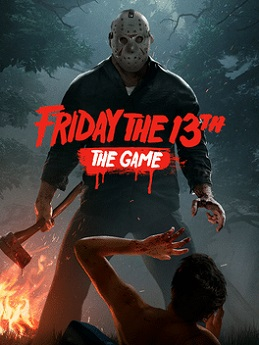
Friday the 13th: The Game
» see f13game.com as it lived, on the wayback machine
~ the goodbye ~
A video game can die because two men who made a horror film in 1980 could not agree on which of them owned it. That is what happened here, and it took six years to finish happening.
The game came out of a Kickstarter that ran in late 2015 and raised about $823,000, plus another $423,000 on BackerKit, roughly $1.25 million from more than thirty thousand backers. IllFonic developed it and Gun Media published it. The design was asymmetric multiplayer: seven players as camp counselors trying to escape Camp Crystal Lake, one player as Jason Voorhees hunting them. Kane Hodder, who played Jason in four of the films, did the motion capture. Harry Manfredini, who wrote the score for the original, wrote the music.
It shipped on 26 may 2017 into mixed reviews and a broken launch week, and found a real audience anyway. 1.8 million copies by august, then Best Indie Game at the Golden Joystick Awards that year and a Switch port two years after. Whatever the critics thought of it, a lot of people wanted to be Jason for an evening, and the game was the only place to do that.
I am on the outside of this one for the obvious reason. Slasher franchises were a very American thing that reached Turkey as VHS tapes and late-night TV, and I was not a horror kid. I am writing it because of how it ended, which has nothing to do with games and everything to do with a clause in US copyright law.
~ the chronicle ~
| Born | 26 may 2017, after a crowdfunding campaign that raised about $1.25 million |
|---|---|
| Peak | 1.8 million copies sold by august 2017, three months in |
| Killed | 31 december 2024, online services off |
| Lifespan | seven years and seven months, of which one year had new content |
| Made by | illfonic, published by gun media |
| Killed by | a copyright termination notice filed by victor miller in 2016 |
~ the breakout ~
For about a year it worked exactly as intended. Gun Media shipped patches and kept adding counselors and Jason variants. There was a single-player challenge mode in development and a Paranoia mode where one counselor was secretly Jason in disguise. The roadmap was public and full.
Then in june 2018 the publisher announced that all future content was cancelled. Not delayed. Cancelled. A representative put it about as plainly as anyone could: "we can't keep building content that may never see the light of day." The game stayed on sale and stayed online, but from that day it was frozen at whatever version it happened to be at.
~ the paperwork ~
Victor Miller wrote the screenplay for Friday the 13th in 1979 for a small company run by Sean Cunningham, who directed it. Section 203 of the US Copyright Act lets an author terminate a copyright grant after thirty five years and take the rights back, unless the work was made as an employee. In 2016 Miller filed to terminate. Cunningham's side argued Miller had been an employee and could not.
The District of Connecticut ruled for Miller in 2018, which is precisely when the content stopped. The Second Circuit affirmed it on 30 september 2021 in Horror Inc. v. Miller, finding Miller had written the script as an independent contractor and had therefore reclaimed the copyright in it. What that produced was not one owner but a split: rights to the original screenplay on one side, rights to everything built on top of it across a dozen sequels on the other. Nobody could license the franchise cleanly to anyone, because nobody could say for certain what they were licensing.
~ the postmortem ~
The license Gun Media held ran out on 31 december 2023, and the game came off Steam and the console stores that day. If you already owned it you kept it, and the servers kept running through 2024 on a promise Gun Media had made publicly: they would stay up for one more year.
They did. On 31 december 2024 the dedicated servers went off. Peer-to-peer matches limped on for a while depending on platform, and the offline bots still work if you own a copy, but the game as a product ended that day. A fan remake was shut down afterward too, for the same reason: the rights problem does not care who is doing the building.
~ the long tail ~
What sits under this grave is not a failure. The game sold nearly two million copies in three months and had a devoted playerbase for years after the content stopped. It was killed by a document filed in 2016 about a document signed in 1979, and there was no version of running the business better that would have saved it.
That is the part worth keeping. When you buy a licensed game you are buying a lease on somebody else's argument. Gun Media went on to make a Texas Chain Saw Massacre game and had to publicly reassure people it would not happen again, which tells you the fear is now permanent. The rights under a horror franchise from 1980 have outlived a game that shipped in 2017, and they will outlive the next one too.
~ leave a rose ~
an anonymous tribute. one rose per visitor per day.
@}-->-- ... roses left here
~ leave a wreath ~
a rose fades by morning. a wreath stays on this grave for good, with your name on it.
from $1, paid once through stripe. it keeps the graveyard running: the hosting and the nightly digging. adopt it and the headstone reads "maintained in memory by" you. the groundskeeper plants new wreaths at the next tending, usually within a day.
» one email a week: new graves and the anniversaries of the dead. subscribe
other gaming: Ghost Recon Phantoms, Origin Systems, Technosoft, Vectrex
also died in the 2020s: Kaspien, Pebble (social network), Horizon Worlds (Quest)
~ leave a note ~
visitors before you have left these graveside notes. anonymous welcome.