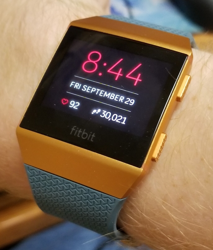
Fitbit Ionic
» see fitbit.com as it lived, on the wayback machine
~ the eulogy ~
Seventy eight people in the United States told Fitbit that its watch had burned them, and two of those were third-degree burns. On 2 March 2022 the company recalled every Ionic it had ever sold, roughly 1.7 million of them worldwide, and offered the full $299 back to anyone who sent one in.
The Ionic was Fitbit's attempt to stop being a company that made pedometers. It was announced on 28 August 2017 and reached buyers that autumn at $299.95, pointed directly at the Apple Watch Series 3. It had built-in GPS and contactless payments through Fitbit Pay, and it ran an operating system with an app store on top of it. A lot of the software talent behind that came from Pebble, whose assets Fitbit had bought in December 2016 after Pebble ran out of money.
It did not land. Reviews were lukewarm about the design and about an app store that never really filled up. Fitbit followed six months later with the Versa, which was cheaper and sold far more, and the Ionic was quietly out of production by 2020. Google closed its acquisition of Fitbit on 14 January 2021, so the recall landed on the new owner rather than the company that had built the thing.
The date at the top of this page is the day a company asked for something back, not the day a server went dark, and that makes this a different kind of death from most of what is buried here. A recall has to reach into houses. Fitbit had to find 1.7 million people and persuade them to post a watch back, and whoever it failed to find kept wearing a device the manufacturer had formally declared dangerous. Here the Ionic arrived through the electronics chains and through people carrying them home from abroad, and the second route leaves no support channel that can tell you your watch has been recalled. That part of the story never resolves.
~ the dossier ~
| Born | 28 august 2017, announced; on sale from late september at $299.95 |
|---|---|
| Peak | about 1.7 million sold, one million of them in the United States |
| Killed | 2 march 2022, recalled |
| Lifespan | four years and six months |
| Made by | Fitbit, owned by Google from January 2021 |
| Killed by | a lithium-ion battery that could overheat against your wrist |
~ what actually went wrong ~
The fault was in the lithium-ion battery, which could overheat. Fitbit had at least 115 reports of it happening in the United States, and 78 of those involved a burn, four of them second degree and two third degree. A watch is strapped to skin by design, so there is no gap between the failure and the injury the way there is with a laptop you can push off your lap.
What turned a defect into a penalty was the timing of the disclosure. Under United States law a company that learns its product carries a substantial hazard has to report it to the Consumer Product Safety Commission immediately. In January 2025 the CPSC announced Fitbit had agreed to pay $12.25 million for failing to do that, with the settlement describing the company as aware of overheating incidents well before it filed. Fitbit did not admit the findings, which is how these settlements always read.
~ the pebble inheritance ~
Pebble ran the first genuinely successful hardware Kickstarter and built a watch people were fond of in a way this industry rarely earns, then ran out of runway and sold its intellectual property to Fitbit in December 2016. Fitbit shut Pebble's servers down and moved its engineers onto the Ionic. What came out carried none of what people had actually liked about a Pebble.
So the line runs from a product people loved, bought for parts, to a product built out of those parts that had to be taken back off their wrists. Google closed its $2.1 billion purchase of the whole company in between, mostly for the health data and for a permanent position on the arm. The Ionic is the piece of that history nobody at Google has any reason to bring up.
~ the long tail ~
Recalls do not finish, they fade. Fitbit's recall page stayed open for years and units kept trickling back, because a good share of those 1.7 million were already in drawers by 2022, out of charge and out of mind. The remedy was $299 plus a discount code for 40 percent off something else in the catalog, which is a refund with a coupon stapled to it, and it worked exactly as intended on the people who had stayed inside the brand.
What the Ionic left behind is a warning about the shape of the whole category. Everything on a wrist is a battery pressed against a person for most of a day. Basis Peak, which Intel owned, was recalled for the same reason in 2016 and remotely disabled rather than repaired. Twice in six years the industry demonstrated that the worst failure mode of a smartwatch is not a crash.
~ leave a rose ~
an anonymous tribute. one rose per visitor per day.
@}-->-- ... roses left here
~ leave a wreath ~
a rose fades by morning. a wreath stays on this grave for good, with your name on it.
from $1, paid once through stripe. it keeps the graveyard running: the hosting and the nightly digging. adopt it and the headstone reads "maintained in memory by" you. the groundskeeper plants new wreaths at the next tending, usually within a day.
» one email a week: new graves and the anniversaries of the dead. subscribe
other gadgets: Conner Peripherals, Kendall Square Research, Apple AirPort, Orchid Technology
also died in the 2020s: Wikimedia Space, Blacklight: Retribution, Indafotó
~ leave a note ~
visitors before you have left these graveside notes. anonymous welcome.