Orchid Technology
~ the eulogy ~
Orchid Technology was already dead by the time I had a PC to put a card into. It was founded in Fremont in 1982, two years before I was born, and sold to Micronics in August 1994, by which point I was ten and the Turkish home computer market was a few importers and a great deal of secondhand 386 hardware. What I eventually saw of Orchid was a brand name in a magazine some years later, printed on a card the company that made it never lived to sell.
The first product explains the name. Le Nhon Bui's flagship in 1982 was the PCNet card, a one megabit per second local area network board for the IBM PC and its clones, at a moment when hardly anybody was networking personal computers at all. LAN is also the Vietnamese word for orchid. The company was named after the acronym.
The same year it shipped the Orchid Graphics Adapter, a monochrome high-resolution board aimed at business users stuck on text-only displays, and one of the first three third-party graphics boards anyone built for the PC. What followed was a decade of add-in cards for whatever the PC could not yet do on its own: LIM expanded memory boards to push DOS past its ceiling, and the PC Turbo and TinyTurbo accelerators that dropped a 186 or a 286 into a machine running something slower.
The end arrived from a direction Orchid had walked into by itself. In 1988 it started building backplane motherboards through a Privilege Systems Division and got nowhere against Micronics and AMI, who already owned that market. Six years later Micronics bought it. InfoWorld reported the deal on 20 June 1994 at eleven million dollars, and it closed that August.
~ the dossier ~
| Born | 1982, Fremont, California |
|---|---|
| Peak | the ProDesigner and Fahrenheit VGA line, then the Righteous 3D in 1996 under Micronics |
| Killed | August 1994 |
| Lifespan | 12 years |
| Made by | Le Nhon Bui |
| Killed by | an $11 million merger with Micronics Computers |
~ the card that outlived the company ~
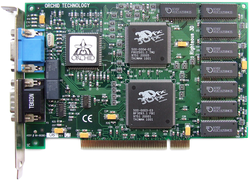
3dfx Interactive finished the Voodoo Graphics chipset in late 1995 and needed somebody to turn it into a retail product. The first one in shops was the Orchid Righteous 3D, on 7 October 1996, at around three hundred dollars, and it did no 2D at all: you kept your existing video card and ran a pass-through cable between the two of them.
Orchid Technology had been a Micronics brand for two years by then. The card that most people remember the name from was made by a company that had already been bought, using a chip from a company that did not exist when Orchid was still independent. Fahrenheit Video3D and Kelvin 64 came out of the same window, alongside the SoundWave 32 and the Vidiola capture line.
~ the second death ~
Micronics did not outlast its purchase by much. On 26 June 1998 Diamond Multimedia took 11,616,380 of its shares at $2.45 apiece, about $28.6 million, and Micronics became a Diamond division. Diamond wanted the Northern European retail channels and the board engineering team, and it retired the Orchid name not long after.
Diamond itself was bought by S3 the following year. The chain runs from a Fremont network card in 1982 through three acquisitions to a chipset company that eventually sold its graphics business to VIA, and nowhere along it did anyone announce that Orchid was over. It was a line on a brand list that stopped getting printed.
~ leave a rose ~
an anonymous tribute. one rose per visitor per day.
@}-->-- ... roses left here
~ leave a wreath ~
a rose fades by morning. a wreath stays on this grave for good, with your name on it.
from $1, paid once through stripe. it keeps the graveyard running: the hosting and the nightly digging. adopt it and the headstone reads "maintained in memory by" you. the groundskeeper plants new wreaths at the next tending, usually within a day.
» one email a week: new graves and the anniversaries of the dead. subscribe
other gadgets: Microcom, Spotify Car Thing, Camputers Lynx, Apple AirPort
also died in the 1990s: AOL Greenhouse, Microcom, eaasySabre
~ leave a note ~
visitors before you have left these graveside notes. anonymous welcome.