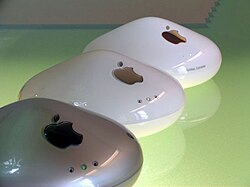
Apple AirPort
» see apple.com/airport as it lived, on the wayback machine
~ the last words ~
The AirPort was the kind of thing the mac household used. i was not in that demographic. Every router that has ever sat next to a phone jack in my apartment in turkey was a ttnet-issued zte or huawei adsl box, then a vdsl box, with the wifi pre-configured at the factory by the carrier. The Apple home-router product line ran for nineteen years and i never owned one and never knew anyone in ankara who did.
AirPort launched on July 21 1999 at Macworld New York. Steve Jobs walked across the stage with an iBook in his hands and opened a browser to surf the web from across the room. It was the first time most of the audience had seen consumer wireless internet in the wild, and the base station that made it work was a white dome with curves that already looked like Apple hardware. The dome sat in mac-magazine photos for years after.
Across the next two decades the product line worked through several form factors. AirPort Extreme arrived in January 2003 with 802.11g. AirPort Express followed in June 2004 as a compact plug-in version that doubled as an AirPlay audio receiver. Time Capsule launched in January 2008 with a built-in hard drive for Time Machine backups. The white dome got replaced by a flat square in 2007 alongside the 802.11n update. Apple finally pulled the whole product line on April 26 2018.
~ the record ~
| Born | July 21 1999 at Macworld NY, demoed by Steve Jobs surfing the web on an iBook |
|---|---|
| Peak | the default home WiFi router for the mac household through the late 2000s |
| Killed | April 26 2018, discontinuation announced after stock-out |
| Lifespan | 18 years 9 months |
| Made by | Apple |
| Killed by | Apple deciding it was no longer interested in being in the home-router business |
~ how it landed ~
AirPort was an early consumer-WiFi product but never an industry-share product. Its addressable market was the mac household and the few PC households willing to pay an Apple premium for nicer industrial design and a cleaner admin tool. The AirPort Utility app on Mac and on iPhone was the genuinely distinctive part: a graphical map of your network with each base station and each connected client laid out as icons, which compared favorably to the brown-tabbed router admin pages everyone else had to navigate by typing 192.168.1.1 into a browser.
In turkey the product was effectively invisible at the consumer level. ttnet shipped routers as part of the service. Most homes had what the carrier installed. Apple stores did not arrive in istanbul until 2014, and by then the router category at home was already a settled commodity. AirPort was the kind of product whose distribution depended on people choosing to buy a router separately from their ISP, which was a US and western-european household pattern more than a turkish one.
~ the fall ~
The signs of the discontinuation showed up in late 2016, when Bloomberg reported that Apple had disbanded the internal team working on wireless routers. After that the AirPort firmware updates slowed and then mostly stopped. The product hardware kept selling for another eighteen months while supply lasted. The official statement came on April 26 2018: Apple confirmed the product line was discontinued and would sell existing stock until exhausted. Apple stores started carrying third-party Linksys and Eero boxes on the shelves where AirPort had sat.
The framing in the press was that Apple rarely exits a product category, which is roughly true. The router exit was treated as a real event partly because it happened in the same wave as the iPod nano and shuffle discontinuation, and because Apple had just started selling competitor routers in its own retail stores while announcing the change.
~ what it became ~
The home-router niche that AirPort had occupied was already being absorbed by mesh-networking products like Eero and Google WiFi by the time Apple exited. Apple bought no home-networking company to fill the gap and quietly let the category go. The recommended replacement for AirPort users was Eero, which Amazon bought in 2019, which means the trajectory of a US mac household's home wifi went from an Apple-designed white dome to an Amazon-owned mesh node inside of about a year.
The dome is the part of AirPort that has the longest cultural afterlife. People who had one in 1999 or 2000 remember the shape. It looked like a small flying saucer or like an upside-down cereal bowl, and it was one of the visible pieces of Apple industrial design from the same era as the candy-colored iMac. The flat square that replaced it from 2007 onward is the version most current AirPort photos online actually show, but the dome is the form people draw from memory when you say the name.
~ leave a rose ~
an anonymous tribute. one rose per visitor per day.
@}-->-- ... roses left here
~ leave a wreath ~
a rose fades by morning. a wreath stays on this grave for good, with your name on it.
from $1, paid once through stripe. it keeps the graveyard running: the hosting and the nightly digging. adopt it and the headstone reads "maintained in memory by" you. the groundskeeper plants new wreaths at the next tending, usually within a day.
» one email a week: new graves and the anniversaries of the dead. subscribe
other gadgets: Kendall Square Research, Fitbit Ionic, Conner Peripherals, Orchid Technology
also died in 2015-2019: WDYL (What Do You Love), FunOrb, Elfwood
~ leave a note ~
visitors before you have left these graveside notes. anonymous welcome.