Electronic Associates
~ the eulogy ~
Before a computer could be asked a question it had to be wired into the shape of the question. That is what an analog computer is: a cabinet of operational amplifiers patched together so that voltages in the machine obey the same differential equations as the thing you are studying, and the answer comes out as a curve on a plotter rather than a number on a printout. Electronic Associates of West Long Branch, New Jersey, built those cabinets for a living from 1952 onward, and its customers were aerospace programs and universities.
The company was incorporated on 31 October 1945, a date that survives only because the amendment the shareholders adopted fifty years later quotes the original filing back to the New Jersey Secretary of State. Lloyd F. Christianson and Arthur L. Adamson founded it. Analog computer manufacturing started in 1952, and NASA used the results to develop space probes and to simulate physical systems that nobody could afford to build twice.
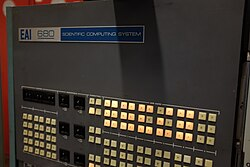
The hardware got stranger through the 1960s. The EAI 680 was a hybrid, 156 amplifiers' worth of analog section bolted to digital control, with diode function generators for curves the amplifiers could not produce on their own. There was a straight digital machine too, the EAI 640. In 1963 the company bought Pacific Data Systems from Mesa Scientific of Inglewood, California, which made general-purpose minicomputers built into desks.
Then came the detour that paid for everything. Under Robert E. Finnigan the company developed the first quadrupole mass spectrometers built for gas chromatography, and sold over 500 of them between 1965 and 1966. That line accounted for most of the firm's profit in those years. Finnigan later left and founded his own instrument company, and his name rather than this one is the one that stayed attached to quadrupole mass spectrometry.
~ the dossier ~
| Born | 31 October 1945, incorporated in New Jersey by Lloyd F. Christianson and Arthur L. Adamson |
|---|---|
| Peak | analog computers for NASA, and over 500 quadrupole mass spectrometers sold in two years |
| Killed | 21 May 1999, Chapter 11, District of New Jersey |
| Lifespan | 53 years |
| Made by | Electronic Associates, Inc., West Long Branch, New Jersey |
| Killed by | contract manufacturing, and a subsidiary that went under first |
~ how it landed ~
Analog computing ended quietly, for the obvious reason: digital machines got fast enough to integrate the same equations numerically, and the patch panel stopped being the only way to watch a system move. Companies that had sold op-amp cabinets either turned into something else or stopped. This one turned into a contract manufacturer.
Along the way it sold hardware with uses nobody writes into the brochure. A Wall Street Journal piece from 7 December 1990, going back over who had armed Iraq, names the company as the supplier of a $500,000 analog computer that could be used for missile testing and development at Saad 16. That is a sentence about export policy more than about the company, and it is close to the last time the name appeared in a national newspaper attached to a product.
~ the unraveling ~
On 4 January 1995 the company bought Tanon Manufacturing of Fremont, California, a contract electronics assembler, and Tanon promptly became the business. The annual report filed the following year describes a company "engaged principally in the business of providing contract electronic manufacturing services", a sentence that would have baffled anyone who patched a differential analyzer in that building in 1960. Twelve days after the Tanon purchase it also took a quarter of BarOn, a development-stage Israeli firm in Haifa working on a device that could digitize handwriting off any surface.
On 12 October 1995 the shareholders voted to drop the old name. The amendment certificate records 8,846,966 shares in favor out of 13,927,620 outstanding, deleting "Electronic Associates, Inc." from Article One and substituting "EA Industries, Inc." The shares carried the new name on the NYSE for the rest of the company's life.
~ what came after ~
Tanon filed for Chapter 11 on 2 December 1998 and its assets went to nominees of Smartflex Systems on 1 February 1999 for $10.9 million. The parent sold another subsidiary on 20 May 1999 for $2 million, and filed its own Chapter 11 petition in New Jersey the next day, owing over $15 million. The 8-K describing all of it is calm and procedural and ends by admitting that no plan had been formulated and no assurance could be given about anything. Nine years later, on 14 November 2008, the SEC revoked the registration of a company that had not filed a report since. The analog machines are in museums, and the company that built them left behind a court docket and a set of initials that a life-science consultancy uses today for entirely unrelated work.
~ leave a rose ~
an anonymous tribute. one rose per visitor per day.
@}-->-- ... roses left here
~ leave a wreath ~
a rose fades by morning. a wreath stays on this grave for good, with your name on it.
paid once through stripe. payments are handled by OÜ Lakeview, the small company that keeps rip.so running. the money pays for the hosting and the nightly digging. adopt it and the headstone reads "maintained in memory by" you. the groundskeeper plants new wreaths at the next tending, usually within a day.
» one email a week: new graves and the anniversaries of the dead. subscribe
other gadgets: Amazon Glow, Palm Pilot, Meta Portal, Samsung Galaxy Note 7
also died in the 1990s: Octel Communications, Synergistic Software, Votrax
~ leave a note ~
visitors before you have left these graveside notes. anonymous welcome.