Combat
» see combat.fr as it lived, on the wayback machine
~ the eulogy ~
The paper was assembled out of two illegal ones. In the southern zone a clandestine sheet called Vérités had been running since August 1941, and that December it merged with the Liberté group out of Marseille to make a single title covering all three zones. The name they chose, Combat, was then handed back to the movement itself, which had been the Mouvement de libération nationale until its own newspaper renamed it. Henri Frenay and Berty Albrecht got number one out that December.
André Bollier ran the production side, which in 1941 meant presses that had to be hidden, moved and rebuilt, and he kept doing it until the Milice caught up with him. The print run reached 10,000 over the summer of 1943 and 50,000 by number 50 on 1 November that year. For an object that could get everyone who touched it killed, those are large numbers, and they are the reason Combat mattered more after the war than its sales ever justified.
In August 1944 the paper walked into the Paris offices of L'Intransigeant at 100 rue Réaumur and started publishing in daylight. Albert Camus had been pulled in by Pascal Pia in the autumn of 1943 and now ran it, with Sartre and Malraux among the names appearing in its pages. The circulation went the wrong way almost immediately: 185,000 in January 1945, 150,000 by August. The Communist daily L'Humanité was printing 500,000. Combat had the best bylines in France and could not sell a paper.
It stopped in 1974, a decade before I was around to notice, and the only Combat that travels outside France is the filtered one. What you can buy today is Camus's editorials, gathered up and reissued as literature long after the deadlines that produced them. The daily itself, four pages meant to be finished and discarded the same evening, exists for most readers only as a book.
~ the dossier ~
| Born | December 1941, number 1, printed clandestinely in occupied France |
|---|---|
| Peak | 185,000 copies in January 1945, with Albert Camus running it |
| Killed | 30 August 1974, six and a half weeks after its owner died |
| Lifespan | 32 years and 9,376 issues |
| Made by | Henri Frenay and Berty Albrecht's Resistance movement |
| Killed by | its owner's death, after the staff had already gone |
~ what a surviving copy says ~
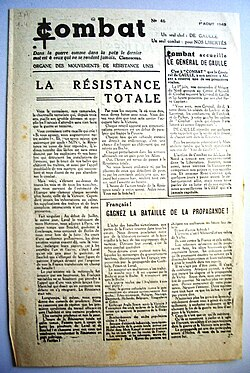
Number 46, dated 1 August 1943, still exists in scans. The masthead is set in a heavy gothic script, and across the top it carries two slogans: one leader only, De Gaulle, and one fight only, for our liberties. Under the title is a line from Clemenceau about how in war as in peace the last word belongs to those who never surrender. The lead article is headlined total resistance, and the bottom of the page tells the French to win the propaganda battle.
It is four pages of very small type with no photographs, and every column is argument rather than news, because news was what the occupier's papers printed. By the Algiers edition of December 1944, published openly and weekly at three francs, the gothic masthead had been replaced by plain block capitals. The typeface moved before anything else did.
~ Camus and the handover ~
Camus wrote the editorial of 8 August 1945 on the atomic bomb, two days after Hiroshima, while most of the French press was still running the story as an Allied triumph. That piece is the single most reprinted thing Combat ever published, and it is also close to the end of his time there. In 1947 the team Pia had built came apart. The paper was short of money, Claude Bourdet took it over, and to refloat it he brought in a Franco-Tunisian businessman named Henri Smadja in exchange for a minority holding.
Smadja did not stay a minority for long. Bourdet lasted until March 1950, when a fight with Smadja over the Indochina war pushed him out, and he left to start L'Observateur, which eventually became the Nouvel Observateur. Combat lost Camus in 1947 and Bourdet in 1950, and both departures produced something that outlived it.
~ the Smadja years ~
Victor Fay took the direction in July 1948, Louis Pauwels took it after Bourdet, and in 1960 Smadja appointed a young Philippe Tesson as editor in chief on the theory that he would be easy to manage. Tesson stayed fourteen years and was not easy to manage. During the Algerian war he ran Pierre Boutang and Maurice Clavel against each other in the same paper, so a reader could get the case against colonialism and the case against the FLN rebellion in a single issue.
The address at the time was 2 rue du Croissant, a few steps from the Paris Bourse, shared with L'Esprit Public, which was widely understood to be speaking for the OAS. A paper founded to print the Resistance was by then sharing a building with the unofficial voice of the generals.
~ number 9376 ~
In May 1968 Combat was broke and tried something anyway. On 13 May it planned a free special issue to hand out at the next day's demonstration, and its own printworks at Médan refused to run it. The people who refused had been sent by a CGT-affiliated union, and they did agree to print the students' paper Action on the same presses. Combat put out a communiqué about it. Three weeks later, on 3 June, it printed the Address to All Workers with the Situationist references quietly removed.
Tesson left at the beginning of 1974 and took the editorial staff with him, founding Le Quotidien de Paris in March and naming it after Combat's own subtitle. Smadja died on 14 July 1974. The last issue, number 9376, came out on 30 August. The BnF catalog records one more line under the same title: a new series of fourteen numbers between 7 and 20 March 2001, produced by a journalism school to cover the Paris municipal elections. That fortnight is the only time anyone has put the title back on a newsstand. The domain combat.fr now belongs to a French culture and media group built in 2026 around Radio Nova and Les Inrockuptibles. It claims no descent from the paper, and nothing on it mentions 1941.
~ leave a rose ~
an anonymous tribute. one rose per visitor per day.
@}-->-- ... roses left here
~ leave a wreath ~
a rose fades by morning. a wreath stays on this grave for good, with your name on it.
paid once through stripe. payments are handled by OÜ Lakeview, the small company that keeps rip.so running. the money pays for the hosting and the nightly digging. adopt it and the headstone reads "maintained in memory by" you. the groundskeeper plants new wreaths at the next tending, usually within a day.
» one email a week: new graves and the anniversaries of the dead. subscribe
other news: The East Village Other, Blue Network, Park Avenue, New York Herald Tribune
also died in the pre-1980s: The East Village Other, Blue Network, New York Herald Tribune
~ leave a note ~
visitors before you have left these graveside notes. anonymous welcome.