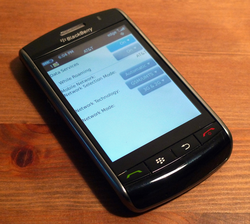
BlackBerry Storm
» see blackberry.com/storm as it lived, on the wayback machine
~ the eulogy ~
the storm was a verizon-only product at the carrier-licensing layer, and verizon was not a network i could buy a phone from in turkey. by november 2008 i was on a turkcell prepaid sim and a small nokia s40 candybar, the iphone had only just arrived in turkey through a turkcell exclusivity deal earlier that year, and the blackberry brand in ankara was almost entirely the corporate-bold tier on company-issued lines. honestly, the storm specifically never showed up on a vitrine in any turkcell store i remember. the closest i got to it was reading engadget coverage of the launch on a 56k connection at my parents' house over the new year break, which was the closest i got to most us-exclusive hardware at that point.
the storm was research in motion's first touchscreen phone, designed for verizon wireless to compete with the iphone on at&t. verizon had been the largest us carrier without an iphone for over a year and was actively shopping for a flagship of its own. rim agreed to build a touchscreen blackberry on verizon's cdma network with a launch window for the holiday 2008 buying season. it shipped november 21 2008 in the us and a week earlier on vodafone in the uk, priced at $199 with a two-year contract.
the device's defining feature was surepress, a clickable glass screen that pressed down like a single large button under your finger. the idea was that a touch surface that gave tactile feedback would feel more like a physical keyboard than the iphone's pure-glass surface, which rim had publicly declared would fail in business markets. in practice the click was loud and the screen would only register a tap if the entire glass was pressed down with enough force to make repeated typing uncomfortable. the software underneath was an early port of blackberry os to a touch ui that was not designed for one. honestly, lockups and slow rotation were universal in early reviews. by january 2009 a leaked vodafone group ceo memo described the storm as "totally unacceptable" and demanded a "concrete action plan" from rim. verizon spent most of 2009 replacing units under warranty. the storm 2 in october 2009 swapped the mechanical click for a piezoelectric haptic that worked better, but the brand reputation was already gone.
~ the dossier ~
| Born | November 21 2008 on Verizon Wireless in the US, Vodafone in the UK from november 14 |
|---|---|
| Made by | Research In Motion (RIM) |
| Signature feature | SurePress, the clickable touchscreen that pressed down like a single button |
| Sales | 500k units in first month, 1M units by january 2009 |
| Recalls | Verizon replaced nearly all 1M units under warranty across 2009 |
| Storm 2 | October 21 2009, SurePress 2 with piezoelectric haptics, never sold as well |
| Killed | October 2010 discontinuation, replaced internally by the Bold 9930 and the Torch 9800 |
| Lifespan | ~23 months |
| Killed by | Laggy software, the SurePress click that nobody enjoyed, and the iPhone 3G's Verizon arrival in 2011 |
~ how it landed ~
the launch was huge by 2008 standards. verizon had pent-up iphone-envy demand and the storm cleared 500,000 units in the first month and over a million by january 2009. rim's stock spiked into the launch window and then started a decline that did not reverse for the rest of the company's independent existence. the reviews started coming in by december and the consumer return rate climbed through january. engadget called the typing experience "fundamentally broken." gizmodo gave it a do-not-buy. honestly, the verizon warranty replacement program through 2009 was one of the largest in us mobile-phone history at the time, with internal estimates leaked to the wall street journal suggesting near total replacement of the first wave of units.
~ the unraveling ~
the surepress idea was an attempt to solve a real problem with the wrong mechanism. blackberry users had been buying the devices for a decade for the physical keyboard, and rim's leadership genuinely believed pure touch would lose to physical-feedback alternatives. the surepress screen was that bet. the bet failed on the engineering side because the click required pressing the entire screen against a spring, which made the device feel mushy under the thumb and made typing on the qwerty soft keyboard slower than typing on the iphone's flat glass. the software was a bigger issue, blackberry os 4.7 was a touch port of an os that had been designed for trackballs and was not architected for fluid animation. honestly, the lockups were the dealbreaker. the storm 2 in october 2009 fixed the click with piezoelectric haptics and added the bedrock os 5.0, but the early reviews of the storm 2 still mentioned the slow software.
~ what it became ~
the storm got two generations and then rim moved on. the next attempt at touch was the torch 9800 in august 2010, a slider with a physical keyboard underneath. the playbook tablet shipped april 2011 running a new qnx-based os, and rim spent the next two years trying to port that os onto phones as blackberry 10. blackberry 10 launched in january 2013 with the z10 (the first all-touch blackberry that actually worked), but by then the company's market share had collapsed below 5% globally and the brand never recovered. honestly, the storm is now remembered as the moment rim formally announced it had no idea what to do about the iphone. the 2015 book losing the signal called it the single biggest disaster in smartphone history. you can find unboxed storms on ebay for under twenty dollars, the click still works.
~ leave a rose ~
an anonymous tribute. one rose per visitor per day.
@}-->-- ... roses left here
~ leave a wreath ~
a rose fades by morning. a wreath stays on this grave for good, with your name on it.
from $1, paid once through stripe. it keeps the graveyard running: the hosting and the nightly digging. adopt it and the headstone reads "maintained in memory by" you. the groundskeeper plants new wreaths at the next tending, usually within a day.
» one email a week: new graves and the anniversaries of the dead. subscribe
other gadgets: Apple LaserWriter, Igloo, Elektronika BK, Apple iSight
also died in 2010-2014: Fotopic.net, True.com, htmlGEAR
~ leave a note ~
visitors before you have left these graveside notes. anonymous welcome.