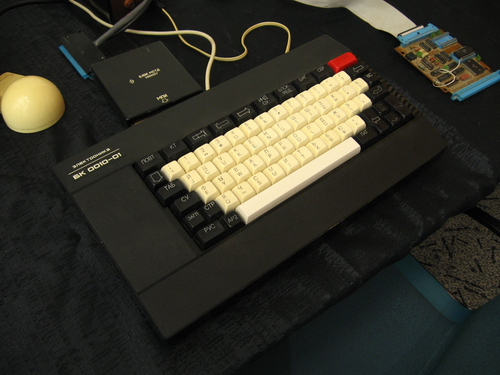
Elektronika BK
~ the goodbye ~
BK stood for bytovoy kompyuter, household computer, and that name was a policy statement. Soviet computing was organized around institutes and factories, so a machine aimed at a private flat had to be argued for and then budgeted for. The Elektronika BK is the only Soviet home computer design that made it into mass production with official approval and a line in the economic plan behind it.
The first model, the BK-0010, was developed in 1983 and entered serial production in 1985. Inside was the K1801VM1, a Soviet single-chip implementation of the PDP-11 instruction set, clocked at 3 MHz with 32 KiB of RAM. That is the strange part of this machine. The home computers of the same years in Britain and Japan were 8-bit designs around the Z80 or the 6502. The Soviet household machine was a 16-bit minicomputer architecture, because the USSR had already standardized on PDP-11 compatibility for its institutional hardware and reused what it had.
The BK-0010-01 added a real full-travel keyboard and put a Vilnius BASIC compiler in ROM. The BK-0011 arrived in 1989 at 4 MHz with 128 KiB of paged memory, broke compatibility with the earlier software, and was followed by the BK-0011M which put that compatibility back.
~ the chronicle ~
| Born | developed 1983 at NPO Scientific Center, serial production from 1985 |
|---|---|
| Peak | one of the most widely owned home computers in the USSR despite costing four months of average wages |
| Killed | 1993, production ended |
| Lifespan | eight years in production |
| Made by | NPO Scientific Center, sold under the Elektronika brand |
| Killed by | the collapse of Soviet industrial planning and imported PC clones |
~ from where i was standing ~
Turkey in the late 1980s got its home computers from the other direction entirely. The machines in Turkish living rooms were Commodore 64s and Spectrum clones, and everything after them came through the western PC channel. The Soviet machines stopped at the border as completely as the western ones stopped at the other side of it, and by the time I had a modem in 1998 the BK had already been out of production for five years.
~ the price ~
600 to 650 roubles against an average monthly wage of about 150. Four months of gross pay for a computer with a cassette interface and a membrane keyboard. It sold anyway, because there was nothing else to buy, and because for most households the real cost was measured in years on a waiting list rather than in roubles.
~ the classroom variant ~
The BK-0010Sh was the school model, and it came with a current-loop network adapter so a room of them could be wired to a teacher's machine. Soviet school computer labs were built as sets rather than as individual desks, and a generation of engineers in the post-Soviet states learned to program on exactly this hardware. That is where most of the surviving software came from, and it is why the emulator scene for a machine nobody outside the bloc ever saw is still active.
~ how it ran out ~
Production ended in 1993. By then the planning apparatus that had put the BK in the plan did not exist, and a grey-market 286 out of a container was a better computer for less money than a state factory could make a 16-bit cassette machine for.
~ leave a rose ~
an anonymous tribute. one rose per visitor per day.
@}-->-- ... roses left here
~ leave a wreath ~
a rose fades by morning. a wreath stays on this grave for good, with your name on it.
from $1, paid once through stripe. it keeps the graveyard running: the hosting and the nightly digging. adopt it and the headstone reads "maintained in memory by" you. the groundskeeper plants new wreaths at the next tending, usually within a day.
» one email a week: new graves and the anniversaries of the dead. subscribe
other gadgets: Igloo, Apple LaserWriter, BlackBerry Storm, CrossPad
also died in the 1990s: Exidy, Apple LaserWriter, First Virtual Holdings
~ leave a note ~
visitors before you have left these graveside notes. anonymous welcome.