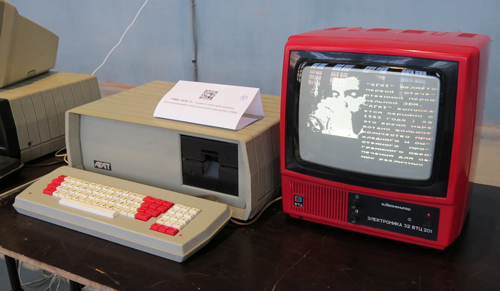
Agat
~ the obit ~
Turkey and the Soviet Union shared a border for the whole of my childhood and nothing like this came across it. In 1990 the machines in Turkish classrooms, where there were machines at all, were Commodores and IBM compatibles, and a thousand kilometers north of that border there was a domestic Apple II that almost nobody outside the system has ever touched. Two computer cultures a short drive apart with no overlap at all.
The Agat was designed at the Scientific Research Institute of Computing Complexes in Moscow between 1981 and 1983, shown at a trade fair in 1983, and put into serial production the following year. Architecturally it is an Apple II: a 6502 at 1 MHz with the same slot-based expansion idea sitting behind it. It was not a copy at the board level and it was never fully compatible, which is the detail that defines the whole machine. Early units ran a Soviet part emulating the 6502 rather than the chip itself, and software written for an Apple would run or would not depending on which Agat you had in front of you. Later models shipped real 6502s and an Apple compatibility mode, and by then the West had moved on anyway.
Two main models mattered. The Agat-7 had 96 KB of memory and one 140 KB floppy drive, and the Agat-9, from the second half of the decade, went to 128 KB with better graphics and room for a second drive.
~ the rap sheet ~
| Born | shown in Moscow in 1983, serial production from 1984 |
|---|---|
| Peak | about 12,000 machines by 1988, with roughly 7,000 more in nine months of 1989 |
| Killed | 1993, when serial production stopped |
| Lifespan | about a decade in production |
| Made by | LEMZ in Lianozovo, ZEMZ in Zagorsk and the Volzhsky computer plant, among others |
| Killed by | imported PCs arriving in a country that no longer had a plan to buy anything |
~ the price ~
An Agat-7 listed at 3,900 roubles. The average monthly wage in the Soviet Union at the time was somewhere around 150 to 200, so the machine cost the better part of twenty months of work. Nobody bought one to put on a desk at home. Compare it with the Electronika BK at 600 roubles, which was already considered outrageous and was still sold as a household computer. What made the Agat exist at all was that the buyer was never a person. A complete school computer classroom, the KUVT, ran to between 50,000 and 65,000 roubles for twelve to sixteen machines plus a teacher's station, and it was a ministry that signed for it. Take the ministry out of the picture and there is no market for this product at any volume.
~ the classroom ~
Schools are where almost all of them went, and it is why the Agat has the reputation it has among Russian programmers of a certain age. It was the first computer thousands of them ever sat at, in a room with a rack of identical beige boxes and one floppy being passed around. The software was overwhelmingly educational, written to a curriculum rather than to a market, and the pirated Apple II games that circulated alongside it were part of the appeal precisely because they were not on the syllabus.
Production was spread across a lot of factories: the Lianozovsky and Zagorsk electromechanical plants, Volzhsky, Kovylkino, Kostroma, and NPO Agat in Minsk. That is the shape of Soviet manufacturing rather than a sign of demand. Volume stayed small for a machine that was meant to equip a country's schools, about 12,000 units by 1988 and around 7,000 in nine months of 1989.
~ what got buried with it ~
Serial production carried on to 1993, past the end of the country that had commissioned it, and there is something honest in that. The factories kept filling orders until there were no orders, and then imported PCs turned up at prices that a school could pay out of its own budget. Agats stayed in service in classrooms far longer than they were made, with documented use into the early 2000s in places where nothing replaced them.
What died with it was an odd branch of computing history: a machine built to the shape of a Western design by people who mostly could not buy the Western design, aimed at a customer who was a government rather than a household. The Apple II died a commercial death and gets remembered for what it sold. The Agat died a budgetary one.
~ leave a rose ~
an anonymous tribute. one rose per visitor per day.
@}-->-- ... roses left here
~ leave a wreath ~
a rose fades by morning. a wreath stays on this grave for good, with your name on it.
paid once through stripe. payments are handled by OÜ Lakeview, the small company that keeps rip.so running. the money pays for the hosting and the nightly digging. adopt it and the headstone reads "maintained in memory by" you. the groundskeeper plants new wreaths at the next tending, usually within a day.
» one email a week: new graves and the anniversaries of the dead. subscribe
other gadgets: Coin, Qimonda, Mattel Aquarius, AST Research
also died in the 1990s: AST Research, UdiWWW, Microsoft Creative Writer
~ leave a note ~
visitors before you have left these graveside notes. anonymous welcome.