Australian Apple Review
~ the last words ~
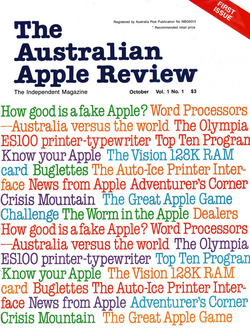
The cover of the first issue carries the definite article, The Australian Apple Review, under a second line reading The Independent Magazine, and gives the date as October, Vol. 1 No. 1, and it carries an Australia Post publication number because that is what a magazine needed in 1983 to be posted at the periodical rate. Thirty-six pages, three dollars recommended retail, out of Randwick in Sydney's eastern suburbs. Wikipedia dates the launch to 1984. The cover of the scanned first issue gives only the month and the volume, but the Internet Archive item holding it is dated October 1983 and there is a December 1983 issue sitting beside it, so the 1984 date is one year late.
Gareth Powell published it, first through Gareth Powell Pty Ltd and later through Saturday Magazine Pty Ltd, and by the end he was both publisher and editor with his own name in both slots of the masthead. Graeme Philipson edited it first, Gene Stephan later. It came out roughly monthly at ten issues a year, printed at Offset Alpine and then at Ian Liddell, distributed through NETWORK, which is about as local an operation as a national computer magazine gets.
It was independent in the sense that mattered then, which is that Apple did not own it. The first issue ran a feature asking how good a fake Apple actually was, and no officially licensed magazine prints that. Apple's own Australian business was small in 1983 while the clone trade was substantial, and the magazine covered the clones without apologizing for it. I was born the year after this launched, in a country where an Apple II arrived as an import and a rumor rather than as a product on a shelf.
~ the record ~
| Born | october 1983, vol 1 no 1, 36 pages at $3.00 recommended retail |
|---|---|
| Peak | roughly monthly at ten issues a year; 34 issues survive as scans |
| Killed | 1987, vol 4 no 5 |
| Lifespan | 4 years, four volumes |
| Made by | Gareth Powell Pty Ltd, then Saturday Magazine Pty Ltd, Randwick NSW |
| Killed by | no announcement; the magazine simply stopped |
~ thirty-six pages and a fake apple ~
One issue could carry an impossible spread of readers. The first number put a word-processor comparison headlined "Australia versus the world" next to a review of a printer-typewriter. Further in there was a piece on a 128K RAM card, a column of bug reports called Buglettes, and an adventure-game section walking readers through Crisis Mountain. Beginners and assembly-language programmers were being sold the same magazine, because in Australia in 1983 there were not enough of either group to print two.
~ hypercard and out ~
The last issue is volume four, number five, 1987, and you can date it from its own contents page. The lead feature is headlined "THE HYPERCARD REVOLUTION" and describes HyperCard as the most important program for the Macintosh, ever. Apple had announced HyperCard that August. The rest of the issue runs to Apple IIGS graphics software and a comparison of two hard disks available locally for the Mac.
There is no farewell in it. No editor's note and nothing addressed to subscribers about what happens next. The editorial for the final issue is about a new wind blowing through Apple and a product line that was finally adding up to a whole system. Somebody writing that paragraph expected to be back the following month.
~ the scans ~
Thirty-four issues of it are on the Internet Archive, uploaded with volume and issue numbers in the metadata, including both the first and the one marked Last Issue. That is most of a four-year run from a market of about sixteen million people, kept by somebody who went to the trouble of putting the volume numbers in.
That metadata is what fixes the launch date. A scanned cover with a month printed on it answers a question no amount of secondary sourcing was going to, and the file name on the first issue, aar198310-1.1, carries the volume and number as well as the date.
~ leave a rose ~
an anonymous tribute. one rose per visitor per day.
@}-->-- ... roses left here
~ leave a wreath ~
a rose fades by morning. a wreath stays on this grave for good, with your name on it.
paid once through stripe. payments are handled by OÜ Lakeview, the small company that keeps rip.so running. the money pays for the hosting and the nightly digging. adopt it and the headstone reads "maintained in memory by" you. the groundskeeper plants new wreaths at the next tending, usually within a day.
» one email a week: new graves and the anniversaries of the dead. subscribe
other news: Mondo 2000, Total PC Gaming, gdgt, Download Squad
also died in the 1980s: Xonox, Bug-Byte, Kilobaud Microcomputing
~ leave a note ~
visitors before you have left these graveside notes. anonymous welcome.