Your Computer
~ the last words ~
The first issue carries two months on its cover, June and July 1981, the hedge of a publisher not yet sure it could fill either one. IPC had spun it out of Practical Computing, the serious title, and handed it to Duncan Scot, who left the following year to edit Popular Computing Weekly. The brief was the new machines and the people buying them for the house, and the first issue tested a ZX81 alongside the Atari 400 and 800.
What makes the run worth keeping is how little it missed. BBC Micro in January 1982, the Spectrum that June, the Jupiter Ace in November. The October 1982 issue reviewed four machines at once, the Commodore 64 among them, because four was roughly how many were launching that month. The Sinclair QL and the Amstrad CPC 464 share June 1984. The Atari 520ST is July 1985.
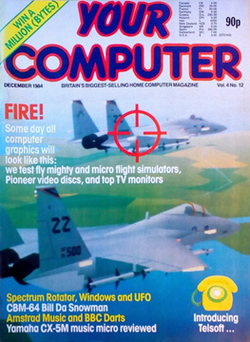
The December 1984 cover is a good place to stop and look. Ninety pence, volume 4 number 12, a flight simulator feature printed over a fighter jet, and along the top of the masthead that line about being Britain's biggest-selling home computer magazine. I was a few months old when that issue reached British newsagents, and the whole run had finished before I ever sat down in front of a keyboard. What is left for me is the volume numbering, which turns out to be a decent record of the decade by itself.
~ the record ~
| Born | June 1981, volume 1 number 1, spun out of Practical Computing |
|---|---|
| Peak | 90p a month, with the biggest home computer sale in Britain claimed on the masthead |
| Killed | 1988, final number volume 8 issue 8/9 |
| Lifespan | seven years across eight volumes |
| Made by | IPC, out of Sutton in Surrey |
| Killed by | a home computer audience that had either grown up or gone |
~ what the back pages were for ~
Type-in listings. Pages of BASIC printed on paper, retyped by hand into a machine with no storage worth the name, then debugged against a printer's error you could not tell apart from your own. It is the hardest part of the era to explain now: software distributed as text, compiled by the reader's fingers. Your Computer ran them in volume, for whichever machines were selling that season.
The rest was news, hardware tests and the advertising that paid for both. A 1984 issue is mostly mail order pages, and the mail order pages are the real document: they show what a Spectrum game cost and how fast that price fell.
~ the turn ~
By early 1987 the magazine had moved toward PCs and Macs, which is where the money was going and where its readers were not. The review list tells it plainly enough, with the Amstrad PC1512 in October 1986 and the PCW 9512 in November 1987. A title that made its name on the ZX Spectrum was now writing about office machines for an audience who had bought a toy and never asked it to grow up.
~ the last volume ~
The final number is recorded as volume 8, issues 8 and 9 combined, dated 1988. Two numbers under one cover is a publisher stretching a schedule it can no longer hold, and the archives read the same way. No public collection carries anything past the spring. April 1988 is the last issue the Internet Archive has, and the Centre for Computing History in Cambridge stops one month later. Eight volumes, from the ZX81 to a word processor, and then the double issue.
~ leave a rose ~
an anonymous tribute. one rose per visitor per day.
@}-->-- ... roses left here
~ leave a wreath ~
a rose fades by morning. a wreath stays on this grave for good, with your name on it.
paid once through stripe. payments are handled by OÜ Lakeview, the small company that keeps rip.so running. the money pays for the hosting and the nightly digging. adopt it and the headstone reads "maintained in memory by" you. the groundskeeper plants new wreaths at the next tending, usually within a day.
» one email a week: new graves and the anniversaries of the dead. subscribe
other news: HitFix, Togech, Facebook News, Computing Today
also died in the 1980s: CommaVid, Computing Today, Optimized Systems Software
~ leave a note ~
visitors before you have left these graveside notes. anonymous welcome.