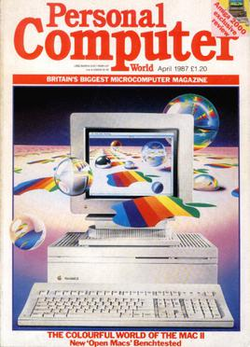
Personal Computer World
» see pcw.co.uk as it lived, on the wayback machine
~ the eulogy ~
Issue one is dated February 1978 and the machine on the cover is a Nascom-1, a British single-board computer that arrived as a bag of parts and a soldering job. Angelo Zgorelec, born in Croatia, had seen that board and concluded Britain needed a magazine about machines like it. The word personal in the title was doing generic work at the time. The Apple II and the TRS-80 had both been sold as personal computers the year before, and nothing resembling a standard had settled.
It went monthly with the second issue. Zgorelec brought Felix Dennis in as a partner, Dennis published his first issue in September 1979, and the title was sold on to VNU in 1982. It traveled with the rest of VNU's business titles into Incisive Media in 2007. PCW reviewed the original IBM PC in November 1981 as a newcomer to a crowded field, which is the right order to keep in mind: the magazine was older than the platform it spent its last fifteen years covering.
PCW's biggest years ran from 1992 to about 1996. A reader marketing push in 1992 lifted circulation from a middling 80,000 to more than 155,000, Windows 3.1 and cheap clones were landing in every shop, and the magazine fought Computer Shopper and PC Pro for several thousand pages of advertising a month.
Those years are the ones I have no claim on whatsoever. My first dial-up connection came in 1998, six years after that circulation push, and a British monthly with a cover CD was never going to turn up at a house in Turkey. What I have read of PCW is scanned pages on the Internet Archive, opened long after any benchtest inside them could tell anybody what to buy.
~ the dossier ~
| Born | February 1978, with a Nascom-1 kit on the cover |
|---|---|
| Peak | circulation over 155,000 in the mid 1990s, issues past 700 pages |
| Killed | 8 June 2009 |
| Lifespan | 31 years 4 months |
| Made by | Angelo Zgorelec, then Dennis Publishing, VNU, Incisive Media |
| Killed by | the collapse of print technology advertising |
~ benchtests ~
The furniture had names and kept them for decades. Newsprint was Guy Kewney's news section. Benchtests were the long hardware reviews, Subset handled machine code, TJ's Workshop was written for terminal junkies, Bibliofile did books, Screenplay did games, and Banks' Statement was Martin Banks' column. The help pages were called Computer Answers and ran long enough that the 1985 to 1987 stretch of them is archived on its own.
Jerry Sanders joined as features editor in 1983 and wrote the first published review of Microsoft Word 1.0 for the magazine. The covers had their own habit: a single dominating photograph, often a joke, and every new Sinclair machine was photographed being operated by chimpanzees. That tradition started with the ZX81 and survived until the style was dropped in the early 1990s.
~ the fat years ~
From 1978 to 1989 the magazine put its name on the Personal Computer World Show, an annual trade and consumer fair in London every September. On the newsstand the arms race was measured in bulk. An issue arrived with a cover-mounted CD-ROM, later a DVD, and the DVD edition cost more money for identical pages. A single monthly issue could pass seven hundred pages because the advertising would not fit in fewer.
~ the last cover ~
Incisive Media announced the closure on 8 June 2009, blaming an unprecedented advertising decline and falling newsstand sales, and said the title was no longer economically viable. Around a dozen jobs went. Subscribers were offered a refund or a transfer to Computeractive. The audited circulation at the end was 54,069, which still made it the second most popular monthly technology title in the country.
The final issue was dated August 2009 and went on sale that month. There was no farewell inside it and no editor's letter marking thirty-one years. There was an ad for the September issue.
~ leave a rose ~
an anonymous tribute. one rose per visitor per day.
@}-->-- ... roses left here
~ leave a wreath ~
a rose fades by morning. a wreath stays on this grave for good, with your name on it.
paid once through stripe. payments are handled by OÜ Lakeview, the small company that keeps rip.so running. the money pays for the hosting and the nightly digging. adopt it and the headstone reads "maintained in memory by" you. the groundskeeper plants new wreaths at the next tending, usually within a day.
» one email a week: new graves and the anniversaries of the dead. subscribe
other news: Akiba Souken, Rawporter, Culture11, Politics Daily
also died in the 2000s: Radio.Blog.Club, Doctor Fun, RemoteAccess
~ leave a note ~
visitors before you have left these graveside notes. anonymous welcome.