WinG
~ the obit ~
WinG was born and dead before I owned a modem. Twenty first of september 1994 to thirtieth of september 1995, one year and nine days, an entire product life that fits inside the gap between my tenth birthday and my eleventh. I was not online, not in a position to care about graphics libraries, and nowhere near the argument this thing was built to win.
The argument was whether games belonged on Windows. In 1994 the answer from anyone who made them was no. DOS gave you the hardware directly. Windows put a graphics layer in between that was designed for drawing menus and printing documents, and it was slow enough that a game running through it looked like a slideshow. Every serious PC game of that period shipped as a DOS binary, and Microsoft was watching an entire category of software decline to run on its operating system.
So a programmer in Microsoft's research group named Chris Hecker, helped by Todd Laney, wrote a library that let a program get at a block of memory, draw into it directly and then hand the finished frame to the screen in one operation. Double buffering, dirty rectangles, all the things a DOS game did as a matter of course and Windows had made impossible. It was unveiled at the 1994 Game Developers Conference with a port of Doom, running in a window at something close to the speed it ran under DOS, which is the demo that ended the discussion.
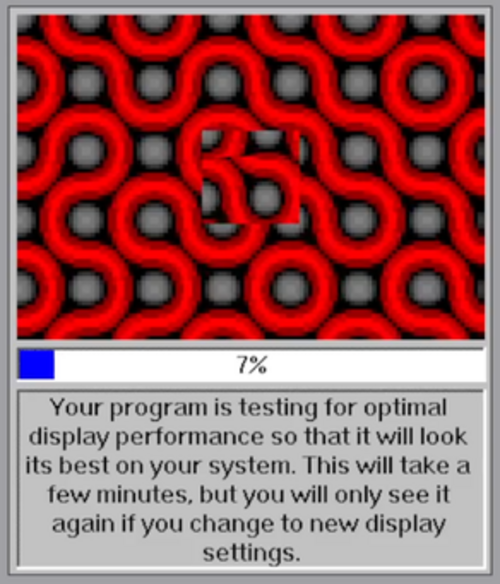
I never wrote a line against it. What I did see, years later and without knowing what I was looking at, is the calibration screen. Anyone who ran Warcraft II or SimCity 2000 or Civilization II on a Windows machine got a small gray dialog with a red pattern crawling in it and a progress bar, explaining that the program was testing for optimal display performance and would only do this once. That was WinG, benchmarking your video card to work out which of several drawing paths was least broken on your particular hardware.
~ the rap sheet ~
| Born | 21 september 1994, for 16-bit windows 3.x |
|---|---|
| Peak | the 1994 game developers conference, running id software's doom |
| Killed | 30 september 1995, when the windows games sdk shipped with directdraw |
| Lifespan | one year and nine days |
| Made by | chris hecker at microsoft, with todd laney |
| Killed by | directx, which was already being built while wing was being announced |
~ what it actually did ~
The core of it was a device-independent bitmap you could write to like ordinary memory, plus one call that pushed the result to the screen. That sounds like nothing now. In 1994 it was the difference between ten frames a second and sixty, because the alternative was going through the standard Windows drawing interface one operation at a time and letting the driver decide how to interpret each one.
There was no hardware acceleration in it. WinG never touched a graphics chip's capabilities, it just got out of the way of the software rendering the game was doing anyway. That limitation is also what killed it, because the next generation of cards was going to have real hardware behind it and a bitmap-shoveling library had no way to reach that.
~ the broken drivers ~
The part that has aged strangest is what Hecker found while building it. Video drivers in 1994 were written by card manufacturers to whatever standard they felt like, and a great many of them were wrong in ways nobody had noticed because nobody had pushed them hard. Getting games to run fast meant working around dozens of separate driver bugs, and in several cases meant Microsoft writing better drivers and shipping them.
This is why the calibration screen exists at all. WinG could not trust the machine it was running on to tell it which path was fastest, so it measured. Every install of every WinG game ran a small benchmark against your specific hardware and stored the answer. It is a piece of engineering that assumes the platform underneath is lying to you, which was correct.
~ the day it ended ~
On 30 september 1995 Microsoft shipped the Windows Games SDK, later renamed DirectX 1.0, built in about four months by Alex St. John, Craig Eisler and Eric Engstrom. DirectDraw did what WinG did and then kept going into the hardware. DirectSound, DirectPlay and DirectInput covered the rest of what a game needed. WinG was the Win32 replacement's predecessor from the moment the replacement was announced, and it was superseded almost exactly one year after it launched.
The libraries kept shipping for a while out of inertia. WinG was still present in Windows 95, Windows 98 and Windows NT 4.0, because the games that used it were still on shelves. It was gone from Windows 98 Second Edition, which bundled DirectX 6, and from every version after that.
~ the long tail ~
The list of games that shipped against WinG is short and disproportionately memorable: Doom's Windows port, Warcraft II, SimCity 2000, Civilization II, Heroes of Might and Magic II. Roughly a two-year window of PC gaming ran on an API that existed for one year, and every one of those games outlived it by a decade or more in the places where people actually played them, including a lot of internet cafés a long way from Redmond.
Nobody mourned it and nobody was supposed to. WinG was a bridge with a known demolition date, put up to hold the traffic until the real road opened. It did that, and the thing worth keeping from it is not the code but the finding underneath the code, which is that the fastest way to make a platform good at something is to go and repair the parts of it that other people got wrong.
~ leave a rose ~
an anonymous tribute. one rose per visitor per day.
@}-->-- ... roses left here
~ leave a wreath ~
a rose fades by morning. a wreath stays on this grave for good, with your name on it.
from $1, paid once through stripe. it keeps the graveyard running: the hosting and the nightly digging. adopt it and the headstone reads "maintained in memory by" you. the groundskeeper plants new wreaths at the next tending, usually within a day.
» one email a week: new graves and the anniversaries of the dead. subscribe
other software: Norton SystemWorks, Apple Pay Later, PalmSource, 7th Level
also died in the 1990s: Packard Bell, 7th Level, Simtex
~ leave a note ~
visitors before you have left these graveside notes. anonymous welcome.