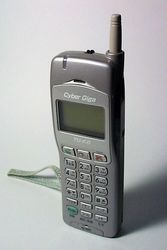
TU-KA
» see tu-ka.co.jp as it lived, on the wayback machine
~ the eulogy ~
Three companies were set up in 1992 to run one brand, split by region: Tu-Ka Cellular Tokyo in the capital and Tu-Ka Phone Kansai in Osaka, with a third company covering Nagoya. Nissan put up most of the money, with DDI and Kyocera alongside it, and service began in June 1994. The coverage map explains the shape of the whole business. Tu-Ka sold in three metropolitan areas and nowhere else, on the theory that the biggest urban blocks were enough of a market.
For a while they were. Contracts peaked at 4,018,200 at the end of June 2001, which put Tu-Ka in the same conversation as the national carriers even though it only existed in a handful of prefectures. Then came the 3G auctions, and Tu-Ka did not enter. The network stayed on PDC, the Japanese second generation standard, while NTT DoCoMo launched FOMA and au went to CDMA2000.
A Japanese phone of that era was not a phone anywhere else. PDC ran in exactly one country, so the handsets did not roam and were not sold abroad. Turkey was on GSM from the beginning, like most of the world outside Japan, and the practical result is that this entire carrier came and went without ever touching a network I could have reached.
~ the dossier ~
| Born | June 1994, service from Tu-Ka Cellular Tokyo |
|---|---|
| Peak | 4,018,200 contracts at the end of June 2001 |
| Killed | 31 March 2008 at midnight JST |
| Lifespan | 13 years and 9 months of service |
| Made by | Nissan Motor with DDI and Kyocera, later KDDI |
| Killed by | the decision not to apply for a 3G license |
~ the phone that only made calls ~
The most interesting thing Tu-Ka ever shipped came out of being behind. In 2004 it launched the Tu-Ka S, a handset with no camera and no browser, built for people who wanted a telephone. It used a bone conduction speaker so it could be heard in a noisy street, and it was aimed squarely at older customers who had been sold four generations of features they never asked for.
It worked well enough that the idea outlived the carrier. Stripped-down handsets for older users became a standing category in Japan and are still sold there. A network that could not compete on technology had found the one segment where having less was the product.
~ the migration ~
KDDI took full ownership through a share exchange completed on 25 March 2005 and merged the three companies into itself on 1 October 2005. Ten days later it opened a program letting Tu-Ka customers move to au and keep their numbers, at a point when Japanese number portability did not yet exist for the rest of the market.
The response overwhelmed the processing and the program was suspended within days, reopening on 2 November 2005. Over the following two and a half years the base drained from roughly a million to almost nothing. Ayumi Hamasaki had fronted the advertising through the good years, and there was no equivalent campaign for the exit.
~ what the domain does now ~
The service ended at midnight on 31 March 2008 with about 237,800 contracts still active, around ninety percent of them prepaid, which is another way of saying most of the people left were not really customers anymore. KDDI reported its first ever drop in total subscribers that quarter as a result.
tu-ka.co.jp still resolves. It serves an unofficial archive of the company's history, its handsets and its advertising, assembled by people who were not paid to remember any of it.
~ leave a rose ~
an anonymous tribute. one rose per visitor per day.
@}-->-- ... roses left here
~ leave a wreath ~
a rose fades by morning. a wreath stays on this grave for good, with your name on it.
from $1, paid once through stripe. it keeps the graveyard running: the hosting and the nightly digging. adopt it and the headstone reads "maintained in memory by" you. the groundskeeper plants new wreaths at the next tending, usually within a day.
» one email a week: new graves and the anniversaries of the dead. subscribe
other connectivity: Ya.com, Transpac, Lucent Technologies, ConSentry Networks
also died in the 2000s: All Your Base Are Belong To Us, Exodus Communications, Lucent Technologies
~ leave a note ~
visitors before you have left these graveside notes. anonymous welcome.