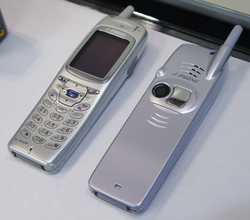
J-Phone
~ the goodbye ~
The camera reached my pocket as a hardware feature with nothing attached to it. By the time a phone with a lens on the back was ordinary in Turkey, sending the picture anywhere cost enough per message that you mostly did not. You showed it to whoever was standing next to you, and that was the entire use case for a couple of years. In Japan the order was the other way around. The service came first and the camera was built to feed it.
J-Phone was the brand Japan Telecom's mobile business took in 1999, after the Digital Phone group and the Digital TU-KA group, nine regional companies between them, were folded into one thing. Japan Telecom held 45.1 percent of it. It was the third carrier in a market where NTT DoCoMo was enormous and KDDI's au was the other serious operator, which is the position where a company either finds something or disappears quietly.
What it found went on sale on 1 November 2000. The J-SH04, built by Sharp, had a camera on the back with a hundred and ten thousand pixels behind it, a number that reads like a joke now and was a working camera then. The sensor was never the point. The point was that the phone knew how to put the picture into a message and send it somewhere.
~ the chronicle ~
| Born | 1999, out of nine regional operators under Japan Telecom |
|---|---|
| Peak | the first camera phone, and Sha-Mail past six million users |
| Killed | 1 october 2003 |
| Lifespan | four years as a brand |
| Made by | Japan Telecom, with Vodafone buying control in 2001 |
| Killed by | Vodafone painting its own name over it |
~ sha-mail ~
The service was called Sha-Mail, from the Japanese for photograph, and it did the one thing that made a camera in a phone worth paying for. You took the picture and mailed it as an attachment to another subscriber, over the 2G network, with no cable and no computer anywhere in the chain. Within a couple of years it had gone past six million users.
Every other Japanese carrier shipped an answer to it, and then everybody else in the world did, which is how a global industry of phone cameras traces back to a third-place operator looking for an argument. The narrow thing worth noticing is what the product actually was. It was a messaging product. The camera was there to give people something to put in a message.
~ the rebrand ~
Vodafone had been buying in since 2001 and by that October held 69.7 percent of J-Phone, with 66.7 percent of Japan Telecom sitting above it. The name went on 1 October 2003. J-Phone became Vodafone K.K., and the Sha-Mail branding went with it, replaced by Vodafone live!, which was the same idea rendered in a way that made sense to a European marketing department.
It did not work. Vodafone Japan had 15.1 million subscribers in February 2005 and had dropped below fifteen million by October of the same year. Handsets designed for a global lineup did not suit a market where DoCoMo shipped whatever Japanese customers asked for, and a company that had spent four years leading on features spent the next three following.
~ what it became ~
Vodafone gave up on 17 March 2006 and sold the whole Japanese business to SoftBank for about 15.1 billion dollars. On 1 October 2006, three years to the day after the J-Phone name came down, the company became SoftBank Mobile.
SoftBank still runs it. The lineage goes from nine regional operators to J-Phone to Vodafone to SoftBank inside seven years, and out of all that corporate motion the only thing anyone outside Japan remembers is a Sharp handset from 2000 with a small lens on the back. Everyone reading this has that phone in their pocket now, with a better sensor and the same basic promise on it.
~ leave a rose ~
an anonymous tribute. one rose per visitor per day.
@}-->-- ... roses left here
~ leave a wreath ~
a rose fades by morning. a wreath stays on this grave for good, with your name on it.
from $1, paid once through stripe. it keeps the graveyard running: the hosting and the nightly digging. adopt it and the headstone reads "maintained in memory by" you. the groundskeeper plants new wreaths at the next tending, usually within a day.
» one email a week: new graves and the anniversaries of the dead. subscribe
other connectivity: Atlas VPN, Farallon Computing, Nextel iDEN Network, Vodafone live!
also died in the 2000s: Stage6, ITV Digital, Qimonda
~ leave a note ~
visitors before you have left these graveside notes. anonymous welcome.