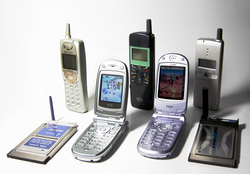
PHS (Personal Handy-phone System)
~ the obit ~
NTT's laboratories designed PHS in 1989 as a deliberately smaller idea than a cellular network. Base stations were low-power boxes covering a hundred to five hundred meters, cheap enough to hang on a utility pole and dense enough to work in a Japanese city. Handsets were simpler and cost less to build. Commercial service opened in July 1995 with three operators going at once, and the promise was a phone bill an ordinary person would not think twice about.
The engineering had one honest limitation and Japan named it immediately. Cells that small mean handovers happen constantly, and PHS handovers were not built for somebody in a moving car. The service picked up the nickname "poor man's cellular" and never put it down. NTT DoCoMo, which had absorbed NTT Personal, closed its PHS network in January 2008 along with ASTEL. DDI Pocket went the other way. It became Willcom and turned the cost advantage into flat-rate unlimited data in 2005, for people who wanted a modem more than a telephone.
Turkey never had a second network to be cheap on. GSM arrived here in 1994 as a duopoly running on Türk Telekom's license, and from the first day the choice was one expensive mobile phone or none, with prepaid cards arriving later as the affordable version. There was no third thing between the landline and the mobile. Reading about PHS from here is reading about a decision the Turkish market was never offered.
~ the rap sheet ~
| Born | July 1995 in Japan, three operators launching at once |
|---|---|
| Peak | over 90 million Xiaolingtong subscribers in China as of 2007 |
| Killed | 31 March 2023, when Y!mobile ended the last telemetry service |
| Lifespan | twenty eight years |
| Made by | NTT Laboratory, from 1989 |
| Killed by | cheap GSM handsets, then 3G |
~ the chinese decade ~
PHS became enormous in China for a bureaucratic reason. China Telecom and China Netcom were fixed-line operators and were not licensed to sell mobile service, but PHS was arguably a wireless extension of the fixed network rather than a mobile network, so they sold it anyway. It went out as Xiaolingtong, borrowed from Ye Yonglie's children's science fiction story about a boy reporter who travels to the future, and it was cheap enough that it became many people's first phone.
By 2007 there were more than ninety million subscribers on it. UTStarcom and ZTE built most of the equipment, and both companies grew substantially on the back of a standard nobody outside Asia was buying. What ended it was not regulation but price: ordinary mobile handsets fell far enough that the reason to accept the compromise disappeared. On 13 February 2009 the Ministry of Industry and Information Technology told the operators to stop registering new users and stop expanding the networks, with service to end by the close of 2011. The last of it was switched off in September 2013.
~ the long tail ~
PHS ran commercially in more places than its reputation suggests. Thailand had it from November 1999 as PCT, sold by TelecomAsia and integrated with the fixed network so a landline subscriber could carry the same number and the same voicemail out of the house, which was a first. Taiwan ran it from May 2001 to March 2015, Hong Kong from 1997 to May 2016. Chile's Telefónica del Sur launched a PHS service in the south of the country as late as March 2006. There was even a roaming agreement letting a Japanese handset work in Taiwan.
Japan kept it longest. Y!mobile, which inherited the network through Willcom and SoftBank, ended consumer PHS service on 31 January 2021, and kept a corporate telemetry service running on it for two more years because hospitals and industrial sites had equipment that spoke nothing else. That last piece was switched off on 31 March 2023, twenty eight years after the first call. The Japanese press covered it as the end of a phone system rather than the end of a product, which is the right framing.
~ what it was actually for ~
Every telecom market of the early nineties tried some version of the cheap short-range phone. Britain had telepoint services where the handset only worked near a base station and could not receive calls at all. France had Bi-Bop. Almost all of them died within a few years of launch, and PHS is the one that did not, because Japan built enough base stations to make it a real network rather than a coupon for occasional access, and because China then found a regulatory reason to sell it by the tens of millions.
The lesson underneath it has held everywhere since. A cheaper network with holes in it competes against an expensive network without them, and the expensive one gets cheaper faster than the cheap one can fill its holes. PHS bought itself an extra twenty years by being genuinely good at dense cities and by finding a market where the licensing was strange. It still lost to the same thing everything else lost to, which was a normal phone getting cheap.
~ leave a rose ~
an anonymous tribute. one rose per visitor per day.
@}-->-- ... roses left here
~ leave a wreath ~
a rose fades by morning. a wreath stays on this grave for good, with your name on it.
from $1, paid once through stripe. it keeps the graveyard running: the hosting and the nightly digging. adopt it and the headstone reads "maintained in memory by" you. the groundskeeper plants new wreaths at the next tending, usually within a day.
» one email a week: new graves and the anniversaries of the dead. subscribe
other connectivity: WebTV / MSN TV, Club-Internet, Google Station, Datex-P
also died in the 2020s: Delicious Library, Apple Photo Stream, SGT STAR
~ leave a note ~
visitors before you have left these graveside notes. anonymous welcome.