Tiki Data
~ the eulogy ~
In December 1982 there were 75 different models of computer running in Norwegian schools, and around 30 of those models were in use at exactly one school each. The education ministry treated that as a problem worth legislating about. After a consultation and a tender, the government wrote a specification for what a school computer had to be, and decided that for the time being it would run CP/M. Tiki Data was founded in Oslo in 1983 by Lars Monrad Krohn and Gro Jørgensen, and the machine it designed was a direct answer to that document.
The first name did not survive contact with Thor Heyerdahl. The computer was shown to the press in late 1983 as the Kontiki-100, Heyerdahl threatened to take the Kon-Tiki name to court, and it reached shops in the spring of 1984 as the Tiki-100 at NOK 12,000. The operating system had the same kind of week. It shipped as KP/M, Computerworld noted that KP/M ran CP/M software and said the obvious thing about where it came from, and it was renamed Tiko to put some air between Tiki Data and Digital Research. Two renames before the product had a customer.
What finally took the company was the thing that took every national computer: a cheaper clone from somewhere else. The Tiki-200 was a plain IBM PC compatible with no attempt at running anything the Tiki-100 ran. The Tiki-300 was reported as a Taiwanese AT clone while the company's own publicity insisted every model was produced in Norway to West European quality standards. Oslo municipality bought NOK 5 million of IBM systems rather than the approved educational machines from Tiki Data and Scandis, attempts at Sweden and the Netherlands were abandoned, and half the staff went. Merkantildata bought the remainder in December 1996 and the name stopped existing.
~ the dossier ~
| Born | 1983 in Oslo, by Lars Monrad Krohn and Gro Jørgensen |
|---|---|
| Peak | over 15,000 machines claimed inside Norwegian schools and higher education in 1989 |
| Killed | December 1996 |
| Lifespan | 13 years |
| Made by | Tiki Data, Oslo |
| Killed by | Merkantildata, after the IBM PC clone had already taken the school market |
~ the machine ~
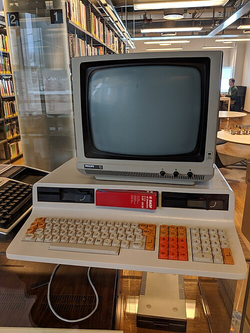
A Z80 at 4 MHz, 64 KB of main memory, 32 KB of video memory, and a mechanical keyboard with N-key rollover built into the case. The graphics were made of discrete TTL parts and were bitmapped only, with no text mode at all: a 256-color palette and three resolutions, and terminal emulators that drew anything from 40 to 160 characters across by faking the text in pixels. Every mode could scroll vertically in hardware, which was a strange luxury on a machine aimed at classrooms.
The box came with BBC BASIC and a COMAL interpreter, which tells you who it was for. You could replace a floppy drive with an 8 MB hard disk, and there was a hub that let sixteen Tiki-100s share disks and up to three printers off a server running MP/M. Tiki Data published five commercial games for it, among them Tiki Invaders and a chess program, all in Norwegian and all for a market that could fit in one country.
~ the school standard ~
Being the approved machine is a good business until the approval stops mattering. Tiki Data had it on paper and could still claim over 15,000 installations across Norwegian schools and higher education in 1989, seven years after the fragmentation the standard was written to fix. What the standard could not do was make a municipality buy Norwegian when IBM quoted a price, and public budgets in the late 1980s were tightening in exactly the places that had been told to buy Tiki.
~ what came after ~
I was born the year the Tiki-100 shipped, in a country that was not Norway, and my own internet did not start until 1998, at 14.4k. The Tiki was already finished by then and had never left Norway in the first place, so the only honest claim I have on it is none. The part that travels is the shape. Governments across Europe did the same thing through the 1980s, blessing a local builder with a specification and then finding out the specification was the only thing holding the imports off.
What is left is a Kontiki-100 sitting in a university library in Oslo and an emulator kept running by a hobbyist. Gro Jørgensen went on to found Cyberbook. The Tiki-100 itself was discontinued in 1989, seven years before the company that built it.
~ leave a rose ~
an anonymous tribute. one rose per visitor per day.
@}-->-- ... roses left here
~ leave a wreath ~
a rose fades by morning. a wreath stays on this grave for good, with your name on it.
paid once through stripe. payments are handled by OÜ Lakeview, the small company that keeps rip.so running. the money pays for the hosting and the nightly digging. adopt it and the headstone reads "maintained in memory by" you. the groundskeeper plants new wreaths at the next tending, usually within a day.
» one email a week: new graves and the anniversaries of the dead. subscribe
other gadgets: Multiflow Computer, Microsoft Surface Duo, iSmell, Apple Lisa
also died in the 1990s: Minuet, TURNET, Multiflow Computer
~ leave a note ~
visitors before you have left these graveside notes. anonymous welcome.