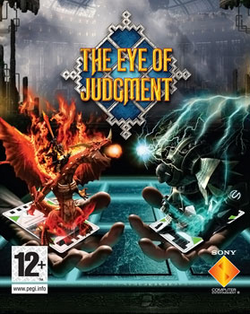
The Eye of Judgment
~ the obit ~
The Eye of Judgment reached North America on 23 October 2007, with Japan and Europe following within three days. Japan Studio built it and Sony published it, and it shipped with a PlayStation Eye in the box. Alongside the camera came a stand to hold it above the table, a playing mat and a starter deck of printed cards.
You put a card on one of the nine squares of the mat. The camera looked down at it, read the code printed on its face, and a creature stood up on the television in the square where the cardboard was. Then your opponent put down a card of their own and something happened between the two of them. The screen was showing you a board that physically existed on the table underneath it.
Reviews landed around 75 out of 100, which is roughly the right score for a game whose best quality is the first ten minutes of showing it to somebody. Sony kept printing for it through October 2008, across three sets that came to 311 different cards, sold in booster packs and in ready-made theme decks the way any other trading card game is sold.
~ the rap sheet ~
| Born | 23 October 2007 in North America |
|---|---|
| Peak | 311 card types across three sets, the last printed in October 2008 |
| Killed | 30 September 2010, online only |
| Lifespan | 2 years, 11 months, 7 days |
| Made by | Japan Studio, published by Sony Computer Entertainment |
| Killed by | online servers switched off |
~ cards a camera could read ~
The enabling trick was a matrix code, a dense printed pattern on the card face that the camera could resolve at an angle, under whatever lighting the room happened to have. Sony called the system CyberCode. It is the same family of idea as a QR code and it was doing a harder job, because a QR code gets pointed at deliberately and a game card gets dropped on a mat.
That constraint shaped the whole product. The mat had to be a fixed three by three so the camera always knew where the squares were. The stand existed because the angle mattered. Every physical object in the box was there to make an optical problem tractable, and the result was a game you could teach to someone across a table using objects they could pick up.
~ switched off at the source ~
In July 2010 Sony said the online servers would close, and on 30 September 2010 they did. What went with them was ranked play and matchmaking, the part that let you sit in your own house and play a stranger's deck. Just under three years is a short commercial life for a system sold on the promise of an expanding card pool, and the last expansion was almost two years old by the time the servers went.
Offline play survived, which makes this a gentler ending than most. The cards are inert plastic-coated cardboard and the camera does not need permission from anyone to read them, so a PS3 with the disc still runs a working game against the computer, or against somebody sitting opposite you with a shoebox of boosters. There was a PlayStation Portable spin-off called Legends in 2010 that kept the rules and dropped the cards, because the handheld had no camera to point at them. The version that survived on hardware is the version that gave up the only thing the game was actually about.
~ leave a rose ~
an anonymous tribute. one rose per visitor per day.
@}-->-- ... roses left here
~ leave a wreath ~
a rose fades by morning. a wreath stays on this grave for good, with your name on it.
from $1, paid once through stripe. it keeps the graveyard running: the hosting and the nightly digging. adopt it and the headstone reads "maintained in memory by" you. the groundskeeper plants new wreaths at the next tending, usually within a day.
» one email a week: new graves and the anniversaries of the dead. subscribe
other gaming: LJN, Game.com, NEC PC-FX, Tribe Nine
also died in 2010-2014: VMware Server, Ta-da List, Google Schemer
~ leave a note ~
visitors before you have left these graveside notes. anonymous welcome.