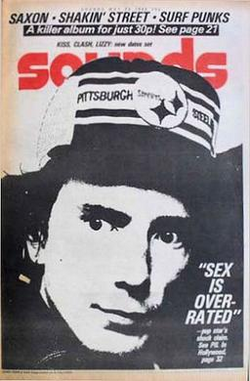
Sounds
~ the eulogy ~
Sounds launched on 10 October 1970 out of Spotlight Publications, a company set up by John Thompson and Jo Saul together with Jack Hutton and Peter Wilkinson, both of whom had just left Melody Maker. Hutton described the plan to the people he was trying to poach from his old paper as a leftwing Melody Maker. The first version was a weekly devoted to progressive rock, aimed squarely at the gap between Melody Maker and NME.
What it became was something else. Sounds was one of the first music papers in Britain to take punk seriously, and it kept taking the unfashionable side for the next fifteen years. It gave away a poster in the center pages every week, black and white at first, then color from late 1971, which is a small thing that put its logo on an enormous number of teenage bedroom walls. It coined "new musick" for the stuff that came after punk and did not sound like it, and the term survived in altered form as post-punk.
The bylines ran deep. Garry Bushell carried the Oi! coverage. Mick Middles wrote Manchester from 1978 to 1982, which meant Buzzcocks early and Joy Division as they happened. Jon Savage and Caroline Coon came through, John Peel wrote for it, Jane Jackman filed as "Jane Suck," and Alan Moore drew a strip under the name Curt Vile before anybody knew who he was. Steve Lamacq and Mary Anne Hobbs went on to Radio 1, and James Brown left to found Loaded.
~ the dossier ~
| Born | 10 October 1970, by two defectors from Melody Maker |
|---|---|
| Peak | the new wave of British heavy metal and Oi!, covered weekly |
| Killed | 6 April 1991, the final issue |
| Lifespan | 20 years and 6 months |
| Made by | Spotlight Publications, later United Consumer Magazines |
| Killed by | a parent company that wanted out of consumer music |
~ the Obscurist Chart ~
From the issue of 5 September 1981, Sounds ran a chart that was not based on sales. Paul Platypus started the Obscurist Chart and compiled the first nine of them himself, as a deliberate counterweight to a record industry that only measured what it had already sold. It ran a little over a year and the last one appeared on 11 December 1982.
That instinct is most of the paper's legacy. John Robb joined in 1987 and used the word "Britpop" in its pages for the La's and the Stone Roses, years before anyone built a movement out of it. Robb also did the first British interview with Nirvana in 1989, and Keith Cameron wrote them up in Sounds afterward. Kurt Cobain was photographed in London in a white long-sleeved Sounds shirt on 22 August 1991 and wore it to Reading the next day, four months after the paper had already stopped printing.
~ the supplement that outlived it ~
Kerrang! started life as a heavy metal supplement inside Sounds before it got a masthead of its own. By 1991 it was selling 58,685 copies as a weekly, against a Smash Hits that moved 470,463 and a Melody Maker on 70,100. Sounds itself is not in the audited circulation table Music Week printed that month at all. The supplement got a line in the figures and the paper that created it did not.
~ the worst week ~
Morgan-Grampian had been bought by United News and Media in 1987, which made Sounds part of United Consumer Magazines. In the spring of 1991 United decided to pull out of consumer music altogether and concentrate on trade papers like Music Week. Select and Kerrang! were sold on to Emap Metro as going concerns. Sounds went to Emap as a title and was closed on arrival, while Record Mirror was folded into Music Week as a section, which is a death with a tombstone attached.
Music Week covered it on 13 April 1991, the week after, and counted twenty-five jobs gone across Sounds and Record Mirror. Set against ninety at the Power Station and twenty-four at BMG, the paper called it the worst week for employment the British music industry had seen in a long time. The record labels gave the sort of quotes you give at a funeral for someone you did not entirely like: John Waller at Polydor said Sounds "wasn't the best paper but it was useful for new acts," and Deborah Edgley at 4AD said it made life more difficult to push new bands. Buried in the same piece, after the detail about which editor was moving to which magazine, is the flat line: there are no plans to revive Sounds.
The final issue is dated 6 April 1991. I was seven at the time and eight years off my first modem, so everything above is reconstructed out of a trade paper somebody scanned and the memories of people who bought it off a newsagent's rack in Britain. The closure notice and the circulation table that explains it sit on the same page of the same issue.
~ leave a rose ~
an anonymous tribute. one rose per visitor per day.
@}-->-- ... roses left here
~ leave a wreath ~
a rose fades by morning. a wreath stays on this grave for good, with your name on it.
paid once through stripe. payments are handled by OÜ Lakeview, the small company that keeps rip.so running. the money pays for the hosting and the nightly digging. adopt it and the headstone reads "maintained in memory by" you. the groundskeeper plants new wreaths at the next tending, usually within a day.
» one email a week: new graves and the anniversaries of the dead. subscribe
other media music: Listn, VirginMega.fr, MyStrands, PassAlong Networks
also died in the 1990s: ORACLE, Dartmouth Time-Sharing System, Digital Compact Cassette
~ leave a note ~
visitors before you have left these graveside notes. anonymous welcome.