Dartmouth Time-Sharing System
~ the goodbye ~
On the night of 31 december 1999, most of the industry was standing around waiting to see whether anything would fall over at midnight. At Dartmouth College somebody shut down the Dartmouth Time-Sharing System at 11:59pm, one minute before the rollover it had been patched to survive. The machine had been answering logins since 1964. It went out during the only minute of the century when nobody was going to notice.
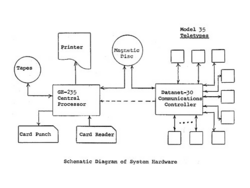
DTSS started at four in the morning on 1 may 1964, when two teletypes got responses from the same computer at the same time and neither user had to wait for the other. That is the whole trick of time-sharing and it was not obvious then. John Kemeny and Thomas Kurtz, both mathematicians, wanted every Dartmouth undergraduate to be able to use a computer, including the ones studying French literature. Batch processing made that impossible, because batch meant handing a deck of cards to an operator and coming back tomorrow.
The language came out of the same requirement. Fortran and ALGOL were built for people who were going to spend a career on them, and Kemeny and Kurtz needed something a nineteen year old could learn in an afternoon between classes. BASIC ran on DTSS from the start, free to every student, with no account approval and no charge per second of processor time. Undergraduates wrote much of the operating system itself, which is a sentence no computing center would allow today.
This is 1964, twenty years before I was born, in a New Hampshire building I have never seen. What survives of it where I am is the language. BASIC is the thing that got onto the ROM of every cheap home computer of the eighties, and from there into the hands of people who were never going to be given a mainframe account. The teaching decision was made at Dartmouth for Dartmouth freshmen, and it ended up defining what a generation of home users thought programming was.
~ the chronicle ~
| Born | 1 May 1964 at 4:00 a.m., two teletypes served at once |
|---|---|
| Peak | around 30,000 users by the early 1970s, close to 300 of them simultaneous |
| Killed | 31 December 1999 at 11:59pm |
| Lifespan | thirty five years and eight months |
| Made by | John Kemeny and Thomas Kurtz, with Dartmouth undergraduates writing most of the code |
| Killed by | Dartmouth retiring it, one minute short of the rollover |
~ how it landed ~
The important choice was giving it away. Dartmouth opened DTSS to local high schools and then to other colleges over dial-up, which meant a teenager in New England in 1968 could get computer time on a machine that cost more than the school building. Around eleven sites across North America and Europe were running it during the seventies, and General Electric, which supplied the hardware, took the design out commercially as its own time-sharing service.
That is how the model escaped. GE sold time-sharing accounts to businesses, other vendors copied the pricing, and the idea that you rent computing by the hour from somebody else's machine became an industry before anybody thought to call it one. Around thirty thousand people were on Dartmouth's own system by the early seventies, with fewer than a tenth of them actually at the college.
~ the long tail ~
DTSS should have died in the early eighties, when a personal computer on a desk made renting mainframe seconds look ridiculous. It did not. Dartmouth kept it running for another fifteen years past the point of obvious usefulness, partly out of institutional stubbornness and partly because the people who had grown up on it were now running the place. By the end it was doing very little except existing, which for a system with that history is not nothing.
In 2000, a group rebuilt DTSS on a simulator so the thing could be booted on an ordinary desktop. That project is why the system is not simply gone. You can start it up now and get the same prompt a Dartmouth freshman got in 1965, on a laptop, for free, which is the outcome Kemeny and Kurtz were arguing for in the first place.
~ what got buried with it ~
The idea that computing should be free at the point of use, for everyone at an institution, without a justification form. Dartmouth charged nothing to students and did not meter their time, which was radical when a processor hour had a real price attached. Every other time-sharing operation of the era existed to bill somebody. DTSS existed to remove the reason a student would not try.
BASIC then spent the eighties being sneered at by serious programmers, and the sneering missed what it was for. It was never designed to be a good language. It was designed so that the barrier between a curious person and a working program was one afternoon, and by that measure nothing since has beaten it.
~ leave a rose ~
an anonymous tribute. one rose per visitor per day.
@}-->-- ... roses left here
~ leave a wreath ~
a rose fades by morning. a wreath stays on this grave for good, with your name on it.
from $1, paid once through stripe. it keeps the graveyard running: the hosting and the nightly digging. adopt it and the headstone reads "maintained in memory by" you. the groundskeeper plants new wreaths at the next tending, usually within a day.
» one email a week: new graves and the anniversaries of the dead. subscribe
other software: Android Things, CoTweet, SafeDisc, Microsoft FrontPage
also died in the 1990s: ORACLE, anon.penet.fi, GameTek
~ leave a note ~
visitors before you have left these graveside notes. anonymous welcome.