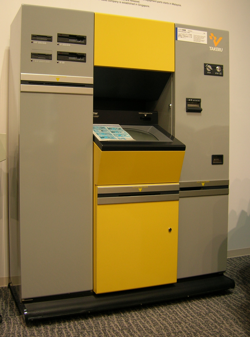
Soft Vendor TAKERU
~ the obituary ~
Japan had a vending machine that sold software. You picked a title off the screen and paid, and the box wrote the program onto a blank floppy and printed the manual for you while you waited. Nothing remotely like it stood anywhere near me. Where I was, software arrived on a disk somebody had already copied for free, and a machine on a shop floor selling you a legal copy at under the shelf price, one floppy at a time, would have sounded like a report from another planet.
ソフトベンダーTAKERU was built by Brother Industries, the sewing machine and printer company, which still describes it on its own history pages as the world's first vending machine for PC software. Four prototypes were shown at a press event in March 1985 and fifteen shops across three cities ran trials from that December. Full sales started in the spring of 1986, though the sources cannot agree on the month. Brother commits only to the year. The Japanese Wikipedia article says 21 April and ASCII says March.
The name was written 武尊 when it launched, after the mythic hero Yamato Takeru. Children kept misreading the kanji as Buson, and it was quietly dropped from the third generation onward. The prototype had been called SV-2000 and the number was a target: two thousand machines installed by the year 2000, a business worth two hundred billion yen. It reached about three hundred machines and was switched off in February 1997.
~ the case file ~
| Born | 1986, Japan, after four prototypes were shown in March 1985 |
|---|---|
| Peak | About 300 machines nationwide, after the yellow SV-2300 arrived in 1991 |
| Killed | February 1997 |
| Lifespan | About eleven years |
| Made by | Brother Industries, over leased network lines from Intec |
| Killed by | 32-bit PCs and CD-ROM, which outgrew a floppy disk and an ISDN line |
~ what buying from it was like ~
You fed it a blank floppy. Writing a 3.5-inch 2DD disk took somewhere around seventy seconds, and the third-generation machine's laser printer produced a page of manual in about fifteen. Anything running past ten pages was too much to print while you stood there and got posted to you instead. The disk came out wearing a plain label, so a lot of buyers wrote their own.
The reason to stand there was price. A copy of Artdink's A-Train cost 7,800 yen on a shelf and 6,600 yen out of the machine. A back-catalog line called 名作文庫 went further and put older titles at 3,800 yen against the 9,800 they had cost new, which is a secondhand price for a brand new copy, and the only reason it could be done is that there was no box and no shop taking a cut of either.
~ three hundred machines ~
The fleet started at 127 units and got to nearly three hundred when the yellow SV-2300 rolled out through 1991. That generation was a serious piece of hardware: an Intel 80386SX where the first two had run an NEC V30, a touch panel, a laser printer, an ISDN connection and a CD-ROM drive. One of those yellow cabinets is on display at the Brother Museum.
Behind the cabinets was a network nobody saw. Intec ran leased lines from the data center to every shop, and the popular titles were pushed out to local hard disks overnight at 1200 bits per second. Early on that network cost 13 million yen against 10 million yen of sales, and Yuichi Anryu, who had started the project, was told to shut it down. He asked for 50 million yen to close it and spent the money switching the whole fleet from leased lines to ordinary dial-up telephone calls, after which it made a profit. A membership scheme followed in 1991 at 500 yen to join and 500 a year, and by March 1992 it had around 40,000 members, 91 percent of them in their teens or twenties.
~ the doujin door ~
The famous publishers were hard to sign and mostly stayed hard. Some came: Nihon Falcom sold Sorcerian scenario disks through it, Koei put Nobunaga's Ambition on it, T&E Soft had Hydlide there and Enix had Portopia. But a machine with no shelf space does not need a title to sell in volume, and so the catalog that made TAKERU matter was the one no shop would stock.
From about 1993 the sales chief Ichiro Hirosawa was handing out flyers at Comiket and running submissions through a sheet called TAKERU PRESS. As many as a hundred arrived in a week; they were read on Fridays and roughly one in three was taken. Authors could take 40 to 50 percent of the price, or pay nothing at all and let the machine keep about 200 yen a floppy. Imagic began exactly this way, as a circle selling Mebius Link out of a vending machine, and then became a company.
~ why brother switched it off ~
Day-to-day operation had already moved across to Xing in May 1994. The service itself ended in February 1997, and the date is firmer than it looks: Brother's own page commits only to the year, while the Japanese Wikipedia article and ASCII both say February and one retrospective says the service ran to the end of that February. It was not killed by the internet, at least not in the way the shape of the story suggests. Anryu's account is that TAKERU was still in the black in 1997 and that he ended it because he could not see a future for it: the network was improving, and 32-bit PCs and CD-ROM software were getting larger faster than any line into a shop could keep up with. The hardware's real descendant was karaoke, since the same servers that fed the machines by day carried JOYSOUND's music data by night.
~ leave a rose ~
an anonymous tribute. one rose per visitor per day.
@}-->-- ... roses left here
~ leave a wreath ~
a rose fades by morning. a wreath stays on this grave for good, with your name on it.
paid once through stripe. payments are handled by OÜ Lakeview, the small company that keeps rip.so running. the money pays for the hosting and the nightly digging. adopt it and the headstone reads "maintained in memory by" you. the groundskeeper plants new wreaths at the next tending, usually within a day.
» one email a week: new graves and the anniversaries of the dead. subscribe
other software: Altamira Software, Sunrise Calendar, Twitter Music, Microsoft Wallet
also died in the 1990s: Altamira Software, Compunet, Fidelity Electronics
~ leave a note ~
visitors before you have left these graveside notes. anonymous welcome.