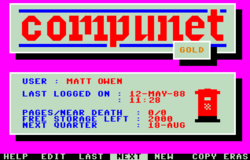
Compunet
~ the eulogy ~
The Commodore 64 reached Turkey. The network some of them plugged into did not, and that gap is the whole reason this grave is written from outside. A machine is a box in a shop and boxes cross borders. Compunet was a phone number on a BT line with a subscription in pounds attached, and none of that travels at all.
It ran from 1984 to May 1993 and its users called it CNet. Ariadne Software had been running a version of the idea on the PET since 1982, under the name PETNET, with Nick Green and Mike Bolley among the names on it. Commodore UK backed the launch and then let go: after the first year the operation was bought out and Compunet Teleservices carried on as an independent company.
The access hardware was the thing people remember, a Commodore Communications Modem running 1200 bits down and 75 up, known to everybody who owned one as the brick. It carried the client software in its own ROM, so the terminal program was not a disk you could copy. No modem meant no service, which made the hardware a dongle as much as a peripheral.
Money worked the way money worked in Britain then, which is to say the subscription was the small part. A quarterly fee ran somewhere between £7.50 and £15.00 depending on tier, and off-peak connect charges came to about eighty pence an hour on top, paid to BT rather than to Compunet. That is why the editor had a cache. You pulled down a batch of pages, hung up, read them with the line free, and composed your reply offline before dialing back to send it.
~ the dossier ~
| Born | 1984, out of a Commodore UK project called PETNET |
|---|---|
| Peak | the C64 demoscene's home network, later on Amiga and Atari ST |
| Killed | May 1993 |
| Lifespan | nine years |
| Made by | Compunet Teleservices, with software from Ariadne |
| Killed by | receivership over unpaid VAT after its only accountant died |
~ the origin ~
What made it different from a videotex service was that the users wrote it. You could own a section, build the pages for it in the frame editor and upload whatever you had made into it, and the rest of the network voted on what you put there. The menu scrolled sideways and was called the duck shoot, keywords jumped you straight to a page, and the whole navigation model was closer to a modern site than to anything Prestel was doing on the same island in the same years.
The demoscene lived there. New releases went up and got argued about within hours, which is a feedback loop that did not otherwise exist for people writing graphics routines alone in bedrooms. Jeff Minter and Rob Hubbard were both present and posting. There were games too, a Multi-User Dungeon and Federation II, and Federation II is still online now, thirty years past the death of the service it ran on.
~ the day it died ~
The account that survives is unusually specific and unusually stupid. Compunet's accountant, a sole practitioner named Jim Chalmers, was negotiating a VAT refund when he became ill and died suddenly. The company failed to pay VAT, and in May 1993 it went into receivership over it, with a quarter of a million pounds of debt asset on the books and a barrister brought in too late to stop any of it.
Nine years of a working community ended because one person's paperwork stopped mid-negotiation. No competitor beat it and no technology made it obsolete. The C64 was fading by 1993 and the ports to Amiga and Atari ST had already been made in 1987 and 1988 precisely to handle that, so the platform argument does not carry the weight either.
~ what got buried with it ~
The user sections went with the servers. Everything people had made in that frame editor, the pages along with the arguments underneath them, existed in exactly one place with no export path, and when the receivers arrived it stopped existing. What has been recovered since came off disks in people's own cupboards rather than from anything Compunet kept.
The people are the part that survived. A noticeable share of the British games industry through the nineties came out of that network, having learned in public on it. That is a real inheritance, even if the thing that produced it left no readable remains.
~ leave a rose ~
an anonymous tribute. one rose per visitor per day.
@}-->-- ... roses left here
~ leave a wreath ~
a rose fades by morning. a wreath stays on this grave for good, with your name on it.
from $1, paid once through stripe. it keeps the graveyard running: the hosting and the nightly digging. adopt it and the headstone reads "maintained in memory by" you. the groundskeeper plants new wreaths at the next tending, usually within a day.
» one email a week: new graves and the anniversaries of the dead. subscribe
other community: Teen Second Life, Yahoo! Japan Bulletin Board, Wiser.org, QuestionCopyright.org
also died in the 1990s: SoftKey, Electronika BK, PCBoard
~ leave a note ~
visitors before you have left these graveside notes. anonymous welcome.