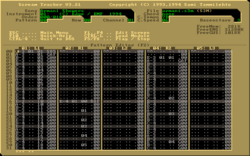
Scream Tracker
~ the eulogy ~
Scream Tracker had been finished for four years before I had a modem. That is the whole distance in this one. I came online in 1998 and what reached me was the output, not the tool: files ending in.s3m that turned up inside game directories and download packs, playing music that was clearly made on a PC by somebody who knew exactly what the hardware could do. I never opened the program. I heard it constantly without knowing that was what I was hearing.
Sami Tammilehto signed his work Psi and was one of the founders of Future Crew, the Finnish demogroup whose name is attached to most of what the PC demoscene looked like in the early nineties. He wrote Scream Tracker in C and assembly for DOS and released it as freeware. Version 1.0 got four-bit mono sound out of the PC speaker, with better output available if you happened to own a Covox Speech Thing hanging off the parallel port or an early Sound Blaster.
Version 2.2 arrived in 1990 and was the first one that spread properly. It wrote STM files. A tracker is a sequencer where the score is a grid of numbers you type into directly, columns for channels and rows for time. The samples travel inside the file, so the music plays identically on any machine that can open it. The Amiga had been doing this since 1987. The PC had the sound hardware by 1990 and no serious program to drive it.
~ the dossier ~
| Born | 1990, version 2.2, the first one that spread |
|---|---|
| Peak | the tracker that carried the scene from Amiga to PC |
| Killed | 1994, version 3.21 |
| Lifespan | about four years |
| Made by | Sami Tammilehto of Future Crew, Finland |
| Killed by | FastTracker II arriving and development simply stopping |
~ what version three could do ~
Version 3.0 replaced STM with S3M and that is the format the name survives on. It carried up to ninety-nine eight-bit samples across thirty-two channels. A hundred patterns and two hundred and fifty-six order positions sat on top of that. The channel count is less generous than it sounds, since the layout reserved sixteen of those slots for paired left and right positions and nine more for the FM bank, which left about twenty-five usable in practice.
The unusual capability was mixing the two kinds of sound. Up to nine channels could be handed to the FM synthesis chip on an OPL2 or OPL3 card while the rest played digitized samples, and both ran at once. Almost nothing else did that. If you owned a Gravis Ultrasound there was sixteen-position panning available on top. This was a program written by somebody who had read the sound cards rather than the specifications, which is the difference between a tool the scene used and a tool the scene ignored.
~ how it stopped ~
Version 3.21 went out in 1994 and was the last one. There was no announcement worth preserving and no server to switch off. FastTracker II had appeared out of another demogroup by then and took the audience, and Impulse Tracker took it from FastTracker the year after that. Tammilehto stopped working on a free DOS program while he had a demoscene and a career in front of him, which is the ordinary way this category of software dies.
~ what it left in the file format ~
The interface is the first inheritance. Impulse Tracker's author said outright that Scream Tracker 3 was what its layout came from, and anybody who has opened a tracker since is looking at a rearranged version of a 1992 DOS screen. The second inheritance is S3M itself. Impulse Tracker and OpenMPT both adopted it, and it is still a format current playback libraries are expected to handle.
That is the durable part. Games built decades after DOS stopped mattering ship module playback code that reads S3M because the libraries have always read it and nobody had a reason to remove the support. A program that stopped being updated in 1994 is still executing, in a sense, every time one of those files opens.
~ leave a rose ~
an anonymous tribute. one rose per visitor per day.
@}-->-- ... roses left here
~ leave a wreath ~
a rose fades by morning. a wreath stays on this grave for good, with your name on it.
from $1, paid once through stripe. it keeps the graveyard running: the hosting and the nightly digging. adopt it and the headstone reads "maintained in memory by" you. the groundskeeper plants new wreaths at the next tending, usually within a day.
» one email a week: new graves and the anniversaries of the dead. subscribe
other software: Microsoft Plus!, Chartio, Stormix, RealJukebox
also died in the 1990s: Zip2, DigiCash, Nixdorf Computer AG
~ leave a note ~
visitors before you have left these graveside notes. anonymous welcome.