Impulse Tracker
~ the last words ~
My modem arrived about a year before Impulse Tracker stopped. That is close enough in time to be embarrassing and far enough in every other direction to be honest: the tracker scene was a making scene, and the making end of it was never where I was. The people writing modules in 1997 mostly had a Gravis Ultrasound in the machine, and what was in Turkish machines was Sound Blaster and Sound Blaster clones.
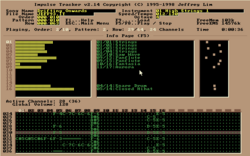
Jeffrey Lim, who signed everything as Pulse, put version 1.0 out on Christmas Day 1995. It was a DOS program written in assembly, and it was free, with a small set of paid extensions for anybody who wanted them. It arrived into a category that already had winners in FastTracker II and Scream Tracker 3, and it took the category anyway inside of about eighteen months.
A tracker is a spreadsheet that makes noise. Columns are channels and rows are ticks of time, and you type hexadecimal into the cells until the samples line up into a song. It is the least welcoming interface any creative tool has ever shipped with, and it produced an enormous amount of music, because it ran on machines that could not dream of a studio and it demanded nothing but patience.
~ the record ~
| Born | 25 December 1995, version 1.0, released as freeware |
|---|---|
| Peak | the default tracker of the late-nineties demoscene |
| Killed | 8 April 1999, version 2.14 patch 5 |
| Lifespan | three years and four months |
| Made by | Jeffrey Lim, who signed his work Pulse |
| Killed by | a leaked copy of the one part that funded it |
~ what it did that the others did not ~
The.it format was the technical argument. It carried resonant filters, so a sample could be shaped after the fact instead of only played back. It had new note actions, which decided what an already-playing note should do when the next one arrived on the same channel, and that single feature is what let a tracker module hold a reverb tail or a fading pad instead of chopping everything off at the row boundary. Sixty-four channels and ninety-nine instruments, at a mixing quality that made the older formats sound like what they were.
It also supported the Gravis Ultrasound properly, along with the AWE-class Sound Blasters, which meant the good hardware of the period had a program that knew what to do with it. The paid extensions were the practical stuff: a stereo WAV writer so you could get a finished file out, and network editing over IPX so two people on the same LAN could work on one module.
~ how it actually ended ~
The WAV writer leaked. Somebody who had paid for it put it where everybody could take it, and the scene took it. The only revenue attached to a free program written by one person in assembly stopped being revenue. Lim announced that development would end with version 2.14, and it did. Patch 5 went out on 8 April 1999 and there was never a 2.15.
It is a small and completely legible death. There was no acquisition and no company, no server to switch off and nothing to migrate. One person decided the arrangement was no longer worth his time and said so. Most of the graves on this site would be shorter if the people involved had been that direct about it.
~ the long tail ~
On 25 December 2014, the same calendar day the program had first appeared nineteen years earlier, the complete source was released under a BSD license, sound drivers and all. By then Schism Tracker had already spent years rebuilding the interface as a portable program that runs on machines Lim never targeted, and it is still the way most people open a.it file with the intention of editing it.
The format outlived everything around it. Module playback libraries built on the.it specification are quietly compiled into games that shipped decades after DOS died, and a lot of people have heard Impulse Tracker output without ever hearing the name. A file format is the most durable thing a piece of software can leave behind, and this one is still in the build.
~ leave a rose ~
an anonymous tribute. one rose per visitor per day.
@}-->-- ... roses left here
~ leave a wreath ~
a rose fades by morning. a wreath stays on this grave for good, with your name on it.
from $1, paid once through stripe. it keeps the graveyard running: the hosting and the nightly digging. adopt it and the headstone reads "maintained in memory by" you. the groundskeeper plants new wreaths at the next tending, usually within a day.
» one email a week: new graves and the anniversaries of the dead. subscribe
other software: Microsoft Math Solver, Drive.ai, TrueType core fonts for the Web, AppleWorks
also died in the 1990s: Apple Newton MessagePad, Cray Computer Corporation, Four11
~ leave a note ~
visitors before you have left these graveside notes. anonymous welcome.