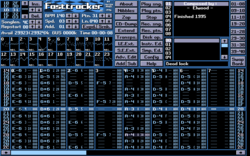
FastTracker II
~ the eulogy ~
The files got to Turkey years before the program did. What circulated on a 33.6k line in 1998 was the output,.xm and.mod files pulled out of games and demos and played back through a plugin in Winamp, small enough that a whole song cost less to download than one photograph. I never made one. Writing music into a hex grid was a scene skill, and the scene doing it was somewhere north of me.
Fredrik Huss and Magnus Högdahl were in a Swedish demogroup called Triton, winning competitions from 1992 onward. In 1993 they released FastTracker, a single 43 KB DOS executable that loaded and saved Amiga MOD files and only spoke to Sound Blaster cards. Through 1994 the musicians in the group started releasing songs in a new format called XM, with a standalone player attached, and in November 1994 the editor that made them went public as FastTracker 2.
It was written in Borland Pascal with assembler underneath, it ran natively on MS-DOS, and it borrowed its layout from the Amiga's Protracker. Pattern editor on the bottom half, instrument list and oscilloscopes on the top, with the whole lower panel switchable to a sample editor. There was a Nibbler clone hidden inside it and the full documentation shipped in the program itself, which was practical in an era when nobody expected the manual to be a website.
~ the dossier ~
| Born | November 1994, released by the demogroup Triton |
|---|---|
| Peak | the standard PC tracker of the late-nineties demoscene |
| Killed | 23 May 1999, put on hold indefinitely |
| Lifespan | four years and six months |
| Made by | Fredrik Huss and Magnus Högdahl |
| Killed by | its authors going into the games business |
~ the xm file ~
XM stood for extended module and it did two things the older formats could not. It went to thirty-two channels where the standard MOD topped out at four, and it wrapped samples into instruments with envelopes and key mapping, so one instrument could be several recordings that the tracker picked between depending on the note. Everything lived inside the file, including the audio, which meant the song played back identically on somebody else's machine without a single external dependency.
That is why the format traveled. A finished piece of music was a file you could put on a BBS or attach to a mail without thinking about it, at a size that a modem could carry in the time it took to make tea. Games shipped their soundtracks as XM because the alternative was an audio track that took the entire disc budget with it. The format's reach ended up much larger than the program's, which is usually the sign that the format was the real product.
~ how it stopped ~
Version 2.08 came out in August 1997 and it was the last stable one. A 2.09 was running as a closed beta, and in 1999 it escaped through a beta tester and turned up on a public download page. It fixed some interface annoyances and broke Gravis Ultrasound support in the process, so the leaked build was better and worse than the official one at the same time, and it was never blessed.
On 23 May 1999 Starbreeze productions put a note on its website. "FT2 has been put on hold indefinitely," it said, and then, "If this was an ideal world, where there was infinite time and no need to make a living, there would definitely be a multiplatform Fasttracker3. Unfortunately this world is nothing like that." Signed Vogue. By then Triton had become Starbreeze and Starbreeze was a games studio with payroll. A free tracker for a dying operating system did not survive that arithmetic.
~ the next chapter ~
Ruben Ramos Salvador started building the FastTracker 3 that never came, which turned into Skale Tracker and runs on Windows and Linux to this day. MilkyTracker rebuilt the interface as a portable program for machines Huss and Högdahl never targeted. Olav Sørensen was handed the original sources and has been shipping fixed builds ever since, up to version 2.13, without permission to publish the Pascal underneath them.
Starbreeze went on to make The Chronicles of Riddick and Payday, and most people who know that name have no idea it started as a tracker. The XM specification is quietly compiled into playback libraries inside games that shipped decades after DOS was retired. A program can be put on hold indefinitely and its file format can carry on regardless, which is roughly what happened here.
~ leave a rose ~
an anonymous tribute. one rose per visitor per day.
@}-->-- ... roses left here
~ leave a wreath ~
a rose fades by morning. a wreath stays on this grave for good, with your name on it.
from $1, paid once through stripe. it keeps the graveyard running: the hosting and the nightly digging. adopt it and the headstone reads "maintained in memory by" you. the groundskeeper plants new wreaths at the next tending, usually within a day.
» one email a week: new graves and the anniversaries of the dead. subscribe
other software: iBooks Author, Postbox, Yahoo! Go, Microsoft Dangerous Creatures
also died in the 1990s: ROLM, Microsoft Dangerous Creatures, Alex
~ leave a note ~
visitors before you have left these graveside notes. anonymous welcome.