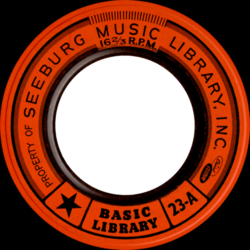
Seeburg 1000
~ the last words ~
The Seeburg 1000 played music built to be ignored. Success meant a customer walked around a hardware store for twenty minutes and left without ever registering that anything had been playing. Seeburg was not selling records to listeners. It was selling a condition to a room, on a contract, by the quarter.
The unit arrived in 1959 as the BMS1, a metal cabinet about twenty-two inches wide, and it did one job. It held a stack of up to twenty-eight nine-inch records with two-inch center holes and turned them at 16 2/3 rpm, working through them in order until somebody switched it off. There was no way to select anything and no way to skip. The name is a count rather than a model number: twenty-five records, both sides, twenty songs a side, one thousand songs before the machine came back around to where it started.
The records were never sold. Seeburg mailed a box of new ones four times a year, seven at a time after 1966, and the operator swapped them into the stack and sent the old ones back to 1510 North Dayton Street in Chicago, where they were destroyed. Each box carried the date it was to be placed in service and instructions telling the operator what to return. The arrangement was designed so that nothing was left in the customer's hands at the end of it.
Nothing like this reached a shop i ever walked into. The music in a Turkish shop was whatever the person behind the counter felt like hearing, off the radio or off a cassette they had recorded themselves, and it changed when they got bored of it. Background music as a purchased utility, licensed and shipped by post, needs an industry that sells atmosphere to businesses as a line on an invoice. That industry was American, and the argument underneath it, that a room sounds better when the sound in it was picked by somebody who is not in the room, never had to be made here.
~ the record ~
| Born | 1959, model bms1, out of chicago |
|---|---|
| Peak | the 1960s, a new box of records every three months |
| Killed | 1988, the last set, coded r-99 |
| Lifespan | twenty-nine years, the last eight under other owners |
| Made by | the seeburg corporation |
| Killed by | the cassette deck, and anything else with a play button |
~ playing the underside ~
The mechanism is the part worth keeping. A tone arm carried two needles, one pointing down and one pointing up, so each record could be played on both faces without anybody turning it over. The lower half of the spindle turned clockwise like an ordinary record player. The top half turned counterclockwise, so a record held above the arm ran the correct direction past the upward needle.
Three sets of retractable claws inside the spindle held the stack and dropped one record at a time from the upper position to the lower one, with a weighted plate riding on top so the topmost disc stayed flat while its underside was being played. Later versions changed the packaging rather than the idea. The BMC1 was a windowless grey box with no amplifier in it, and the 1963 BMS2 had chrome and a lit window so the mechanism could be watched, which is why collectors now call that one the microwave.
~ the industrial library ~
Seeburg shipped three libraries and the names tell you what each was for. Basic was mid-tempo instrumental arrangements of chart songs and standards, recorded for Seeburg rather than licensed from the originals, and Mood was the same idea slowed down and pushed toward strings. The third one was called Industrial, and it existed to raise the output of a factory floor.
The Industrial discs are the strangest listening in this whole file. Polkas sitting next to twangy guitar, all of it brisk, none of it chosen because anybody liked it. In 1979 the libraries were renamed and Industrial became Upbeat, which is a marketing department arriving twenty years late to a product that had already said the quiet part on the label. Every December the whole stack came out and went back in again: a set of twenty-five Christmas records installed on the first and pulled on the twenty-sixth, which in a city the size of New York meant the entire service force plus the office staff spent two days doing nothing else.
~ returned and destroyed ~
Seeburg went into bankruptcy in 1979 and the court closed the phonograph division that September. The company was broken up the following year and the jukebox tooling went to Stern Electronics. The record service carried on anyway, because a subscription with machines already bolted into thousands of rooms is worth more running than stopped.
Quarterly boxes held until the end of 1980 and then thinned to roughly one a year. The libraries collapsed into a single one called Rainbow, issued under the Music Theater Network label out of Newton, Massachusetts. The last set went out in 1988 carrying the code R-99. Nobody announced it, and by then a shop that wanted music could buy a cassette deck and be done.
The destroy-on-return policy worked well enough that a format with millions of pressings is now scarce, and what survives is mostly what some operator failed to send back. A site at seeburg1000.com streams the surviving library around the clock. The music is doing exactly what it was built to do, in rooms the company never got to bill.
~ leave a rose ~
an anonymous tribute. one rose per visitor per day.
@}-->-- ... roses left here
~ leave a wreath ~
a rose fades by morning. a wreath stays on this grave for good, with your name on it.
from $1, paid once through stripe. it keeps the graveyard running: the hosting and the nightly digging. adopt it and the headstone reads "maintained in memory by" you. the groundskeeper plants new wreaths at the next tending, usually within a day.
» one email a week: new graves and the anniversaries of the dead. subscribe
other media formats: ffdshow, Betamax, Open eBook, Video CD
also died in the 1980s: Fujitsu FM-7, Muse Software, Datasoft
~ leave a note ~
visitors before you have left these graveside notes. anonymous welcome.