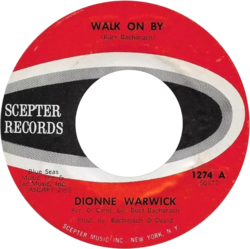
Scepter Records
~ the eulogy ~
Florence Greenberg was 43 in 1956, married to an accountant, living in Passaic and bored. She got into the record business through a friend of her husband's and started a label called Tiara in 1958. Her daughter Mary Jane dragged her to hear a group of Passaic High School girls who had sung at a talent show. They auditioned in the Greenberg living room, and the song they had performed became Tiara 6112. Just as it started to sell locally, Greenberg sold the label and the group's contract to Decca for four thousand dollars. Decca did nothing with them and handed them back the following year. She founded Scepter with the four thousand and signed them again.
What followed was seventeen years of a company that had no business existing. "Will You Love Me Tomorrow" went to number one at the start of 1961, the first time a Black girl group had topped the Hot 100. Luther Dixon came in to run production and publishing and gave the Shirelles their sound until he left for Capitol in 1963. Wand was launched as a sister label in early 1961, opened with Chuck Jackson and put out the Isley Brothers' "Twist and Shout" the year after. In 1963 Greenberg bought a Pacific Northwest record called "Louie Louie" off a Seattle producer, and it outsold everything else either label ever released. Dionne Warwick arrived in 1962 and stayed nine years. B.J. Thomas took "Raindrops Keep Fallin' on My Head" to four weeks at number one in January 1970.
Greenberg described herself as a white woman in a Black business who could not carry a tune, which was her way of explaining why she hired well and then stayed out of the studio. Her son Stan, who was blind, worked as an arranger at the label from early on and stayed until the bankruptcy. In 1965 she turned down six million dollars for the company from Gulf+Western and spent the rest of her life saying she should have taken it.
The slide is visible in the paperwork rather than the records. Springboard International bought portions of the Scepter catalog in 1974. By the spring of 1976 the label had stopped operating, although the trade directories kept printing its address. The last Scepter single was Jesse Green's "Nice and Slow", which was on the disco chart that September, by which point the company that released it had been dormant for months.
~ the dossier ~
| Born | 1959, on the $4,000 Decca paid for Tiara Records |
|---|---|
| Peak | Will You Love Me Tomorrow at number one, the first by a Black girl group |
| Killed | 28 September 1976, by voluntary bankruptcy petition |
| Lifespan | 17 years |
| Made by | Florence Greenberg, of Passaic, New Jersey |
| Killed by | over $2 million of debt, the largest piece of it owed to the Harry Fox Agency |
~ the petition ~
On 28 September 1976 Scepter Records filed a voluntary bankruptcy petition in federal court in New York. The filing named more than seven hundred creditors and reported debts above two million dollars. The single largest was the Harry Fox Agency at $713,081.59. Harry Fox collects mechanical royalties on behalf of music publishers, so the biggest unpaid bill the company left behind was the one owed to songwriters.
Two months later an arbitration panel handed Dionne Warwick's 1962 to 1972 masters back to Burt Bacharach and Hal David and awarded their production company $430,602.29. Scepter did not send anyone to the hearing. The reasoning is printed on the records themselves: the Scepter 1274 label for "Walk on By" credits the arrangement and conducting to Bacharach and the production to Bacharach and David, so the recordings had been made by an outside company all along and Scepter had only been the distributor of them. The remaining catalog sat inside Springboard until Springboard itself collapsed, and it ended up in Nashville with Gusto Records, where most of it still is.
~ the trust ~
The Shirelles had been told their royalties were going into a trust they would receive at 21. In 1963 they found out there was no trust. They sued for breach of contract and Scepter countersued them for leaving. Both actions were withdrawn in 1965 under an agreement whose terms were never published. Shirley Owens' own account is that Greenberg maintained she had done nothing wrong and talked them into dropping it.
They were still signed to Scepter throughout, which meant they could not record anywhere else while suing the only label allowed to record them. The group's chart career had effectively ended by 1964 anyway. Greenberg died in November 1995 at 82, and in 2011 a Broadway musical about her opened and closed inside the same year, with Beverly Lee of the Shirelles and Dionne Warwick suing over the use of their names in it.
~ 254 west 54th ~
In 1965 Scepter moved into a building on West 54th Street with warehouse space and a studio in it. In April 1966 Andy Warhol booked that studio, and most of The Velvet Underground & Nico was cut there by an engineer named John Lakata. The room had been paid for by girl-group singles and was being used by a band whose album would sell almost nothing when it came out the following year.
The building outlived the company. It opened as Studio 54 in 1977, a year after the petition, and everything anybody outside America knows about that address dates from after the record company inside it had gone bankrupt. Plenty of people who can place Studio 54 on a map have never heard the word Scepter, and that includes me until I went looking for who had owned the room first.
~ leave a rose ~
an anonymous tribute. one rose per visitor per day.
@}-->-- ... roses left here
~ leave a wreath ~
a rose fades by morning. a wreath stays on this grave for good, with your name on it.
paid once through stripe. payments are handled by OÜ Lakeview, the small company that keeps rip.so running. the money pays for the hosting and the nightly digging. adopt it and the headstone reads "maintained in memory by" you. the groundskeeper plants new wreaths at the next tending, usually within a day.
» one email a week: new graves and the anniversaries of the dead. subscribe
other media music: PolyGram, picosong, Cold Chillin' Records, Roc-A-Fella Records
also died in the pre-1980s: News Chronicle, Liberty Broadcasting System, Electrologica
~ leave a note ~
visitors before you have left these graveside notes. anonymous welcome.