Saturday Night
» see saturdaynight.ca as it lived, on the wayback machine
~ the last words ~
Canadian general interest magazines did not travel. In the years I was buying magazines in Turkey, the imported rack at a big Ankara bookshop ran to the American and British titles that had international editions, and a Toronto weekly that had been publishing since the 1880s was not among them. Saturday Night is a name I met through its contributors long before I met the magazine, because the people it published went on to be read everywhere else.
It started in Toronto in 1887 as a Saturday broadsheet about public affairs and the arts, with a circulation of ten thousand. The name came out of two legal constraints. Edmund E. Sheppard, the founding editor, had been barred from editing a daily newspaper after a libel action tied to an incident involving Louis Riel, and the Lord's Day Act stopped anyone publishing in Toronto on a Sunday. A Saturday weekly was what was left, so a Saturday weekly is what he made, and the title stuck for the next 118 years through every change of format the magazine went through.
The honor roll is the reason it matters. Robertson Davies was the literary editor in the 1940s. Robert Fulford edited it from 1968 to 1987 and used it for long political reporting, much of it by Christina McCall, alongside an arts and literary section that gave Margaret Atwood and Dennis Lee their first national exposure. Peter Gzowski and Mordecai Richler wrote for it. Yousuf Karsh's photographs ran in it. In a country whose publishing industry has always lived in the shadow of a larger one next door, this was the magazine that proved Canadian writers could be read at length by Canadians.
It was also broke across most of its life. It shrank from broadsheet to magazine size in 1949, went from weekly to fortnightly in 1954, was sold for one dollar to a non-profit foundation in 1971, and stopped dead for six months in 1974 until a group led by the developer Murray Frum rescued it with a hundred thousand dollar grant from Imperial Oil. Conrad Black's Hollinger bought it in 1987 and lost money on it every year, including the late 1990s when other Canadian magazines were doing well. St. Joseph Media announced the suspension on 20 October 2005, citing insufficient advertiser support. Issue 3916 came out that November and is still the last one.
~ the record ~
| Born | 1887 in Toronto, as a Saturday broadsheet weekly |
|---|---|
| Peak | Circulation around 90,000 in the 1960s under Arnold Edinborough |
| Killed | November 2005, announced 20 October |
| Lifespan | 118 years |
| Made by | Edmund E. Sheppard, then roughly a dozen owners after him |
| Killed by | Advertisers who would not fund a general interest magazine |
~ the Churchill cover ~
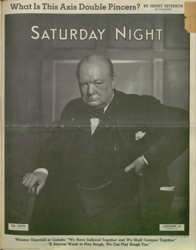
The single most valuable thing Saturday Night ever printed was on the front of the issue dated 10 January 1942, volume 57 number 14, price ten cents. Winston Churchill had addressed the Canadian Parliament on 30 December 1941 and Yousuf Karsh had photographed him immediately afterward in the Speaker's Chamber, a session that produced the scowling portrait now known as The Roaring Lion. Eleven days later a Karsh frame from that sitting filled the cover of a Toronto weekly, credited in small type down the right-hand edge to Karsh of Ottawa.
The cover lines underneath are two sentences from the speech: "We have suffered together and we shall conquer together" and "If anyone wants to play rough, we can play rough too." Running across the top, in larger type than the magazine's own masthead, is a headline asking "What Is This Axis Double Pincers?" by Henry Peterson, see page seven. That is the whole proposition of a general interest weekly in one layout: the most famous photograph ever taken in Canada, sitting underneath a war explainer, for ten cents.
~ the owners ~
The ownership list is almost comic in length and it explains the rest. Jack Kent Cooke bought the parent company in 1952 and tried to turn the magazine into a Canadian Time, which cost it the cultural identity it had. In 1961 he sold it to Percy Bishop, an oil and mining man who backed the Alberta Social Credit League, and the following year Bishop merged it with his own political magazine. The editor-in-chief Arnold Edinborough resigned along with six members of the editorial board. Bishop's renamed Canadian Saturday Night folded after three issues.
Edinborough then bought the title back in 1963 with a hundred thousand dollars of his own money and help from Robertson Davies's family, and ran the circulation up to ninety thousand. That is the pattern for the next forty years: the magazine fails commercially, somebody who cares about Canadian letters buys it out of the wreckage, it recovers editorially, and the economics do not change. Norman Webster bought it in 1979, Black in 1987, MultiVision in 2002, St. Joseph after that.
~ the last stop ~
The final decade is the most confusing part of the record. The last standalone monthly issue was March 2000 under editor Paul Tough. Two months later it came back as a large-format weekend magazine distributed inside Black's National Post, weekly, edited by Dianna Symonds with Leanne Shapton as art director, and that version ran until 22 September 2001 when CanWest cut it in a round of National Post reductions. MultiVision Publishing bought the name, and from April 2002 it was a newsstand magazine again, first bimonthly and then ten times a year.
That last incarnation died in November 2005 with Gary Ross as editor. There was one more twitch: on 18 December 2008 the website came back as a blog, promising to canvass the country on politics, crime, culture and design. Several posts went up that day and then nothing, for eighteen years. The domain now sits in a registrar's auction listing.
~ leave a rose ~
an anonymous tribute. one rose per visitor per day.
@}-->-- ... roses left here
~ leave a wreath ~
a rose fades by morning. a wreath stays on this grave for good, with your name on it.
paid once through stripe. payments are handled by OÜ Lakeview, the small company that keeps rip.so running. the money pays for the hosting and the nightly digging. adopt it and the headstone reads "maintained in memory by" you. the groundskeeper plants new wreaths at the next tending, usually within a day.
» one email a week: new graves and the anniversaries of the dead. subscribe
other news: Brill's Content, RIA FAN, Electric Word, Berliner Illustrirte Zeitung
also died in the 2000s: Brill's Content, Palm OS, ipchains
~ leave a note ~
visitors before you have left these graveside notes. anonymous welcome.