Radio Oranje
~ the obit ~
The Netherlands fell in May 1940 and the government went to London, and within weeks the Dutch correspondents in Paris had put something on the air from there instead. Radio Vrij Nederland ran three times a day for fifty minutes in total, out of a cellar belonging to the French telephone service, with copy built from a monitoring desk that listened to Berlin and to occupied Hilversum. It lasted from 19 May to 10 June 1940 and stopped when German troops reached Paris. Several of the people in that cellar turned up in London shortly afterward.
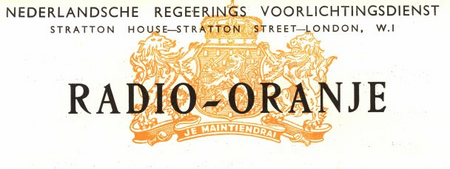
Radio Oranje went out for the first time on 28 July 1940. The BBC already ran a Dutch Service of its own, but that was news and it belonged to the BBC; this was a quarter of an hour that belonged to the Dutch government, arranged after Adriaan Pelt of the government information service went to the BBC and asked. Its own letterhead put it at Stratton House on Stratton Street in London W.1, under the Netherlands Government Information Service and the royal motto, Je maintiendrai. The first broadcast opened with a seventeenth-century war song and then Queen Wilhelmina spoke. She would speak thirty-four times before the end, and the program called itself the voice of a fighting Netherlands.
In practice it was the voice of a committee. Every script was vetted by the British authorities and again by the Dutch council of ministers in exile, and the result was formal to the point of stiffness. The word the Dutch actually used for Germans, moffen, was not allowed on it. There was a separate London station for Dutch sailors and merchant seamen, De Brandaris, named after the lighthouse on Terschelling, and because its texts went through less censorship it was for a while the more popular of the two. The prime minister merged them in October 1942. Most of Radio Oranje's own staff walked out over it, the former Brandaris people set the tone afterward, and of the original crew only the historian Loe de Jong was still there at the end of the war.
What it did best was small and practical. Coded sentences went out for the resistance, lines like a message from Bob to Jan telling him to stay where he was. People living near Wehrmacht and security service barracks were warned that the RAF was coming. In June 1942 listeners were told not to buy Jewish property at auction, on the grounds that it would have to be handed back after the liberation and that buying it counted as receiving stolen goods. Wilhelmina said in October 1942 that she shared her countrymen's outrage and grief at the fate of their Jewish compatriots, and the standing criticism of her, and of the prime minister, is that this needed saying more often and harder than either of them managed.
~ the rap sheet ~
| Born | 28 July 1940, opening with a seventeenth-century war song and a speech by the queen |
|---|---|
| Peak | every evening from 20.15 to 20.30 Dutch time, with Wilhelmina speaking 34 times in all |
| Killed | 2 June 1945 |
| Lifespan | 4 years, 10 months |
| Made by | the Dutch government in exile, through its information service in London |
| Killed by | the liberation, and a successor already on air from Eindhoven |
~ the receiver problem ~
The signal went out on long wave at 1500 meters, with three medium-wave wavelengths and three shortwave bands behind it. German jammers sat on most of that, so in much of the country the broadcast was only really listenable on shortwave, and shortwave reception had only started arriving in consumer radios around 1935. That put it in roughly a quarter of Dutch sets. Radio amateurs and people already in the resistance tended to have had the capability longer, which is a neat accidental filter on who the audience was.
The workarounds are the part I can actually read without needing to have been there. People used a filter they called a moffenzeef, a German sieve, to strip the jamming tone out. Others built a crystal set with the right coil, which gave clean reception on headphones and needed no mains power at all, which mattered a great deal in a country where the occupier had banned listening to English stations and later ordered every receiver handed in. Plenty of people kept theirs and hid them. I have no inherited memory of this war or this country, but a passive receiver with no power supply, chosen because it cannot be heard through a wall and cannot be cut off at the meter, is a solution I recognize on sight.
~ the handover that never quite happened ~
Eindhoven was liberated on 18 September 1944, and by 3 October there was a Dutch station broadcasting from inside the country. Radio Herrijzend Nederland went out on 420 meters using a transmitter that had been built in secret at the Philips research laboratory by an engineer named Cor Gehrels, under the military authority's Section XI. Its first announcer was H. J. van den Broek, who was the head of Radio Oranje. The founding was announced over Radio Oranje itself that October.
So for eight months there were two of them, one in a liberated city putting out nine hours a day across three blocks and one still coming out of London for a quarter of an hour each evening. The London one carried on until 2 June 1945, nearly a month after the capitulation. English Wikipedia files the whole station as having ended in 1944, which is the start date of its successor rather than its own ending, and gives no closing date anywhere in the text. Radio Herrijzend Nederland ran on to 19 January 1946, and Van den Broek, who had wanted a single national broadcaster, watched the old prewar broadcasting associations resume from Hilversum instead.
~ what the country remembered ~
In 2009 the historian Onno Sinke published a doctoral study of Radio Oranje and reached a conclusion the Netherlands had not been expecting. The station had barely encouraged actual resistance and was not decisive for it. More than three quarters of Dutch people said after the war that they had listened; the real figure was considerably lower. The broadcast had been less heard than the country believed it had been.
That gap is the most interesting thing about it. A cautious, double-censored quarter of an hour, audible mainly to people who happened to own the right radio, turned afterward into a thing almost everybody remembered being part of. The signal was weak and the memory of the signal was enormous, and for a country that spent five years being told very little it could trust, the second one was probably doing more work than the first.
~ leave a rose ~
an anonymous tribute. one rose per visitor per day.
@}-->-- ... roses left here
~ leave a wreath ~
a rose fades by morning. a wreath stays on this grave for good, with your name on it.
paid once through stripe. payments are handled by OÜ Lakeview, the small company that keeps rip.so running. the money pays for the hosting and the nightly digging. adopt it and the headstone reads "maintained in memory by" you. the groundskeeper plants new wreaths at the next tending, usually within a day.
» one email a week: new graves and the anniversaries of the dead. subscribe
other phenomena: Will It Blend?, The Vault of Horror, Fire!!, Shutdownify
also died in the pre-1980s: The Vault of Horror, Fire!!, Atlas/Seaboard Comics
~ leave a note ~
visitors before you have left these graveside notes. anonymous welcome.