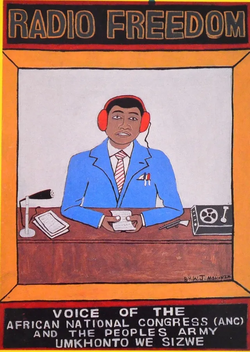
Radio Freedom
~ the obit ~
The first transmission went out in June 1963 from Liliesleaf, the farmhouse at Rivonia north of Johannesburg where the high command of the ANC's armed wing was working. It lasted a quarter of an hour. Walter Sisulu did the announcing and Denis Goldberg built the transmitter. "I speak to you from somewhere in South Africa," Sisulu said. "I have not left the country. I do not plan to leave." Then the line everybody quotes: "Never has the country, and our people, needed leadership as they do now, in this hour of crisis. Our house is on fire." Ahmed Kathrada was among the other voices.
The police raided Liliesleaf within a fortnight and took most of the leadership with it. That raid produced the Rivonia Trial, and the Rivonia Trial produced the life sentences that put Nelson Mandela on Robben Island. Recordings of those first broadcasts were entered as evidence. It took six years for the station to get back on the air, and when it did it was in someone else's country, piggybacked onto the external service of Radio Tanzania in 1969 with fifteen minutes to fill.
The airtime spread as African governments offered it. Zambia came in the early 1970s and became the main operation, broadcasting on 7.3 megahertz in the 41-meter band, daily, over sixteen hundred kilometers. Angola followed in June 1977, Madagascar in 1979, and Ethiopia and Zimbabwe in 1981. Radio Freedom never owned a transmitter in its life. It owned one studio outside Lusaka, at Makeni, and it handed finished tapes to whichever state broadcaster was willing to put them out.
~ the rap sheet ~
| Born | June 1963, from the Liliesleaf farmhouse at Rivonia, north of Johannesburg |
|---|---|
| Peak | the 1980s, carried by six host broadcasters at once on about 50 kilowatts |
| Killed | August 1991 |
| Lifespan | 28 years, with a six-year silence after the first broadcast |
| Made by | the African National Congress and its armed wing, Umkhonto we Sizwe |
| Killed by | the end of apartheid, which sent its broadcasters home |
~ eight years for listening ~
Every account of this station, including those by the people who made it, says that listening to it carried up to eight years in prison. The figure is worth repeating and worth checking, because it does not appear in the statute. The Internal Security Act of 1982 and the Suppression of Communism Act before it both top out at ten years for furthering the aims of a banned organization, and neither contains the words "eight years" anywhere. Possessing a recording of a banned person's voice was a separate offense carrying three. The eight may have been one real sentence that got generalized into a rule. What is not in doubt is that the state treated a radio signal as a weapon.
It treated it that way at the hardware level, which is the part that deserves more attention than the jamming does. Albert Hertzog, as Minister of Posts and Telegraphs, argued for building out South Africa's domestic radio on FM rather than shortwave on explicitly stated grounds: giving a listener a radio put a weapon in his hands, and ultra-shortwaves travel in straight lines, so a set built for FM could not be influenced from overseas. The receiver base was rebuilt so that the thing Radio Freedom used would be unfamiliar to the people it was aimed at.
On top of that came conventional jamming, done by switching on a more powerful transmitter on the same frequency and cancelling the weaker one out. A Zambian engineer described running a shift and being told hours in, by the transmission controller, that he had been talking to himself the whole time. They would announce a new frequency on air and ask people to retune. The station ran at around fifty kilowatts against the South African Broadcasting Corporation's five hundred, and its own director said plainly that there was nothing they could do about it.
~ nought point three percent ~
Every identification opened the same way: the crackle of an AK-47 over "Hamba Kahle Mkhonto we Sizwe", the song for the dead of the Spear of the Nation, then the calls Amandla and Mayibuye, then a voice announcing Radio Freedom as the voice of the African National Congress and of Umkhonto we Sizwe. Zinjiva Winston Nkondo read it. An engineer alone in a transmission booth in Lusaka remembered answering the Amandla out loud, to nobody, from his chair. Murphy Morobe, a student leader in Soweto, said the jamming never managed to take that opening out, and that hearing it through the static was sufficient on its own; they did not need the rest of the program.
A BBC audience survey in 1989 put regular listenership to Radio Freedom among black South Africans at nought point three percent. Just over half owned a set that could receive shortwave at all, and only eleven percent had heard any foreign station in the previous year. Thami Nteteni, the director, conceded in an interview that the station had not had as much impact inside the country as it would have liked. The numbers are also close to meaningless, because tuning in was a criminal offense and nobody being surveyed had a reason to admit it.
What is measurable is the secondary circulation. Tapes went in with taxi drivers. Tambo's address to the nation every 8 January was recorded off the air and passed hand to hand. A Los Angeles Times reporter in 1986 found a Soweto man who called himself a human microphone, listening at night and shouting the contents at the other passengers on the morning train into Johannesburg, because they had started asking him to. Letters back were almost nonexistent: the producer who ran the listeners' program in Lusaka got two or three a month, and the rest were intercepted.
~ switched off in the netherlands ~
Exile was neither comfortable nor safe. Zambia's economy went down with the copper price in the 1970s, food was rationed, and for a while the ANC in Lusaka had one car, a worn-out 1932 Fiat. South African jets bombed a refugee camp near Lusaka in 1986, killed two people and missed an ANC building by very little. Commandos killed five at an ANC camp in southern Zambia the following year, and a car bomb killed an ANC member in Lusaka in 1988. The Dutch organizer Conny Braam wrote that you were "afraid of raids, afraid of strangers, afraid of everything."
The Netherlands is also where it finished, which almost nothing about the preceding twenty-eight years would lead you to expect. A Dutch solidarity body called Omroep voor Radio Freedom had been supplying the station with equipment for years, and in August 1991 it convened a conference at Doorn on what South African broadcasting should look like after apartheid. Thami Nteteni went on Tambo's instruction and announced there, without ceremony, that the station had ceased operations. The transmitters were switched off. Mandela had been out of prison for eighteen months and the broadcasters were going home.
Nothing was transferred. Two years after the exiles returned, not one Radio Freedom broadcaster had a job at the SABC, though three had found work at a commercial station and one at a magazine. Solly Mokoetle, who had run the Luanda and Madagascar and Addis Ababa units, joined the SABC in 1993 and eventually became its group chief executive. The recordings are split between the Mayibuye archive at the University of the Western Cape, which holds hundreds of reels along with the vinyl that was played on air, and Fort Hare, which holds the scripts. The Zambian side is gone: researchers who visited the national broadcaster's archive in 2020 found the roof had leaked onto it. What survives does so because the ANC made a habit of collecting its own tapes back every morning.
~ leave a rose ~
an anonymous tribute. one rose per visitor per day.
@}-->-- ... roses left here
~ leave a wreath ~
a rose fades by morning. a wreath stays on this grave for good, with your name on it.
paid once through stripe. payments are handled by OÜ Lakeview, the small company that keeps rip.so running. the money pays for the hosting and the nightly digging. adopt it and the headstone reads "maintained in memory by" you. the groundskeeper plants new wreaths at the next tending, usually within a day.
» one email a week: new graves and the anniversaries of the dead. subscribe
other news: Russiangate, Scribner's Magazine, ORACLE, News Chronicle
also died in the 1990s: anon.penet.fi, GameTek, Canon FD Lens Mount
~ leave a note ~
visitors before you have left these graveside notes. anonymous welcome.