Quotron
» see quotron.com as it lived, on the wayback machine
~ the obit ~
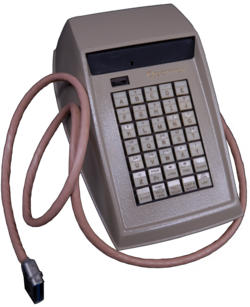
Before 1960 a broker who wanted a price read it off ticker tape as it came out of the machine, or asked somebody who had been watching. Jack Scantlin's company, Scantlin Electronics of Los Angeles, installed the first Quotron systems that year: a magnetic tape unit that sat in the brokerage recording the ticker line as it arrived, and desk units with a keyboard and a small printer. You typed the symbol, the tape searched backward for the last time that stock had traded, and the answer printed out. Around 800 of them went in over the next two years.
Competition arrived quickly and in late 1962 the company answered with Quotron II, which moved the work off the tape and into a machine room in New York running four Control Data 160A processors. That system is documented in the IEEE Annals as one of the earliest multiprogrammed multiprocessors put to commercial work, and it turned a price lookup into something that came back in roughly fifteen seconds. For the next twenty years the Quotron was simply what a trading desk had on it.
The peak was 1986 and it is a clean number: a hundred thousand terminals rented out, about sixty percent of the whole market for financial data. That was the year Citicorp bought the company for $630 million, which was a bank buying the pipe that carried the prices rather than a technology firm buying a technology firm.
It lost money for Citicorp every year that followed. The terminal was proprietary and Quotron was slow to move the service onto the personal computers appearing on the same desks, so the big brokerage contracts started going to Automatic Data Processing and to Thomson's ILX, both of which would run on a PC. Bloomberg took the high end. Citicorp took a $179 million charge in the last quarter of 1993, mostly for Quotron, and sold the whole thing to Reuters in April 1994 for $12.8 million plus about $80 million to cover the operating losses. The technology carried on inside Reuters Plus for a while. The name did not.
~ the rap sheet ~
| Born | 1960, Scantlin Electronics, Los Angeles |
|---|---|
| Peak | 100,000 terminals rented in 1986, about 60 percent of the financial data market |
| Killed | April 1994 |
| Lifespan | 34 years |
| Made by | Jack Scantlin |
| Killed by | Bloomberg, and a refusal to become software |
~ the tape and the desk unit ~
The first Quotron is a good example of solving a problem with the cheapest thing that works. There was no way in 1960 to give a thousand brokerages their own computer, so Scantlin gave each one a tape recorder that never stopped recording, and the "computer" was a search backward through what had already gone past. The intelligence was in the indexing, not in any processor.
It also explains the shape of everything that followed. Once a broker could ask a machine a question and get an answer in seconds, the ticker as a physical object was finished, and the argument moved to how fast and how many fields. That argument is still running. The screen on a trading desk today is a direct descendant of a desk unit in a Los Angeles brokerage that printed one line at a time onto a paper roll.
~ the $630 million mistake ~
Citicorp did not buy a bad business in 1986. It bought a very good one at the exact top, then held it through the transition it was worst equipped to survive. A bank is not the owner you want when your product needs to be rebuilt as software, because the instinct of a bank with a losing asset is to manage the decline rather than to spend into it.
The $12.8 million Reuters paid in 1994 is not really a price, it is a measurement of how much value burned in eight years. Add the $80 million for the losses and Reuters still got a hundred thousand installed customer relationships for a fraction of what one year of the decline had cost Citicorp.
~ what got buried with it ~
Where I grew up this machine was never in the room. It was office furniture in a building nobody had a reason to walk into, and that is a different kind of distance from the geographic sort, because the Quotron was rare even in America outside of one profession. In Turkey through the nineties the prices a normal person could actually see came off the teletext pages on the television, a few numbers a page, refreshing when they felt like it, or out of the newspaper the following morning.
So the thing Quotron invented reached me anyway, just stripped of the terminal and the rental contract. A price on a screen, delayed, taken as authoritative. The company that first made that possible spent its last eight years owned by a bank, and was worth less at the end than a mid-size Manhattan apartment.
~ leave a rose ~
an anonymous tribute. one rose per visitor per day.
@}-->-- ... roses left here
~ leave a wreath ~
a rose fades by morning. a wreath stays on this grave for good, with your name on it.
from $1, paid once through stripe. it keeps the graveyard running: the hosting and the nightly digging. adopt it and the headstone reads "maintained in memory by" you. the groundskeeper plants new wreaths at the next tending, usually within a day.
» one email a week: new graves and the anniversaries of the dead. subscribe
other online services: Snaptalent, Xiu.com, BTC-e, Mondex
also died in the 1990s: Cleveland Free-Net, Multiplan, TEN (Total Entertainment Network)
~ leave a note ~
visitors before you have left these graveside notes. anonymous welcome.