Cleveland Free-Net
~ the eulogy ~
This thing was still running when I got my first modem, which I did not know at the time and find slightly unsettling now. My 1998 was a dial tone in Turkey and an ISP I paid, on a local call that was itself metered by the minute. Cleveland's 1998 was a university handing out accounts to anybody in the county who had a computer, for nothing, because the call to reach it did not cost the caller anything either. that arrangement had no version that could exist where I was, and it was already dying where it did exist.
It began as a hospital, sort of. In 1984 Tom Grundner, an assistant professor in family medicine at Case Western Reserve University, put up a small bulletin board called St. Silicon's Hospital and Information Dispensary, where members of the public could type in a medical question and a real doctor would answer it. anyway, that worked far better than a side project should, and the obvious next question was what else a city might want to ask.
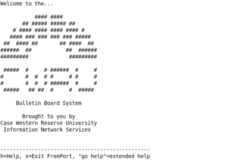
The Cleveland Free-Net opened in July 1986 as the answer, and it is generally counted as the first free public community computer system anywhere. There was no subscription. you dialed in, you got an account, and you were limited to an hour per login because the lines were always full. by 1988 there were a thousand registered users, and after the 1989 upgrade that added internet access and let thirty-four people on at once, that number went past ten thousand within months.
By June 1995 it had over 160,000 registered users, on hardware and phone lines paid for by the university with help from Ohio Bell and AT&T. Then commercial dial-up arrived, and the thing that had been remarkable because it was free became ordinary because everything was cheap. CWRU closed it on 30 September 1999, citing the cost of the upgrades it needed and the work to make it survive the year 2000.
~ the dossier ~
| Born | July 1986, at Case Western Reserve University |
|---|---|
| Peak | over 160,000 registered users by June 1995 |
| Killed | 30 September 1999 |
| Lifespan | thirteen years |
| Made by | Tom Grundner, with Case Western Reserve University paying for it |
| Killed by | cheap commercial dial-up, plus a Y2K bill nobody wanted |
~ the city ~
The word to sit with here is public. Not free as in a trial, and not free as in advertising-supported. this was a piece of municipal infrastructure that happened to be made of modems, run by a university on the theory that a city ought to have one, the way it ought to have a library.
That theory produced a specific texture. The content was local: county services and school boards, a doctor answering a question, neighbors arguing with neighbors who lived eleven miles away. for whatever reason we now find it hard to remember that going online once meant reaching your own town first and the rest of the world second, if at all. Cleveland Free-Net was that inversion running at full size for over a decade.
~ how it spread ~
Grundner founded the National Public Telecomputing Network in 1989 to franchise the idea, and free-nets duly appeared in dozens of other cities and a few other countries. The model was always fragile in the same place: somebody local had to keep paying, and the whole value proposition was that nobody paid.
NPTN filed for bankruptcy and folded around 1996, which is three years before Cleveland itself went. still, the sequence tells you the disease was not local. once an ISP account cost twenty dollars a month and came with the whole web instead of one city's menus, the volunteer network had nothing left to be except a charity for people who could not afford twenty dollars, and that is a much harder thing to raise money for.
~ the day it died ~
The notice CWRU put out was gentle and completely brutal: the Cleveland Free-Net, a remarkable achievement for its time, has been made obsolete by new technologies. Hard to argue. also hard to read, given that the new technologies did not replace what it actually was. they replaced the part that was easy to replace, which was access.
A nonprofit tried to carry the name forward afterward, and today the domain that group used serves whatever a squatter puts on a page, so there is nothing left to visit. what the free-net movement was really doing has no successor and never got one: the internet arrived everywhere else, including where I was, already global, already commercial, with the local layer skipped entirely. Cleveland had it for thirteen years and then joined the rest of us.
~ leave a rose ~
an anonymous tribute. one rose per visitor per day.
@}-->-- ... roses left here
~ leave a wreath ~
a rose fades by morning. a wreath stays on this grave for good, with your name on it.
from $1, paid once through stripe. it keeps the graveyard running: the hosting and the nightly digging. adopt it and the headstone reads "maintained in memory by" you. the groundskeeper plants new wreaths at the next tending, usually within a day.
» one email a week: new graves and the anniversaries of the dead. subscribe
other community: Coco.gg, Lulu Poetry, Penny Arcade Forums, Mobile My Life
also died in the 1990s: Multiplan, TEN (Total Entertainment Network), Quotron
~ leave a note ~
visitors before you have left these graveside notes. anonymous welcome.