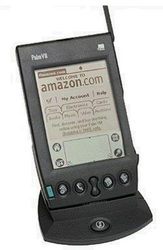
Palm.net
» see palm.net as it lived, on the wayback machine
~ the goodbye ~
Palm.net was American at the carrier layer, which is a harder border than language. It rode on Mobitex, a packet radio network that existed in the United States in a form an ordinary person could buy and did not exist here in any such form. When wireless internet finally reached Turkey it came over GSM as WAP, slower and uglier, and mostly in the service of ringtones. A device with its own aerial, its own monthly bill and no telephone inside it was never going to be sold to me.
The Palm VII went on sale in May 1999 at five hundred and ninety nine dollars. It was the first standalone handheld you could take out of the box and put on the internet without a cable or a second device. You flipped the aerial up from behind the case and the radio woke up with it. Palm.net was what you were connected to, at nine ninety nine a month for fifty kilobytes.
Fifty kilobytes is around a hundred and fifty screens of text on a Palm display. Bigger tiers ran up to about forty dollars for six times that. Everybody who used one describes the same behavior, which is checking the meter, deciding whether a piece of information was worth the money, and mostly deciding it was not. This is the only consumer internet product i can think of where the honest description of the experience is rationing.
~ the chronicle ~
| Born | may 1999, alongside the $599 Palm VII |
|---|---|
| Peak | three handhelds on one network, from the Palm VII to the i705 |
| Killed | 31 august 2004 |
| Lifespan | five years |
| Made by | Palm, riding on the Mobitex packet radio network |
| Killed by | the phone, including Palm's own Treo |
~ what came down the aerial ~
You did not browse. Browsing at eight kilobits a second against a screen a hundred and sixty pixels wide would have been a joke, and Palm knew it. Instead you installed small applications called Palm Query Applications, each one a stub for a single service, and the stub sent a compressed query rather than a page request.
A proxy in Palm's data center did the actual work. It fetched the real page and threw away everything the handheld could not use, then sent back only the fields you had asked for. Weather for one city, or a stock quote, or ten search results with nothing around them. It worked because it barely moved any data at all, and the same architecture came back years later in Opera Mini and in every lightweight mobile product that has ever put a server between the phone and the page.
~ the last handhelds ~
The Palm VIIx followed in 2000 with more memory and better coverage. The i705 arrived in January 2002 with the flip-up aerial replaced by an internal antenna and with push email that turned up without being asked for. It also moved to a flat monthly rate, so the kilobyte counter finally stopped being the main feature of ownership.
It was already too late. BlackBerry had the corporate email argument won, and Palm's own Treo put a phone and a handheld in one shell, which made a data-only device with a separate bill difficult to justify to anyone. By 2003 the company was selling the answer to its own question.
~ the day it switched off ~
Subscribers got a letter in the summer of 2004 telling them the service would close and would not be available after 31 August. There was a hundred dollar discount toward a Treo 600 for anyone still paying. That was the whole of the compensation.
The cruel detail is in the hardware. The wireless side of a Palm VII was built for one network and could not be pointed at another, so there was no migration and no aftermarket and nothing a clever owner could do about it. The devices carried on as calendars and address books for years afterward, with an aerial on the back that had nothing left to talk to. As of today palm.net still resolves, and following it lands you on a domain called mynewpalm.com that has no connection to any of this.
~ leave a rose ~
an anonymous tribute. one rose per visitor per day.
@}-->-- ... roses left here
~ leave a wreath ~
a rose fades by morning. a wreath stays on this grave for good, with your name on it.
from $1, paid once through stripe. it keeps the graveyard running: the hosting and the nightly digging. adopt it and the headstone reads "maintained in memory by" you. the groundskeeper plants new wreaths at the next tending, usually within a day.
» one email a week: new graves and the anniversaries of the dead. subscribe
other connectivity: AT&T WorldNet, OmniSky, SynOptics, Mobile ESPN
also died in the 2000s: Dark and Light, Pownce, Google Answers
~ leave a note ~
visitors before you have left these graveside notes. anonymous welcome.