Outbound Systems
~ the last words ~
The purchase worked like an organ transplant. You bought an Outbound laptop, then you carried a Macintosh Plus or an SE into your nearest Outbound dealer. The dealer opened your Mac and lifted out its ROM chips. In their place went a small interface card with a cable coming off it, and your chips went into the laptop. You went home with a working portable Macintosh and a desktop Macintosh that would only run while cabled to the laptop. Those two models were the only ROMs the machine accepted; an SE/30 or a Mac II would not do.
This was not a loophole somebody found late. It was the design. Apple would not license the Macintosh Toolbox in ROM, and the Mac ROM was nothing like a PC BIOS: at 128 kilobytes on the Plus and 256 on the SE it held most of the operating system's routines, and reverse engineering it was not a weekend for two engineers. So Outbound built what Computerworld called a brainless Mac, shipped the hardware complete and left the one legally dangerous chip to the customer, who already owned it.
The company was in Boulder, Colorado, founded in 1989, with a kangaroo mid-leap for a logo. The founder's identity is not settled: Wikipedia credits Warren Conner, while the most heavily footnoted account of the company credits Douglas Swartz, a PC industry veteran who had worked at AMD and then managed Zilog's Z-8000 product group from 1980. Whoever it was had read Compaq correctly. Compaq had built a business on a well made PC clone in a form factor IBM was not serving, and in 1989 the only portable Macintosh was the sixteen-pound Mac Portable, which sold badly and was reviewed worse.
~ the record ~
| Born | 1989, Boulder, Colorado |
|---|---|
| Peak | the Outbound Notebook of 1991, a little over four kilograms against the seven-plus of Apple's Mac Portable |
| Killed | February 1993 |
| Lifespan | between three and four years |
| Made by | Douglas Swartz by one account, Warren Conner by another |
| Killed by | Apple's PowerBook and the price cuts that followed it |
~ the machines ~
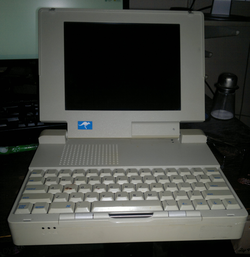
The first one was codenamed Wallaby, in keeping with the logo, and a trademark conflict kept that name internal. It shipped as the retroactively titled Outbound System 2000, and catalogs and reviews of the period also called it the Outbound Laptop System or simply the Outbound. Inside was a 68000 at 15 MHz, later 20. It weighed a little over four kilograms and cost around four thousand dollars, which still compared well against the Mac Portable once you accounted for the donor machine you were cannibalizing.
Two details stand out even now. The pointing device was a cylinder sitting under the keyboard that you rolled up and down and slid left and right, trademarked Isopoint on early machines and later called the Trackbar. And the batteries were standard Panasonic camcorder cells at ninety-nine dollars, not a proprietary pack, in an era when every other portable made you buy its own brick.
The Outbound Notebook of 1991 had a 9.7-inch passive-matrix monochrome screen and a 2.5-inch IDE hard drive, which put it ahead of Apple outright: no PowerBook used IDE until the PowerBook 150 of 1994. Its SCSI port drove a full-page external monochrome monitor called the Outrigger. The later 2030 carried a custom EEPROM that Outbound used to ship patches around the limits of the Mac Plus ROM, and the 2030E could address fourteen megabytes of RAM.
~ how it actually ended ~
Apple shipped the PowerBook in October 1991 and then cut prices. An analyst named Janet Cole put it to InfoWorld as bluntly as anyone could want: the PowerBook had obliterated the need for Outbound, and the price reductions had made PowerBooks competitive. Outbound left the Macintosh conversion business in 1992 and tried selling Windows desktops instead. It then tried to find a buyer for its MicroPC line of DOS systems, and nobody wanted it.
Information Technology Digest carried the ending in its issue of 15 February 1993, reporting that Outbound was five million dollars in debt and could not meet its payroll. It had been forced to cease all operations. No announcement from the company survives anywhere. Because of that absence this grave carries February rather than a specific day, and what stands behind the date is a trade magazine instead of a press release. The same magazine credited Outbound with selling the only Macintosh-compatible computers available from anybody other than Apple, which is not quite true, since Dynamac and Colby had both been there.
The February 1993 issue of MacUser still carried an Outbound advertisement with a sales number on it. MacUser's January 1993 buying guide had already gone out noting that the 2030, unlike earlier Outbound laptops, came with up-to-date standard Mac ROM chips preinstalled. Both went to press after the company had stopped existing. Magazine advertising was booked months ahead, and Outbound ran out of money faster than its own ads could be pulled.
~ the distance ~
I was five when the first Outbound shipped and eight when the company stopped paying its staff. Macintoshes were things you heard described rather than things you touched, where I was; my first machine arrived years later and ran DOS. The whole question of who else was permitted to build a Macintosh had been closed twice over before I ever typed a modem command, once against Outbound and once against the licensed clone makers who followed.
~ leave a rose ~
an anonymous tribute. one rose per visitor per day.
@}-->-- ... roses left here
~ leave a wreath ~
a rose fades by morning. a wreath stays on this grave for good, with your name on it.
paid once through stripe. payments are handled by OÜ Lakeview, the small company that keeps rip.so running. the money pays for the hosting and the nightly digging. adopt it and the headstone reads "maintained in memory by" you. the groundskeeper plants new wreaths at the next tending, usually within a day.
» one email a week: new graves and the anniversaries of the dead. subscribe
other gadgets: Sony VAIO, Motorola Xoom, Intel Turbo Memory, Casio Exilim
~ leave a note ~
visitors before you have left these graveside notes. anonymous welcome.