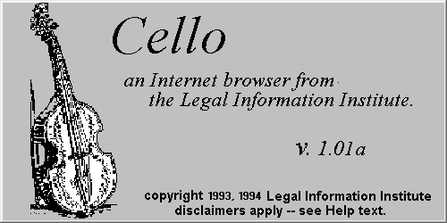
Cello
~ the obit ~
Cello was written for lawyers. That single fact separates it from every other browser of its generation, which came out of physics labs and computer science departments and were built by people who wanted the web to exist for its own sake. Cello exists because a specific profession had a specific problem and could not solve it with the software available.
Tom Bruce and Peter Martin founded the Legal Information Institute at Cornell Law School in 1992 and started putting American case law and statutes online, free, at a point when access to that material meant paying Westlaw or Lexis by the minute. Then they looked at who was supposed to read it. Lawyers ran Windows. Every browser in existence ran on Unix workstations. The audience for the work and the platform the work was published on had no overlap at all.
So Bruce wrote one. Version 0.1 went out as shareware on 8 June 1993, and then 0.2 on the 14th, 0.3 on the 16th, 0.4 on the 18th, 0.5 on the 24th and 0.6 on the 30th. Six releases in twenty-two days, from one person in a law school, in a month when the number of web browsers for Windows went from zero to one.
I came to Windows networking five years after this was settled. In 1998 the modem was a 33.6 and the browser question was Internet Explorer or Netscape, both of them free, both of them assuming the operating system already knew what TCP/IP was. Cello had needed a separate WinSock stack bolted onto Windows 3.1 by hand, which is the part of the story that dates it hardest. Getting a browser was never the difficult step for me. In 1993 it was the only step that mattered.
~ the rap sheet ~
| Born | 8 june 1993, version 0.1, shareware for windows 3.1 |
|---|---|
| Peak | 1993 to 1994, downloaded around 500 times a day |
| Killed | 16 april 1994, version 1.01a, the last public release |
| Lifespan | ten months |
| Made by | tom bruce at the legal information institute, cornell law school |
| Killed by | mosaic shipping a windows build |
~ what it could reach ~
Cello was less a web browser than an everything client that happened to speak HTTP. It handled HTTP 1.0 and Gopher, read-only FTP, Telnet, Usenet news and SMTP mail. It drew inline images in GIF and XBM and PCX and BMP. It cached files, it kept bookmarks, and it did DDE so other Windows programs could hand it a document.
That shape tells you what 1993 looked like from a desk. The web was one protocol among several and not obviously the winner, so anything claiming to be a front door for the internet had to speak all of them. Within three years the others were gone from the interface entirely and the browser was the web and nothing else. Cello is a photograph of the moment before that collapse, taken by somebody who did not know it was coming.
~ the ten months ~
It moved fast. At the start it was being pulled down around 500 times a day, and over its life it reached somewhere between 150,000 and 200,000 users, which in 1993 was a meaningful fraction of everybody on the web. For most of a year, if you were on Windows and you were on the web, you were on Cello.
NCSA shipped Mosaic for Windows in November 1993 and Netscape followed in 1994, and both of them were free rather than shareware and had staff behind them. Bruce shipped version 1.01a on 16 April 1994 and that was the last public release. Cello 2.0 was announced and never came out, though the Legal Information Institute did license the 2.0 source to companies building commercial products on it. Windows 95 arrived with a TCP/IP stack in the box and the problem Cello had been built to solve stopped being a problem.
The Legal Information Institute is still there in 2026, still publishing the US Code and the Supreme Court, still free. The browser was scaffolding. It was put up because there was no other way to reach the building, and it came down as soon as there was.
~ leave a rose ~
an anonymous tribute. one rose per visitor per day.
@}-->-- ... roses left here
~ leave a wreath ~
a rose fades by morning. a wreath stays on this grave for good, with your name on it.
from $1, paid once through stripe. it keeps the graveyard running: the hosting and the nightly digging. adopt it and the headstone reads "maintained in memory by" you. the groundskeeper plants new wreaths at the next tending, usually within a day.
» one email a week: new graves and the anniversaries of the dead. subscribe
other browsers: Internet Explorer Mobile, Arena, QtWeb, SpaceTime
also died in the 1990s: JUNET, Sega Visions, USSB
~ leave a note ~
visitors before you have left these graveside notes. anonymous welcome.