ViolaWWW
~ the last words ~
The first time ViolaWWW got my attention it was evidence. Not a browser, a piece of prior art in an American patent case about embedded objects, cited in arguments I was reading years after the fact. That is a strange way to meet a program. It turns out to be the right way, because the reason ViolaWWW matters is that it did almost everything first and got credit for none of it.
Pei-Yuan Wei built it. He was born in Pingtung County in Taiwan, went to Berkeley High School and then to UC Berkeley, and spent his time there in the student club called the eXperimental Computing Facility. In 1989 he got hold of a HyperCard manual. He did not own a Mac, so he read the manual and implemented the concepts on the Unix machines he did have. His own account of it is about that blunt.
What came out was Viola, a toolkit with a scripting language in it, C-like in syntax. ViolaWWW was the web browser he wrote on top of that toolkit to demonstrate what it could do, released on 9 March 1992. It was the first browser written by anyone outside CERN. Copies were circulating at CERN itself within weeks, and for a stretch it was the browser CERN pointed people at when they asked what to run.
~ the record ~
| Born | 9 march 1992, out of uc berkeley's experimental computing facility |
|---|---|
| Peak | 1992 to 1993, the browser cern recommended and the one in ed krol's book |
| Killed | 10 april 1995, version 3.3 beta, the last release |
| Lifespan | three years |
| Made by | pei-yuan wei, working alone |
| Killed by | mosaic, which ran on windows |
~ what it had first ~
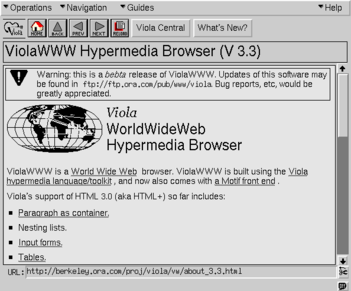
The feature list on the final release reads like a summary of the next four years of web development. There were HTML tables in it, and a stylesheet mechanism for fonts and colors that arrives four years ahead of CSS. Embedded scripts and applets could be reached from inside an HTML document, which is roughly the pitch Java made in 1995 and the pitch Flash made after it. Sidebar panels carried a document's metadata, an idea nobody has managed to make stick even now.
None of this was a roadmap. It was one person with a toolkit he wanted to show off and a web that had almost nothing in it yet. Ed Krol put ViolaWWW in The Whole Internet User's Guide and Catalog in 1992, and O'Reilly built an electronic version of that catalog inside Viola itself, which is how Wei ended up working at O'Reilly and then as a founding employee of Global Network Navigator.
~ why mosaic won ~
It required X11 R4 or later. That sentence is the entire explanation. ViolaWWW ran on the Unix workstations a university computing lab had, which meant it ran in a university computing lab and essentially nowhere else. There was never a Windows build and there was never going to be one.
NCSA released Mosaic in 1993 with builds for Windows and for the Mac, and the argument was over. Not on features, because Mosaic had fewer of them. On whether the machine on your desk could run the thing at all. Wei kept going for another two years and shipped version 3.3 beta on 10 April 1995, announcing it to the www-talk list a week later from an O'Reilly address. Netscape had already shipped by then and there was no race left to be in.
~ the trial ~
In 1994 Michael Doyle at the University of California filed a patent covering interactive objects embedded in a web page. His company, Eolas Technologies, sued Microsoft over it, and in August 2003 a jury awarded $520.6 million, which with interest became a judgment near $565 million.
Microsoft's defense was Wei. He had demonstrated embedded interactive objects in Viola to Sun engineers in May 1993, more than a year before the patent was filed. The trial judge ruled that the jury could not consider it, on the ground that Wei's work had not been published in a form that qualified as prior art. The Federal Circuit reversed that on 2 March 2005 and sent the case back for a retrial, holding that the Viola evidence should have gone to the jury. The patent claims were finally found invalid by a jury in Tyler, Texas in February 2012.
So the browser almost nobody used spent longer as a legal exhibit than it spent as working software. Wei died in 2023.
~ the legacy ~
Wei's answer to the question of what a browser is was wider than the answer that won. Viola was a toolkit first, a general system for building interactive documents, and the browser was only a demonstration of it. Mosaic and everything after took the narrow definition: a program that fetches a page and draws it. The wider idea kept coming back anyway, as plugins first and then as JavaScript, until the browser became a runtime again and behaved as though it had always been one.
The source went out on an O'Reilly FTP server in 1995 and someone has since ported it to modern Macs, so the original X11 interface still opens. It is worth a look for the pie chart that fills up while a page loads, which is the single most 1992 detail in the whole program.
~ leave a rose ~
an anonymous tribute. one rose per visitor per day.
@}-->-- ... roses left here
~ leave a wreath ~
a rose fades by morning. a wreath stays on this grave for good, with your name on it.
from $1, paid once through stripe. it keeps the graveyard running: the hosting and the nightly digging. adopt it and the headstone reads "maintained in memory by" you. the groundskeeper plants new wreaths at the next tending, usually within a day.
» one email a week: new graves and the anniversaries of the dead. subscribe
other browsers: RockMelt, Cyberjack, Netscape Navigator, MacWeb
also died in the 1990s: FilePile.com, Stacker, Signetics
~ leave a note ~
visitors before you have left these graveside notes. anonymous welcome.