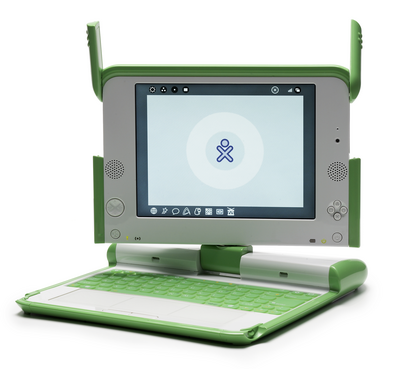
OLPC XO-1
» see laptop.org as it lived, on the wayback machine
~ the eulogy ~
i missed the xo-1 by the wrong demographic and the wrong region. by the time give-one-get-one launched in november 2007 i was already twenty-three, finishing my degree, on a real desktop on ttnet adsl. the xo-1 was a device for children in the developing world, more specifically for ministry-of-education deployments in uruguay, peru, rwanda, ethiopia, mongolia, and about twenty other countries. turkey was not on the deployment list. the give-one-get-one campaign was a way to get a unit into a us household for 399 dollars and put another into the field. that channel was the only consumer path and it was not aimed at me.
the xo-1 was the first hardware shipped under one laptop per child, a non-profit founded by nicholas negroponte and others at the mit media lab. the public unveiling at the world economic forum in davos in january 2005 was the moment kofi annan held up the prototype with the hand-crank version of the design. the production hardware quietly dropped the crank by the time the device shipped, since the mechanical loading on the case was a real engineering problem. mass production at quanta computer in taiwan started in november 2007.
the hardware spec was the radical part. the cpu was a low-power amd geode lx-700 at around half a watt under typical load. the screen was a 7.5-inch transflective lcd that could switch to a sunlight-readable monochrome mode by reducing the backlight to almost zero, which is the feature that let the device function outdoors in classrooms without electrical infrastructure. flash storage was a 1 gb internal nand, the operating system was a fedora-derived linux running the sugar interface, a journal-based ui that replaced the desktop-and-folders metaphor with a chronological activity log. the keyboard was a sealed rubber membrane sized for child hands.
for me. anyway, the original target price of one hundred dollars per unit was the headline number that anchored the press cycle from 2005 through 2008, the actual production cost never got there. the launch price was around 188 dollars per unit at scale, the get-one side of give-one-get-one was 199 dollars, the bulk-procurement price to ministries of education hovered in the 200-dollar range across the product life. by 2014 the olpc association in cambridge wound down the hardware program. the foundation continued in a smaller form, the xo-1 line stopped being manufactured. total units across the field reached around three million.
~ the dossier ~
| Born | november 12 2007 mass production, give-one-get-one launch nov 12 2007 |
|---|---|
| Peak | around 3 million units shipped by 2015 across about 20 country deployments |
| Killed | 2014 hardware program wind-down at olpc association in cambridge |
| Lifespan | about 7 years as a shipping product |
| Made by | the olpc association, quanta computer manufacturing |
| Killed by | missed price targets, low-cost netbooks and android tablets eating the market |
~ what it was supposed to do ~
the constructionist pitch from negroponte and seymour papert was that giving every child a programmable computer would change the educational baseline in a developing-country classroom. the xo-1 had a kid-mode python ide called etoys preinstalled, the journal was visible to the child as a writable record of their own activity, the mesh networking radios let units in a classroom find each other without a wireless access point. the explicit theory was that kids would learn programming and collaboration by using the device as a primary educational tool, not as a supplement.
the practical experience in deployments was more mixed than the press cycle around the launch. the device worked in the field, the sunlight-readable screen and the low-power cpu held up. the bigger questions were software-curriculum integration, teacher training, and repair logistics in remote schools. the uruguayan plan ceibal program is the canonical deployment that ran at national scale through the 2010s and kept being studied as a case in education research. honestly, the per-unit results varied by country and by school.
~ the netbook problem ~
the asus eee pc launched in october 2007, one month before the xo-1 reached mass production. the eee was a 7-inch linux netbook at 299 dollars in its base configuration, sold to the consumer market in europe and the us. the wider netbook category took off in 2008 with cheap windows xp variants from acer, msi, hp and dell at price points between 250 and 400 dollars. the netbook curve undercut the xo-1's price target and reset what a cheap laptop looked like in the consumer mind. by 2010 the android tablet wave started the same dynamic again at a lower price point.
the strategic problem for olpc was that the mainstream consumer hardware industry kept lowering the floor on cheap computing devices at exactly the rate the xo-1's price-target argument needed to hold. by 2012 a basic android tablet at a hundred dollars was a real consumer category, by 2014 the case for a custom kid-laptop with a sealed rubber case was much harder to make to a ministry of education that could buy commodity tablets instead. the wind-down of the hardware program at olpc association was the practical recognition of that shift.
~ the long tail ~
the sugar interface survived the xo-1 hardware sunset as the sugar labs project, which continued porting the activity model to other linux distributions and to web browsers. the constructionist curriculum pieces that came out of the deployments fed into a generation of kid-coding products that landed later: scratch from the mit media lab itself, code.org's hour of code, raspberry pi as a school-oriented sbc starting in 2012. the xo-1 itself stopped shipping, the educational-computing direction it pushed kept moving forward on other hardware.
~ leave a rose ~
an anonymous tribute. one rose per visitor per day.
@}-->-- ... roses left here
~ leave a wreath ~
a rose fades by morning. a wreath stays on this grave for good, with your name on it.
from $1, paid once through stripe. it keeps the graveyard running: the hosting and the nightly digging. adopt it and the headstone reads "maintained in memory by" you. the groundskeeper plants new wreaths at the next tending, usually within a day.
» one email a week: new graves and the anniversaries of the dead. subscribe
other gadgets: Centaur Technology, British Leyland, Mercury, Sony Dash
also died in 2010-2014: Hotbar, Hollywood Video / Movie Gallery, BBC Digital Media Initiative
~ leave a note ~
visitors before you have left these graveside notes. anonymous welcome.