NESticle
» see bloodlust.com as it lived, on the wayback machine
~ the obituary ~
A Nintendo cartridge was smaller than a photograph. A NES rom ran to a few dozen kilobytes and came down a 33.6k line in about a minute, which made it the only sort of game piracy a Turkish dial-up connection could actually perform end to end. A PlayStation disc was six hundred megabytes and belonged to a different economy, the one with a shop counter in it. Emulation reached this country from the bottom of the size chart upward, and for a couple of years the bottom of that chart was NESticle.
Icer Addis of Bloodlust Software released version 0.2 on 3 April 1997. It was a DOS program. It ran the Nintendo Entertainment System at full speed on the sort of Pentium people already owned, which nothing before it had reliably done, and it was free at a time when the competing emulators were slower and mostly unfinished. Within two months it had save states and a built-in graphics editor, so you could freeze a game mid-jump or repaint Mario's hat and watch the change appear in the running cartridge.
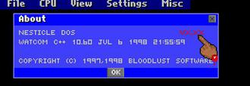
Nothing about the presentation was respectable. The name is a joke about anatomy and the icon carried it through. The mouse cursor was a hand with the middle finger raised. That was the register of the whole scene in 1997, written by people in their twenties who assumed no lawyer would ever look. The About box on the last build says WATCOM C++ 10.60 and the date it was compiled, which is the most formal thing in the entire program.
~ the case file ~
| Born | 3 april 1997, version 0.2 for DOS |
|---|---|
| Peak | 1997 and 1998, the default way to play NES games on a PC |
| Killed | 18 august 1998, the final build |
| Lifespan | sixteen months |
| Made by | Icer Addis at Bloodlust Software |
| Killed by | an open network share, and an author who had had enough |
~ what it did first ~
Two features in NESticle changed what emulation was for. The first was the save state, a snapshot of the whole machine written to disk and restorable in an instant, which turned a fixed twenty-year-old difficulty curve into something you could argue with. Every emulator since has had one. The second was the graphics editor, which let you open a game's tile data and draw over it, and it created the practice we now call rom hacking by making the first step trivially easy.
It also recorded movies of your own play, years before anybody was uploading video anywhere, and it handled sound in a way that sent a generation of musicians looking at how the NES made noise in the first place. None of this was in the plan. Addis was a hobbyist writing an emulator, and the tools he added to debug his own work turned into a creative scene that outlived the program by decades.
~ the theft ~
Five days after the first release, a person from the Damaged Cybernetics group mounted Addis's hard drive over Samba, took the NESticle source, and started handing it around on IRC. He had left a network share open, which in 1997 was an ordinary thing to do. The code was in circulation within the week.
The reaction inside the emulation scene was messier than it looks from here, because the scene existed to distribute other people's software and had just discovered how it felt from the other side. Addis stopped distributing and then started again, and he kept shipping through 1998 while also writing emulators for the Genesis and for Capcom arcade boards. Then he simply left. The final DOS release went out on 18 August 1998 with the version number x.xx, which reads like a man who had stopped counting. He took a job making games and has declined, ever since, to be interviewed about any of it.
~ the long tail ~
The stolen source survived. It circulated privately for twenty years and was eventually preserved and published, so the code that got a program abandoned is now the reason the program is legible at all. A later Bloodlust project for the SNES surfaced the same way, out of the same archive, decades after it stopped being a secret worth keeping.
NESticle itself has been technically obsolete since roughly 2001, when accuracy-focused emulators started getting the hardware right rather than getting it close. Nobody serious runs it. Everybody remembers it, which is the more difficult thing to achieve, and it is remembered for the same reason it died: one person wrote all of it, quickly, with no plan for what came after.
~ leave a rose ~
an anonymous tribute. one rose per visitor per day.
@}-->-- ... roses left here
~ leave a wreath ~
a rose fades by morning. a wreath stays on this grave for good, with your name on it.
from $1, paid once through stripe. it keeps the graveyard running: the hosting and the nightly digging. adopt it and the headstone reads "maintained in memory by" you. the groundskeeper plants new wreaths at the next tending, usually within a day.
» one email a week: new graves and the anniversaries of the dead. subscribe
other software: Remix 3D, Microsoft Bob, AppSurfer, Windows Genuine Advantage
also died in the 1990s: WorldWideWeb (Nexus), Microsoft Bob, Kaypro
~ leave a note ~
visitors before you have left these graveside notes. anonymous welcome.