Lexus Link
» see lexus.com as it lived, on the wayback machine
~ the last words ~
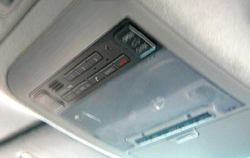
Lexus Link was a button in the console of an expensive car that put you through to a human being. Press it and an advisor came on the line who could unlock your doors remotely or send an ambulance. The same person would find the car if it had been stolen, or book you a table. If the airbags went off, the car called them without being asked. This was 2000, so none of that was ordinary. One note before anything else: Lexus sells something called Lexus Link Connect in Europe today, an infotainment system in the LBX, and it shares nothing with this but the words.
The part worth knowing is whose service it actually was. After what Computerworld called years of quiet talks with General Motors, Toyota licensed OnStar, GM's in-car communications service, and resold it to Lexus buyers with a Lexus name on it. Honda had done the same thing a few months earlier for the Acura RL. So the flagship of Toyota's luxury division shipped with a system operated by Detroit's largest carmaker, and the people who answered the button worked for a competitor.
It arrived in October 2000 on the 2001 LS 430, a fifty four thousand dollar sedan, as a factory-installed option. Over the next four model years it spread to the GX 470, the LX 470, the SC 430 and eventually the RX 330. Then it briefly vanished: the analog hardware was fitted for the last time in model year 2004, and the dual-mode replacement did not arrive until October 2005, so a 2005 Lexus could not be ordered with it at all.
~ the record ~
| Born | October 2000, as a factory option on the 2001 Lexus LS 430 |
|---|---|
| Peak | No subscriber count was ever published. The option was projected for 15 to 30 percent of a 25,000-car model year |
| Killed | 31 December 2007, with new enrollment already closed on 1 January 2007 |
| Lifespan | Seven years and three months |
| Made by | Toyota, reselling General Motors' OnStar under the Lexus name |
| Killed by | The FCC decision releasing US carriers from supporting analog cellular after February 2008 |
~ the prices never moved ~
The hardware was a 1,215 dollar option. The subscription came in two tiers: 215 dollars a year bought Safety and Security, which covered the emergency button and the automatic call placed when the airbags fired, while 413 dollars a year added Route Support and a concierge who would use your credit card over the phone to book restaurants, order gifts, arrange catering or schedule a salon appointment.
Those two numbers, 215 and 413, are the ones Computerworld printed in October 2000. They are also the ones still sitting on the Lexus product page in May 2007, seven months before the service was switched off. In seven years of operation the price list was never once revised. The second-generation system that replaced it moved to a 900 dollar option with 199 and 399 dollar annual plans, and dropped the stolen vehicle notification and the memo-record button along the way.
~ forty nine days early ~
The FCC had ruled that American cellular carriers would no longer be required to run analog service after 18 February 2008. Lexus Link's first-generation box was analog-only, and Lexus stated plainly on its own site that the unit could not be modified to digital operation. The whole installed base was therefore scheduled to stop working, and Lexus published the schedule years ahead.
There were four dates, not one. From 24 July 2006 the service stopped enrolling new subscribers except on cars that already had it. From 1 January 2007 it stopped enrolling anyone at all, though existing customers could keep renewing. On 31 December 2007 the service ended. The FCC's deadline then arrived seven weeks later, on 18 February 2008. Lexus switched its customers off forty nine days before the regulation it was citing actually took effect, so the operative date belongs to Lexus rather than to the FCC.
~ who got sued ~
This era produced a large class action over exactly this problem, and the interesting thing is who was in it. The consolidated case, In re OnStar Contract Litigation, ran in the Eastern District of Michigan and named American Honda, Subaru of America, Volkswagen of America and OnStar itself. The allegation was that buyers were never told their analog safety equipment had an expiry date. The court declined to certify a class in December 2011 and ruled for the defendants.
Mercedes-Benz faced the same allegation separately over Tele Aid, and there the class was certified, with the Third Circuit refusing the company leave to appeal. Toyota and Lexus appear on neither party list. The reason is probably sitting in the dates above: Lexus put its wind-down schedule in public in 2006, roughly eighteen months before the switch-off, and left that notice page online afterward. It was still serving the identical text in May 2013, nearly seven years later and more than five years after the service it described had ended.
~ the sunglasses holder ~
What owners were offered was the strangest part. There was no refund, and there could be no upgrade, because the box physically could not become digital. Instead Lexus approved a no-charge program for 2001 to 2004 cars: bring it to a dealer and they would disable the system and remove the button panel from the console for free. The notice added that Lexus understood some customers would be inconvenienced by the effects of the FCC decision.
That left a rectangular hole in the overhead console of a luxury car, and dealers filled it with a sunglasses holder. One owner wrote the procedure up in July 2006, after their 2001 LS had spent months announcing a Lexus Link system error at almost every start: the dealer took the unit out at no cost and fitted the holder in its place. A thousand dollars of embedded telephony with a concierge attached, converted at the end into somewhere to keep your sunglasses.
~ leave a rose ~
an anonymous tribute. one rose per visitor per day.
@}-->-- ... roses left here
~ leave a wreath ~
a rose fades by morning. a wreath stays on this grave for good, with your name on it.
paid once through stripe. payments are handled by OÜ Lakeview, the small company that keeps rip.so running. the money pays for the hosting and the nightly digging. adopt it and the headstone reads "maintained in memory by" you. the groundskeeper plants new wreaths at the next tending, usually within a day.
» one email a week: new graves and the anniversaries of the dead. subscribe
other connectivity: ClarkNet, Internet America, Multi Matching BB, J-Phone
also died in the 2000s: Cellular Digital Packet Data, Accolade, Microsoft Works
~ leave a note ~
visitors before you have left these graveside notes. anonymous welcome.