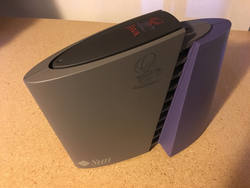
JavaStation
» see sun.com/javastation as it lived, on the wayback machine
~ the obituary ~
In 1998 the closest I got to Java was an applet that took most of a minute to appear over a 33.6k modem, usually a menu or a hit counter, usually not worth the wait. Sun was meanwhile selling an entire computer that could run nothing else. Those two facts sat in the same year and I would not learn the second one for a long time, because a diskless corporate terminal at 599 dollars was never going to be in a Turkish house or a Turkish internet cafe.
The thinking behind it was not stupid. Larry Ellison had been arguing loudly since 1995 that the personal computer was too expensive to own and too hard to administer, and that the future belonged to a cheap terminal that pulled everything it needed off the network. Sun believed the same thing and had a language it thought could deliver it. Write once, run anywhere, and the anywhere would be a box with no state in it at all.
So the JavaStation shipped with no hard drive and nothing you could put a disc or a diskette into. The hardware underneath came from the SPARCstation line, but the machine broke Sun convention by taking PS/2 keyboards and mice and a plain VGA monitor connector, because a corporate buyer already owned those. JavaOS lived in flash memory. Everything else came down the wire.
~ the case file ~
| Born | November 1996, codenamed Mr. Coffee, at $699 |
|---|---|
| Peak | the Krups model on 26 March 1998 at $599, with no drive of any kind inside it |
| Killed | March 2000 |
| Lifespan | three years and four months on sale |
| Made by | Sun Microsystems, on SPARCstation hardware |
| Killed by | a slow JavaOS, and a PC price that would not stop falling |
~ the climb ~
The first production unit was the JavaStation-1, internally Mr. Coffee, out in November 1996 for pilot deployments at 699 dollars and later discounted as far as 299. The one meant to be the real product was the JavaStation-NC, codenamed Krups, launched on 26 March 1998 at 599 dollars in a curved upright case that still looks like an object somebody designed on purpose.
Other variants existed mostly as prototypes. Espresso added PCI slots and JavaEngine-1 put the same board in an ATX form factor for embedded work. Stranger than either was Dover, an x86 model built around a Cyrix MediaGX that seems to have turned up mainly in South Africa. Sun also sketched a third generation with a JavaChip coprocessor to execute bytecode natively, and never built it.
~ the slide ~
People who actually ran these did not blame the price or the concept. They blamed the software. JavaOS was sluggish on the hardware it had, and HotJava, the Java browser it depended on, could not keep up with what the web had already turned into by 1998. Reaching a real X session through GraphOn's Go-Joe was slow enough that users described the refresh rate as the thing that broke them.
Underneath all of that was the arithmetic. The network computer's entire argument was that a PC costs too much. Between 1996 and 2000 the PC answered by collapsing in price, and a 599 dollar terminal that could only run Java stopped being cheap in any way a purchasing department could defend.
~ what it became ~
Sun's answer arrived in September 1999 as the Sun Ray, which threw out the idea that the terminal should run anything at all. No local operating system and no local applications, just pixels arriving from a server, plus a smartcard you pulled out to carry your session to another desk. That project killed the JavaStation from inside the same company, and Sun stopped selling JavaStations in March 2000.
The hardware went on living in a way Sun did not plan for. Linux and NetBSD were both ported to it, and the JavaStation Linux HOWTO on ibiblio outlasted the product by decades. Meanwhile the argument itself came back and won: Chromebooks are network computers that boot into a browser, and the reason they work is that the network finally got fast enough to make a machine with nothing on it feel like a machine.
~ leave a rose ~
an anonymous tribute. one rose per visitor per day.
@}-->-- ... roses left here
~ leave a wreath ~
a rose fades by morning. a wreath stays on this grave for good, with your name on it.
from $1, paid once through stripe. it keeps the graveyard running: the hosting and the nightly digging. adopt it and the headstone reads "maintained in memory by" you. the groundskeeper plants new wreaths at the next tending, usually within a day.
» one email a week: new graves and the anniversaries of the dead. subscribe
other gadgets: de Havilland, Nabaztag, BodyMedia, Norsk Data
also died in the 2000s: Brunching Shuttlecocks, Sherlock, TeleGarden
~ leave a note ~
visitors before you have left these graveside notes. anonymous welcome.