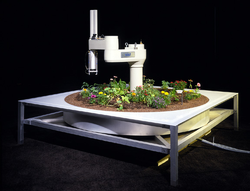
TeleGarden
~ the obituary ~
The TeleGarden went online in June 1995 at the University of Southern California. Ken Goldberg and Joseph Santarromana had taken an Adept-1 industrial robot arm, the kind of machine built to place components on a factory floor, and pointed it at a circular tray of soil under lights. Anyone with a web browser could drive it. You watched the plants through the cameras and moved the arm over the dirt to drop a seed or water somebody else's seedling. Nine thousand people signed up in the first year.
In 1996 the installation moved to the lobby of the Ars Electronica Center in Linz, Austria, and it stayed there until August 2004. I came online in 1998 on a 33.6k modem in Turkey, which means the TeleGarden was sitting there, reachable, through six of the years I was already on the web. I did not know it existed until I went looking for it decades later. That is what the mid-90s art web was like from the outside: one URL away and completely invisible unless you were reading the right press.
By the time it was switched off it had more than ten thousand registered members, and around a hundred thousand people had walked past the physical garden in the lobby. The reason it ended is the least dramatic on this site. Nobody sued it and nothing was acquired. A museum installation ran for nine years, which is an extraordinarily long run for a museum installation, and then it came down.
~ the case file ~
| Born | June 1995 at the University of Southern California |
|---|---|
| Peak | over 10,000 registered members, around 100,000 visitors to the physical exhibit |
| Killed | August 2004 |
| Lifespan | nine years, most of it in a museum lobby in Linz |
| Made by | Ken Goldberg and Joseph Santarromana with a team at USC |
| Killed by | the end of the exhibition |
~ how the arm worked ~
The Adept-1 was a SCARA arm, light industrial automation with a fixed base and a handful of degrees of freedom. Goldberg's team gave it a watering nozzle and a seed dispenser. Two cameras watched the installation, one overhead for the map and one closer in for the view. The web interface was a clickable image of the garden. You clicked where you wanted to be and the arm went there.
Goldberg has said the appeal was that a physical garden operated by people online was the most absurd idea he could come up with. The absurdity was doing real work. Every action had a consequence in dirt, which is a different proposition from a simulation, and the project's own writing was frank that you had no way to verify any of it from your chair. Whether the garden existed, and whether your click had moved anything, was part of the piece.
~ the people who showed up ~
Ten thousand members over nine years is a small number by any measure the web uses now, but the behavior is the part worth recording. People got protective of specific plants. They got territorial about patches of soil. Members organized themselves against attempts to vandalize the garden, which sounds ordinary said about a forum and reads strangely said about a tray of seedlings in Austria.
Some of them met in person. European members arranged to travel to Linz and stand in the lobby beside the machine they had been operating from home. A shared online space produces people who want to meet each other, and this one produced them out of a robot arm and a seed tray.
~ nine years in a lobby ~
The TeleGarden is usually filed under net art and it belongs there, but what it prototyped was remote physical control over the public internet. Everything now sold as teleoperation or cloud robotics is doing what this did in 1995, with better latency and worse manners. Goldberg went on running a robotics lab at Berkeley. The arm went back to being an arm.
~ leave a rose ~
an anonymous tribute. one rose per visitor per day.
@}-->-- ... roses left here
~ leave a wreath ~
a rose fades by morning. a wreath stays on this grave for good, with your name on it.
from $1, paid once through stripe. it keeps the graveyard running: the hosting and the nightly digging. adopt it and the headstone reads "maintained in memory by" you. the groundskeeper plants new wreaths at the next tending, usually within a day.
» one email a week: new graves and the anniversaries of the dead. subscribe
other phenomena: Ogrish.com, Yahoo Answers, HQ Trivia, TheSpark.com
also died in the 2000s: Microsoft Photo Editor, GauchoNet, Ogrish.com
~ leave a note ~
visitors before you have left these graveside notes. anonymous welcome.