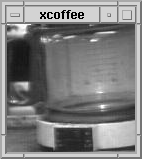
Trojan Room coffee pot
» see cl.cam.ac.uk/coffee/coffee.html as it lived, on the wayback machine
~ the eulogy ~
the trojan room coffee pot sat in the part of internet history i can read about but cannot personally remember. it was already live for seven years by the time i saw my first web browser in 1998, and by then the pot itself was a story people told to explain what a webcam was. one of those origin-of-the-web anecdotes that every computer magazine repeated in the late 1990s alongside the tim berners-lee garage-lab origin of html.
the setup was practical. two researchers at the university of cambridge computer laboratory, quentin stafford-fraser and paul jardetzky, were tired of walking down the hall in the old radio-astronomy building to find the shared filter machine empty. in november 1991 they pointed a philips frame-grabber camera at the pot, wrote a small server called xcoffee that pushed a 128x128 grayscale still every few seconds, and served the image to a client on the office desktops of anyone running xy. the whole system was internal. the pot was still nobody's business but the corridor's.
in 1993 the web caught up. mosaic had just added inline images. daniel gordon and martyn johnson at the same lab rewrote the frontend so the feed served over http as a still frame. now the pot had a url. anyone with a web browser anywhere on earth could see whether the trojan room coffee machine had coffee in it. that url stayed live for another eight years.
~ the dossier ~
| Born | November 1991, University of Cambridge Computer Laboratory |
|---|---|
| Peak | millions of hits from around the world after the web port in 1993 |
| Killed | 22 August 2001 when the Computer Laboratory moved to the William Gates Building |
| Lifespan | just under 10 years |
| Made by | Quentin Stafford-Fraser and Paul Jardetzky |
| Killed by | a building move, not any user drop-off |
~ the origin ~
xcoffee was never designed as a product. stafford-fraser has said since that they built it in an afternoon and never expected anyone outside the building to care. the frame-grabber was an old philips model already sitting on a shelf. the server ran in a few hundred lines of c, and the client was an x window with a single greyscale image and a caption underneath. the whole thing predated the phrase "webcam" by two years. the word was coined afterward, partly to describe what the coffee pot had already been doing.
the pot itself was a krups aromaster filter machine. nothing special. what was special was that once the http port went up in 1993, thousands of strangers started checking on a coffee machine in an office they would never enter. the cambridge lab's server logs from the mid-1990s show hits from every timezone. some of the hits were curiosity, some were fellow researchers wanting to see if the trick actually worked. the pot itself had no idea anyone was watching.
~ the internet moment ~
the coffee pot was one of the small early-web things that got covered in every consumer computing magazine of the 1990s. it appeared in wired and on early bbc technology segments. an entire generation of people who did not use the web yet knew there was a coffee machine at cambridge you could look at from your desk. that is what made it a canonical early-web artifact rather than just a lab curiosity. it was the first time a physical object had become a public url.
by the late 1990s the site was getting millions of hits a year. jennicam had launched in 1996 and reframed what a webcam could point at, but the coffee pot came first, five years earlier, and stayed live parallel to jennicam through the whole late-90s webcam boom. between them they defined the two poles of the category: the object cam and the person cam. the mundane corridor and the confessional dorm.
~ what it became ~
on 22 august 2001 the cambridge computer laboratory turned the camera off. the reason was practical. the department was moving out of the old building and into the new william gates building on west cambridge site, and the trojan room itself was being decommissioned. the last frame served at 09:54 UTC. the pot got auctioned on ebay and was bought by der spiegel for 3,350 pounds. spiegel had it restored and displayed it in their hamburg office for years.
since the summer of 2016 the machine has been on permanent loan to the heinz nixdorf museumsforum in paderborn, germany, the largest computer museum in the world. the coffee pot that started the webcam category sits in a glass case near the exit. the camera is gone. the server is gone. the pot itself is a museum object. the software model it invented, a low-resolution still refreshing every few seconds over http, was already obsolete by 2001 when it was retired, and is now what every doorbell camera in the world uses.
~ leave a rose ~
an anonymous tribute. one rose per visitor per day.
@}-->-- ... roses left here
~ leave a wreath ~
a rose fades by morning. a wreath stays on this grave for good, with your name on it.
from $1, paid once through stripe. it keeps the graveyard running: the hosting and the nightly digging. adopt it and the headstone reads "maintained in memory by" you. the groundskeeper plants new wreaths at the next tending, usually within a day.
» one email a week: new graves and the anniversaries of the dead. subscribe
other phenomena: Red Room (Akai Heya), Yahoo Groups, National Emergency Library, Numa Numa
also died in the 2000s: BBC Local Video, Neo Geo Pocket Color, Planet Internet
~ leave a note ~
visitors before you have left these graveside notes. anonymous welcome.