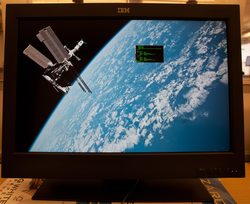
IBM T220 / T221
~ the eulogy ~
In June 2001 IBM shipped a 22.2-inch flat panel with a native resolution of 3840 by 2400. That is 9,216,000 pixels at 204 per inch, on a desk, four years before anybody had a marketing word for it. Contemporary monitors ran around a hundred pixels per inch, so the T220 was not an improvement on the category, it was roughly double it, and the pixel pitch of 0.1245 mm put the thing within reach of printed matter.
Getting an image onto it was the hard part. The back of the monitor carried two LFH-60 connectors, and the cables IBM supplied split each of those into a pair of single-link DVI plugs, giving four channels in total. The screen was then addressed as four columns of 960 by 2400, or as four tiles of 1920 by 1200, and the first unit came bundled with a Matrox G200 MMS card and two separate power supplies to feed it. The T221 that followed tidied this up to one power adapter and added screen modes, while pushing consumption from 111 watts to 135.
Almost nobody bought one. IBM announced a price cut on 19 March 2002 that took it from $17,999 to $8,399, which is a drop of more than half in nine months and tells you how the first year went. A revised T221, model 9503-DG5, was announced on 2 September 2003, and the line was finished by 2005. Some trade journals had taken to calling the family Big Bertha.
~ the dossier ~
| Born | June 2001 as the T220, model 9503-DG0 |
|---|---|
| Peak | 3840 by 2400 on 22.2 inches, 204 pixels per inch, 0.1245 mm pixel pitch |
| Killed | 2005, with the T221 model 9503-DG5 the last one standing |
| Lifespan | four years on sale |
| Made by | IBM |
| Killed by | a price that only a research budget could sign off |
~ what nine million pixels cost ~
$8,400 in 2003 is somewhere around $15,300 in today's money, and that was the discounted price. At launch it was more than twice that. For the same outlay in 2003 you could have bought a small car, or furnished an entire office with the monitors everyone was actually using.
The buyers it did find were the ones for whom pixel count was the job rather than a feature, and if the alternative was tiling four separate displays together with the seams showing, one unbroken panel at this density could be made to look cheap. For everyone else there was no software prepared for it. Desktop operating systems of the era had no real display scaling, so a 204 ppi panel rendered text at a size that sent people back into the settings to run it lower than native.
~ forty one hertz ~
The native refresh rate was 41 Hz. Not 60, not 75, which were the numbers everybody had spent the CRT years learning to care about. Later models and driver tricks improved the situation in parts of the screen, and there is a whole literature of enthusiasts working out which combination of DVI channels and refresh settings gave usable motion, but the honest summary is that this was a panel for looking at still images.
That restriction explains both the buyers and the absence of them. Somebody reading a still scan all day does not need 60 frames a second. Anybody dragging a window across a desktop does, and at either of the prices this thing carried, nobody was buying it for pleasure.
~ who actually bought one ~
Not me, and not anyone I was sitting next to. The T220 shipped in June 2001, and through 2002 to 2005 the screens I spent the most hours in front of were whatever CRTs were bolted to the desks of internet cafes in Turkey, running Counter-Strike at resolutions chosen for frame rate rather than fidelity. A monitor costing more than the entire room's worth of machines was not in the conversation, and the machines in that room could not have driven it anyway.
The gap was wider than money, though. Four DVI channels and a Matrox card existed to solve a problem no consumer had: the connectors of 2001 could not carry nine million pixels down one wire. The T220 was built by people willing to ship a monitor that needed four cables, because the alternative was waiting for the standards to catch up. VESA ratified DisplayPort 1.0 in 2006, a year after the last of these was sold.
~ the afterlife on ebay ~
The T221 had a long second life. Units came out of decommissioned workstations and onto auction sites through the 2010s, where people bought them to find out what 204 ppi felt like before Apple's Retina line made the number ordinary. The date the last one left IBM's price list is the softest fact in this grave: English Wikipedia says the DG5 was discontinued in June 2005 and carries a citation-needed tag on that sentence, and no IBM withdrawal letter has surfaced to confirm the month. The year is solid and the month is not, so this grave says 2005 and stops there.
~ leave a rose ~
an anonymous tribute. one rose per visitor per day.
@}-->-- ... roses left here
~ leave a wreath ~
a rose fades by morning. a wreath stays on this grave for good, with your name on it.
paid once through stripe. payments are handled by OÜ Lakeview, the small company that keeps rip.so running. the money pays for the hosting and the nightly digging. adopt it and the headstone reads "maintained in memory by" you. the groundskeeper plants new wreaths at the next tending, usually within a day.
» one email a week: new graves and the anniversaries of the dead. subscribe
other gadgets: Power Mac G4 Cube, Makani, Number Nine Visual Technology, Siemens Mobile / BenQ-Siemens
also died in the 2000s: Power Mac G4 Cube, GP32, AllAdvantage
~ leave a note ~
visitors before you have left these graveside notes. anonymous welcome.