I Am Rich
~ the goodbye ~
In 2008 a thousand dollars was a computer. Not a joke about a computer, an actual working desktop with a monitor attached, which is roughly what the number meant to anyone reading about this from Turkey. That is the whole reason the story traveled at all. The app itself lasted less than a day, and almost nobody who read about it could have bought one even if the urge had struck.
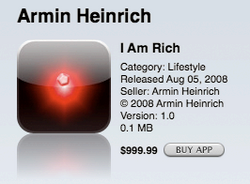
Armin Heinrich, a German developer, put I Am Rich on the App Store on 5 august 2008. The store was four weeks old. It had opened on 10 july and the pricing culture inside it had not settled, with most software going for under a dollar and iPhone owners already complaining in public about anything priced above ninety nine cents. Heinrich set his price at 999.99 dollars, the ceiling Apple allowed, and shipped an app that displayed a glowing red gem. Pressing an icon showed a short mantra: "I am rich / I deserv it / I am good, healthy & successful". The spelling mistake was in the shipped product.
Eight people bought it. Six of those sales were American and two were European, and the split left Heinrich with 5,600 dollars and Apple with 2,400. At least one buyer said afterward that the purchase had been an accident. Apple refunded two of them, which Heinrich told the Los Angeles Times he was glad about, since he did not want dissatisfied customers. To the New York Times he offered something closer to a defense: "I regard it as art. I did not expect many people to buy it and did not expect all the fuss about it."
Then Apple removed it. The sourcing is soft on exactly when, but the contemporary reporting and Wikipedia agree it was gone inside twenty four hours, which puts the removal on 6 august. For a product that existed for one day it generated a remarkable amount of writing, most of it angry, some of it from people who had never seen the thing and were guessing at what the mantra said.
~ the chronicle ~
| Born | 5 august 2008, on an App Store four weeks old |
|---|---|
| Peak | eight copies sold |
| Killed | 6 august 2008, removed by Apple |
| Lifespan | less than twenty four hours |
| Made by | Armin Heinrich |
| Killed by | Apple, after one day of press |
~ how it landed ~
The App Store in august 2008 had no settled sense of what software was worth. Desktop programs had cost tens or hundreds of dollars for decades, and the new store was pricing whole applications below the cost of a bus ticket. Heinrich was pointing at that gap, and the joke only works because the gap was real.
Apple's response is the part that mattered later. Pulling the app meant deciding that a store can refuse something for being pointless, and the rule the company reached for afterward was that an app must have definable content. That is an aesthetic judgment written down as policy, and every app store since has needed one.
~ the funny part ~
Heinrich came back the next year with I Am Rich LE at 9.99 dollars. It had a calculator and a help system bolted on, plus the famous mantra with the spelling corrected, all of it added to satisfy the definable content requirement. Customers rated it badly for exactly those improvements, which is the most honest review the original ever received.
The imitations followed the price caps rather than the idea. Mike DG released I Am Richer on Android in february 2009 for 200 dollars, which was Google's maximum, and Google raised no objection at all. On 22 december 2010 a developer called DotNetNuzzi shipped an I Am Rich for Windows Phone at 499.99 dollars, again the ceiling. Every store had a different number, and every number was a dare.
~ what remains ~
Vox later called it the ultimate Veblen good in app form, which is accurate and slightly too generous. A Veblen good has to be visible to work, and this one lived behind a passcode on a phone in a pocket. You could show it to somebody in a bar. That was the entire use case, and there is no evidence any of the eight ever did.
What survived is the ceiling itself, sitting in every app store as a quiet admission that somebody will always run straight at it.
~ leave a rose ~
an anonymous tribute. one rose per visitor per day.
@}-->-- ... roses left here
~ leave a wreath ~
a rose fades by morning. a wreath stays on this grave for good, with your name on it.
from $1, paid once through stripe. it keeps the graveyard running: the hosting and the nightly digging. adopt it and the headstone reads "maintained in memory by" you. the groundskeeper plants new wreaths at the next tending, usually within a day.
» one email a week: new graves and the anniversaries of the dead. subscribe
other software: XULRunner, Adobe Flash Catalyst, Timbuktu, Spacewalk
~ leave a note ~
visitors before you have left these graveside notes. anonymous welcome.