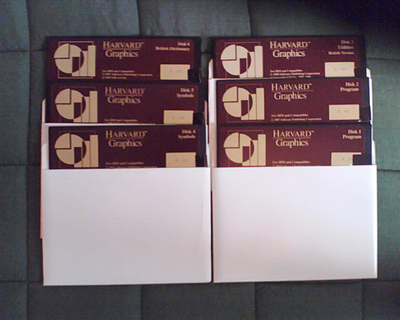
Harvard Graphics
~ the last words ~
in 1986 i was two years old. harvard graphics was selling cardboard boxes to corporate buyers at $395 a copy. by the time i was old enough to make a slide deck it was 1998 and the answer was powerpoint 97 because that was what the school computer had. the name "harvard graphics" never came up. nobody in any office i ever sat in mentioned it. the product had won the market once and lost it cleanly before i was paying attention.
software publishing corporation was a mountain view company spun out of fred gibbons' time at hewlett-packard. the first product was pfs:write in 1980. harvard presentation graphics shipped in 1986 written for ms-dos by a contractor team. the design was a chart generator with a thin slideshow wrapper on top. you typed numbers into a tabular editor, picked a chart type from a menu, and the program produced a 35mm slide-ready output that an in-house service bureau could send to a film recorder. corporate america was making physical 35mm slides for boardroom projectors in 1986 and harvard graphics owned the workflow.
the share peak sat in the 1989-to-1991 window at roughly seventy percent of the presentation market. spc's revenue passed $140 million in 1989. then the windows transition happened. spc shipped harvard graphics for windows 1.0 in late 1991. the port was slow and unstable on the early 386 machines. microsoft had bought powerpoint from forethought in 1987 and bundled it into office 4.0 by 1993. the corporate buyer who already had office did not need to also buy harvard graphics. the share crashed below fifteen percent by 1994.
spc tried to sell the brand. serif (a uk software vendor that made pageplus and drawplus) picked up marketing rights in 1996 and shipped a few more windows versions through the late nineties. the product limped along on the long tail of customers who had macros built against the old chart syntax and could not migrate. by 2010 the user base was a few thousand people running harvard graphics under windows xp on machines kept alive for the purpose. serif quietly pulled it from sale around mid-2017 and the product line ended without a press release.
~ the record ~
| Born | 1986 as Harvard Presentation Graphics for DOS |
|---|---|
| Peak | 1990 with ~70% market share |
| Killed | mid-2017 (Serif pulled it from sale) |
| Lifespan | ~31 years |
| Made by | Software Publishing Corporation (Mountain View, CA) |
| Killed by | PowerPoint bundling plus the Windows transition |
~ what it was ~
harvard graphics was a presentation tool from the era when presentations were physical objects. the output you cared about was a 35mm slide, the projection was an analog carousel in a boardroom, the in-house av department mailed the floppy to a service bureau that ran a film recorder and shipped back a tray of mounted slides. that workflow defined the product's design. the chart types were the ones that translated well to a slide projector. the color palettes were chosen for projection bulbs, not for crt screens.
the chart editor was the part people remembered. you typed columns of numbers into a grid that looked like an early lotus 1-2-3 sheet, then hit a key to render a bar chart or pie chart or line graph. the rendering was fast for the era because the underlying engine was a small dos program with no overlap with the spreadsheet layer. powerpoint, when it arrived, used the office chart engine through ole, which was slower and which broke when ole broke (often).
~ the fall ~
spc misread the platform shift twice. the first miss was waiting too long to ship a windows version, harvard graphics for windows did not arrive until late 1991 and the windows 3.0-era buyers had already started defaulting to powerpoint 2.0. the second miss was the office bundling. microsoft started selling powerpoint as part of office in 1990 and by 1993 the bundled version was effectively free to anyone buying word and excel. spc never had an answer to a competitor whose unit cost was zero.
fred gibbons stepped down as ceo in 1993. spc was acquired by a company called allegro new media in 1996 and the harvard graphics brand was licensed to serif. the parent company dissolved within two years. the brand survived under serif because uk software vendors will keep a niche product on a shelf as long as the licensing math works. by 2017 the math no longer worked and the product line was retired without ceremony.
~ the legacy ~
harvard graphics shaped the visual grammar of the corporate slide deck for everyone who came after. the bar chart conventions and the bullet hierarchy on a title slide were both harvard graphics before they were powerpoint. powerpoint copied the chart library wholesale in versions 1 and 2. the modern corporate slide deck is a direct descendant of fred gibbons' product from a mountain view office park in 1986.
spc itself dissolved into the history of small dos software companies that won a market and lost it before windows 95 shipped. the alumni roster scattered. some went to adobe and oracle, others to startups that did not last past the dot-com cycle. harvard graphics outlived spc by twenty-one years on serif's shelf as a brand that nobody was buying but that nobody had a reason to formally bury.
~ leave a rose ~
an anonymous tribute. one rose per visitor per day.
@}-->-- ... roses left here
~ leave a wreath ~
a rose fades by morning. a wreath stays on this grave for good, with your name on it.
from $1, paid once through stripe. it keeps the graveyard running: the hosting and the nightly digging. adopt it and the headstone reads "maintained in memory by" you. the groundskeeper plants new wreaths at the next tending, usually within a day.
» one email a week: new graves and the anniversaries of the dead. subscribe
other software: LANtastic, UserLinux, Gobuntu, Opera Mail
also died in 2015-2019: Basis B1 Watch, Codehaus, Putlocker
~ leave a note ~
visitors before you have left these graveside notes. anonymous welcome.