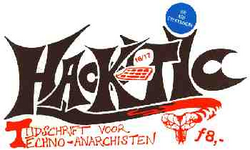
Hack-Tic
» see hacktic.nl as it lived, on the wayback machine
~ the obit ~
In 1988 a small delegation from the Chaos Computer Club came over from Hamburg to Amsterdam, invited by Caroline Nevejan, who programmed political events at Paradiso. Rop Gonggrijp was already well enough known as a hacker to turn up in the papers. He had read Datenschleuder and he had read 2600, and in January 1989 he printed the first Hack-Tic: fifty photocopies, stapled, in Dutch.
It did not stay at fifty. By the middle of its run the magazine was printing several thousand copies an issue, and the table of contents reads like a syllabus nobody was offering anywhere else in the country. How to read the data on the magnetic stripe of your bank card. How to build your own pay-TV descrambler. A guide to VMS in two parts, a Novell NetWare hack, an introduction to VM/CMS, calling cards, trashing, PGP, social engineering, and at least twenty separate variations on the question of how a person might place a telephone call without paying for it.
The free-calls material is what the magazine gets remembered for, and it was never the whole of it. The people making it had worked out early that the network was going to matter, and that access to it would be settled by whoever owned the wire. The economics Hack-Tic attacked were the economics I grew up inside. In Turkey the local call was metered, the meter kept counting until you hung up, and the phone bill was what rationed a household's internet. Nobody was printing the countermeasures in Turkish, and by the time I started dialing in, in 1998, the specific tricks on these pages had stopped working anyway.
~ the rap sheet ~
| Born | January 1989, fifty photocopies |
|---|---|
| Peak | several thousand copies an issue, twenty five numbers in five years |
| Killed | 1994, with a double issue numbered 24/25 |
| Lifespan | five years in print, a camp every four years since |
| Made by | Rop Gonggrijp and the Hack-Tic editors, under Stichting Hack-Tic |
| Killed by | its own readers getting the internet, which it sold them |
~ the ptt years ~
The Dutch state telephone monopoly was called PTT Telecommunicatie then and is called KPN now, and for five years it had a magazine documenting its weaknesses on open sale. Calls were still charged in pulses, audible on the line, and a payphone counted them. Hack-Tic explained that certain payphones only began charging once a number had been dialed from their own keypad, and that a small consumer tone dialer held up to the handset would therefore get you a free international call from a phone box.
The PTT's first response was that these were criminal devices and ought to be banned. Then somebody checked the catalog and found the memokiezer, a tone dialer the PTT sold itself. Relations between the telecom anarchists and the state company did not improve over the following issues.
~ twenty five numbers ~
The numbering tells you how a volunteer magazine actually runs. Issues 1 through 4 came out singly, then 5/6 arrived as a double, then 7 and 8 alone, then 9/10 and 11/12, a single 13, and doubles the rest of the way to 24/25 in 1994. Sixteen physical magazines carrying twenty five numbers. The English Wikipedia entry says the last one appeared in 1993; the archive the editors themselves maintain is titled for 1989 to 1994, and so is the Dutch entry.
~ larserbos, august 1993 ~
The first thing Hack-Tic organized was the Galactic Hacker Party, three days at Paradiso starting 2 August 1989. The second was bigger and stranger. From 4 to 6 August 1993, at an ANWB group campsite in the Larserbos near Lelystad, about five hundred people pitched tents in a Dutch polder for Hacking at the End of the Universe. No hacker festival had been held outdoors anywhere before it.
That one did not stop when the magazine did. The community around it has put on a camp every four years ever since, through Hacking in Progress in 1997 and Hackers at Large in 2001 and onward, every one of them in the Netherlands and so heavily built by the people attending that the standing description is all crew, no visitors. The 2600 people in New York took the idea for HOPE and the Chaos Computer Club took it for the Chaos Communication Camp.
~ what is still online ~
In 1991 the magazine laid the groundwork for Hacktic Netwerk, and in 1993 that became XS4ALL, the first outfit selling network access to ordinary Dutch households. The magazine stopped a year later, which is a clean enough piece of cause and effect: the readership now had the network, and the network did not need a stapled magazine to describe itself. hacktic.nl is still there today, 2,391 bytes, a gray table of twenty five links under a red heading that reads 1989-1994, last touched on 10 October 2003 by Stichting Hack-Tic.
~ leave a rose ~
an anonymous tribute. one rose per visitor per day.
@}-->-- ... roses left here
~ leave a wreath ~
a rose fades by morning. a wreath stays on this grave for good, with your name on it.
paid once through stripe. payments are handled by OÜ Lakeview, the small company that keeps rip.so running. the money pays for the hosting and the nightly digging. adopt it and the headstone reads "maintained in memory by" you. the groundskeeper plants new wreaths at the next tending, usually within a day.
» one email a week: new graves and the anniversaries of the dead. subscribe
other news: The Baltimore Examiner, The Messenger, BNET, CompuKids
also died in the 1990s: TurboGrafx-16, Shiva Corporation, Video On Line
~ leave a note ~
visitors before you have left these graveside notes. anonymous welcome.