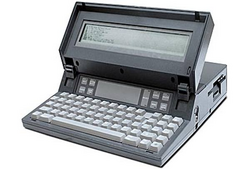
Gavilan SC
~ the eulogy ~
Manuel Fernandez unveiled the Gavilan at COMDEX in Atlanta in the spring of 1983, and what he put on the table was close to the shape every portable computer has had since. The screen folded down over the keyboard. There was a floppy drive inside it and a battery to run it off, a 300-baud modem fitted as standard, and above the keys sat a touchpad, at a time when almost nothing had a pointing device at all. It weighed four kilograms. The Compaq Portable that year weighed more than twice that, needed a wall socket, and had the bulk of a portable sewing machine.
The screen was the compromise. A 400 by 64 pixel LCD gives you eight lines of eighty columns, about an eighth of a printed page, and the machine ran static CMOS memory starting at 64 KB with four slots for CapsuleRam modules at $350 each. Jack Hall did the industrial design, and the printer that clipped onto the back was built with C. Itoh in Japan. Gavilan claimed up to nine hours on the nickel-cadmium batteries. BYTE, in June 1983, called it a traveling professional's dream come true and said it promised to set new industry standards.
Then the schedule happened. The machine was meant to ship in December 1983 and did not, because the design kept being reworked. The first few dozen units went out in April 1984 with enough faults to force another round of changes, and real production did not start until that June. Somewhere in there a major distributor went bankrupt and pulled out of its agreement. Gavilan filed for Chapter 11 protection in late 1984 and ceased operations in 1985, having shipped a few thousand machines.
~ the dossier ~
| Born | april 1984, first units shipped, after an unveiling at COMDEX in the spring of 1983 |
|---|---|
| Peak | a few thousand units in total, against a design that expected fleet orders |
| Killed | 1985, when Gavilan Computer Corporation ceased operations |
| Lifespan | about a year on sale |
| Made by | Gavilan Computer Corporation, founded by Manuel Fernandez |
| Killed by | a ship date missed by four months, then a distributor's bankruptcy |
~ the operating system that never shipped ~
The Gavilan was not designed as a DOS computer. It was supposed to boot its own graphical operating system, the Gavilan Operating Environment, held entirely in 48 KB of ROM and written against a FORTH-like interpreter to make the code small enough to fit. On top of that sat a suite of applications called Capsuleware. In 1983 that meant a graphical environment and its applications living in silicon on a machine you could run off a battery.
Neither of them came to anything, and in November 1983 the company announced the machine would run MS-DOS instead. What shipped was MS-DOS with a terminal program and MBasic on top of it, plus an optional office pack of SuperCalc and SuperWriter alongside two pfs: applications. The slots that could have carried ROM cartridges of Gavilan software mostly carried memory.
~ who gets to be first ~
The Gavilan is routinely called the first computer marketed as a laptop, and that claim is softer than the number of times it gets repeated would suggest. The GRiD Compass had the folding clamshell a year earlier, though it had no floppy drive and no battery. People who were working in the industry at the time have since argued that the word in use then was notebook, and that laptop got attached to the Gavilan later by people telling the story backward.
The hardware itself is not in dispute. A pointing pad above the keyboard did not become normal for another decade. The display hinge and the printer attachment were described at the time as patentable features of the design. Whatever you want to call the category, this machine had most of its furniture in place in 1984, and the company behind it could not stay solvent long enough to sell it.
~ nine pounds in 1984 ~
I was born the year the first Gavilans shipped, in a country where a personal computer of any shape stayed a rare object for most of that decade, so nothing in it is mine to remember. The founder did better than the machine. Manny Fernandez went on to run Dataquest and Zilog, and then spent the 1990s as chief executive of Gartner, which is where most people who recognize the name recognize it from. The laptop he built sits in a museum, and the company that built it lasted about a year on the market.
~ leave a rose ~
an anonymous tribute. one rose per visitor per day.
@}-->-- ... roses left here
~ leave a wreath ~
a rose fades by morning. a wreath stays on this grave for good, with your name on it.
paid once through stripe. payments are handled by OÜ Lakeview, the small company that keeps rip.so running. the money pays for the hosting and the nightly digging. adopt it and the headstone reads "maintained in memory by" you. the groundskeeper plants new wreaths at the next tending, usually within a day.
» one email a week: new graves and the anniversaries of the dead. subscribe
other gadgets: 3Com, HTC First, Revolv, Dynalogic Hyperion
also died in the 1980s: Dynalogic Hyperion, PlayNET, Grundy NewBrain
~ leave a note ~
visitors before you have left these graveside notes. anonymous welcome.